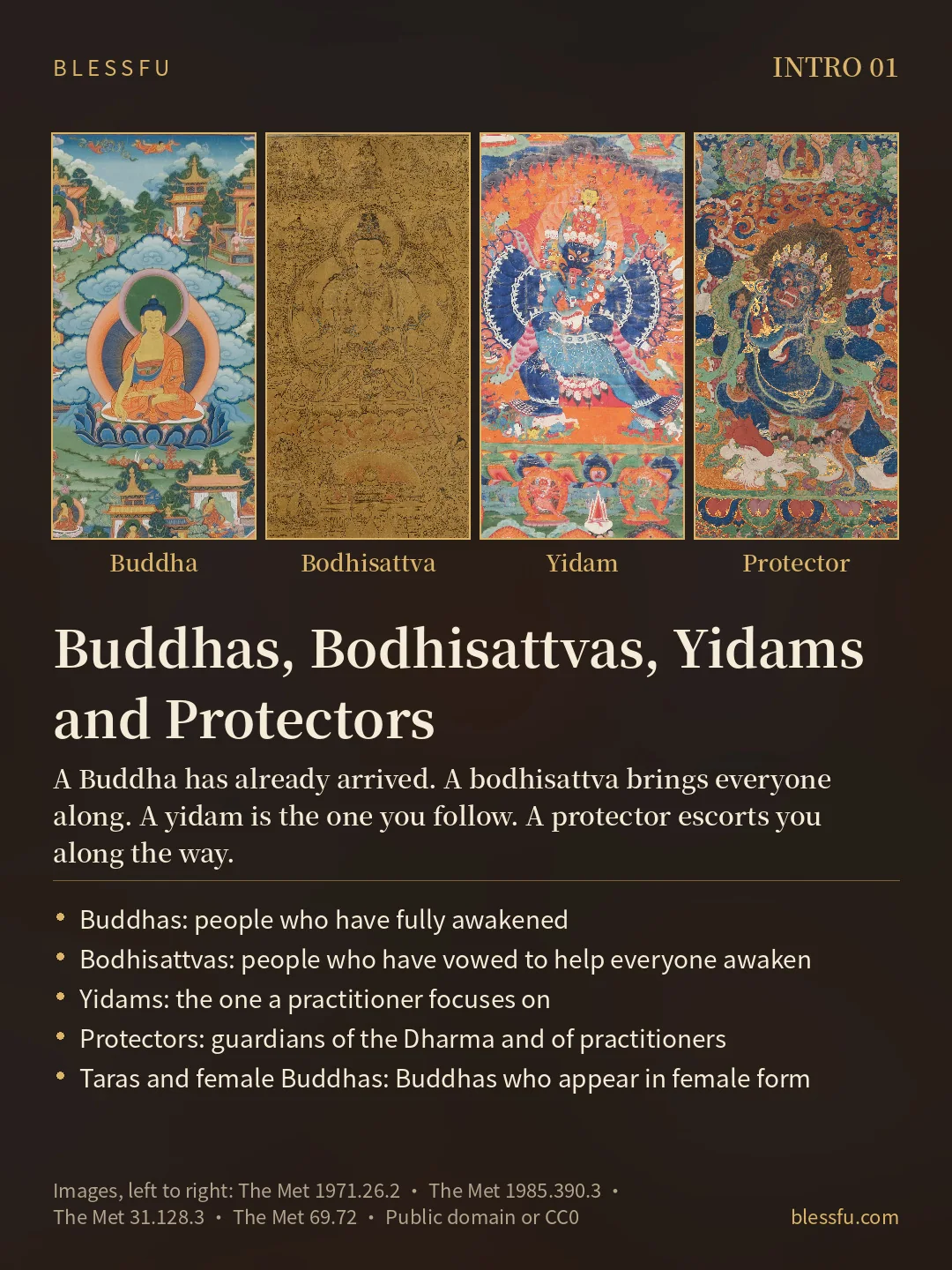
Buddhas, Bodhisattvas, Yidams, and Protectors: What Is the Difference?
Walk into a Tibetan Buddhist monastery and you will see many figures. Some are serene, some are smiling, some glare with wide, angry eyes. They are not a crowd of unrelated "gods." They are four different kinds of identity. Once you can tell these four apart, every figure that follows becomes easy to recognize.
Watch the video
Buddhas: people who have fully awakened
"Buddha" means "awakened one." A Buddha is not a creator, and not someone born a god. A Buddha is a person who has completely removed the disturbing emotions and brought wisdom and compassion to perfection.
The most familiar is Shakyamuni Buddha. He was a real person who lived more than 2,500 years ago, and Buddhism comes from him. Amitabha and the Medicine Buddha (Bhaishajyaguru) are also Buddhas.
Bodhisattvas: people who have vowed to help everyone awaken
A bodhisattva is on the path to becoming a Buddha, and has also made a vow: not only to be free oneself, but to help all beings.
Avalokiteshvara (Chenrezig) stands for compassion, Manjushri for wisdom, and Vajrapani for power. In Tibet these three are known together as the Three Protectors (Lords of the Three Families). They are the three bodhisattvas seen most often.
Yidams: the one a practitioner focuses on
A yidam (meditational deity) is not another kind of god. It is a relationship. Guided by a teacher, a practitioner chooses one Buddha or bodhisattva as the focus of their own practice. That figure is their yidam.
The three most important yidams in the Gelug school are Guhyasamaja, Chakrasamvara, and Yamantaka (Vajrabhairava). Practicing a yidam first requires receiving an empowerment from a qualified teacher. So for a beginner, it is enough to know who they are.
Protectors: guardians of the Dharma and of practitioners
A Dharma protector's job is to clear away obstacles on the path of practice. There are two kinds of protector:
- Enlightened protectors: these are Buddhas and bodhisattvas themselves, who take on a fierce appearance in order to subdue the disturbing emotions. Six-Armed Mahakala is one example; he is traditionally said to be a wrathful emanation of Avalokiteshvara.
- Worldly protectors: gods who have sworn to guard the Dharma. The Four Heavenly Kings at a monastery's entrance are one example.
Most protectors have fierce faces. That is not anger at people. It is showing no mercy to disturbing emotions and obstacles.
And then there are the Taras and the female Buddhas
Green Tara, White Tara, Prajnaparamita, and others are Buddhas who appear in female form. Their standing is the same as a Buddha's. They are not anyone's supporting figure.
One line to remember
A Buddha is someone who has already arrived. A bodhisattva is someone who brings everyone along. A yidam is the one you specifically follow and learn from. A protector is the one who escorts you along the way.
At a glance