
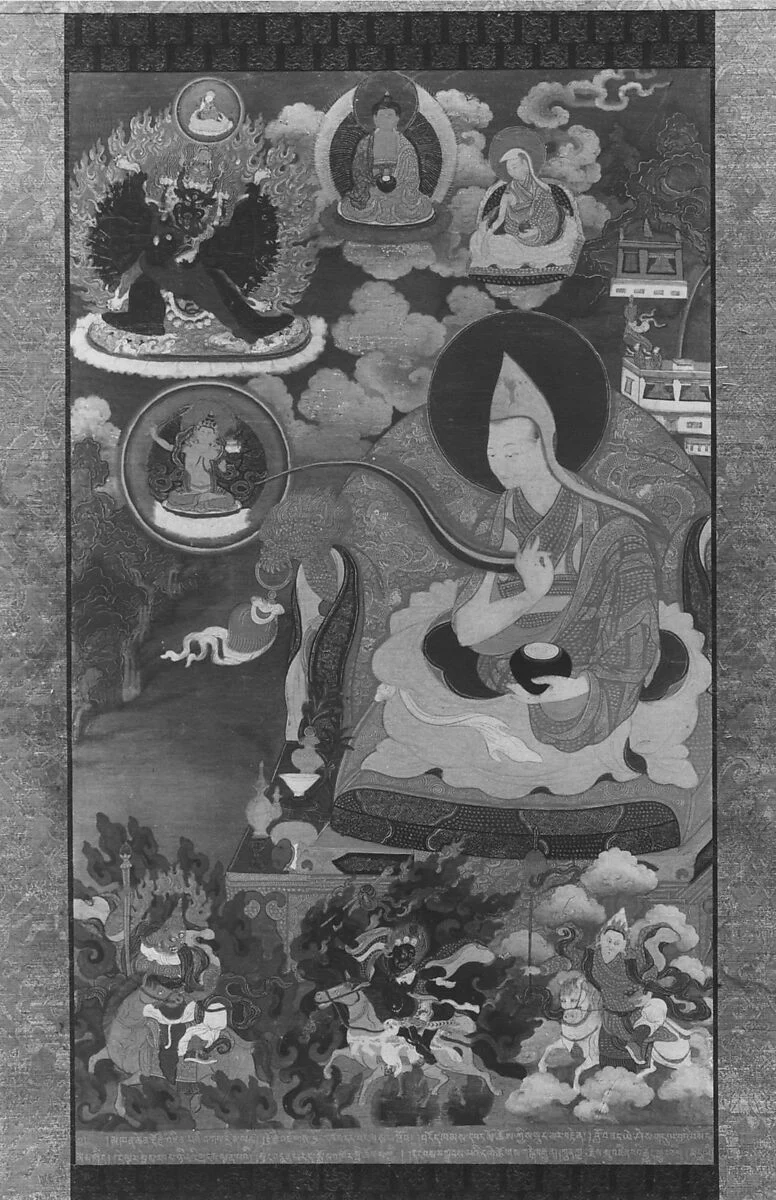
01 · Who was Tsongkhapa?
Tsongkhapa Losang Drakpa (1357–1419) was a Tibetan Buddhist scholar, teacher and practitioner whose work laid the foundations of the Gelug tradition. “Tsongkhapa” refers to his home region of Tsongkha in Amdo, near present-day Kumbum in Qinghai. His monastic name, Losang Drakpa (བློ་བཟང་གྲགས་པ་), is also written Lobzang Drakpa. Je Rinpoche is an honorific meaning precious master.
Devotees revere him as an emanation of Manjushri and sometimes call him a “second Buddha.” These are devotional titles, not a claim that he replaced Shakyamuni. His enduring influence lies in bringing disciplined conduct, careful reasoning and meditation into a coherent path.
02 · From Amdo to a lifetime of learning
He began religious education in childhood under Dondrub Rinchen and travelled to central Tibet as a young man. His teachers came from more than one tradition; Rendawa and Umapa were important to his intellectual and contemplative development. His life alternated between study, teaching, writing and retreat.
Fourteenth-century Tibet supported many active traditions of scholarship and practice. Tsongkhapa worked within this rich environment. His emphasis on monastic discipline should not be used to portray other traditions as uniformly corrupt or lacking learning.
03 · A few landmarks
1357: birth in Amdo. As a young man: extensive study in central Tibet. 1402: composition of Lamrim Chenmo, the Great Treatise on the Stages of the Path. 1409: the Great Prayer Festival in Lhasa and the founding of Ganden Monastery. 1419: death at Ganden.
Gyaltsab Je and Khedrub Je continued his teaching legacy; together with Tsongkhapa they form the familiar image of the master and his two principal disciples. Later generations developed the monastic institutions and curricula of the Gelug tradition. It is misleading to attribute every later institution to the founder personally.
04 · Stories that express devotion
Traditional accounts connect Tsongkhapa’s birthplace with a sacred tree at Kumbum and tell of auspicious dreams and signs. Accounts of his retreats also describe encounters with Manjushri. These are religious narratives, distinct from independently dated historical events.
Read such stories for the qualities they convey: gratitude to teachers, perseverance in study and the wish to understand. A sacred-site narrative is not evidence for a miraculous botanical claim, nor does it promise that a visitor will have the same experiences.
05 · What did he teach?
The three principal aspects of the path are renunciation, bodhicitta and correct view. Renunciation seeks freedom from suffering and its causes; bodhicitta extends the goal to all beings; correct view examines dependent arising and emptiness. Ethical responsibility remains essential: emptiness does not mean that actions have no consequences.
Lamrim arranges learning and meditation as a gradual path. Study gives a foundation, reflection tests understanding, and meditation helps make it familiar. Sutra and tantra are related within his presentation, with tantric practice relying on foundations and the specific instructions required by its lineage.
06 · A guide to the writings
Begin with the Three Principal Aspects of the Path, Songs of Experience or a guided introduction to lamrim. Lamrim Chenmo develops these themes at length. Other major works include the Great Treatise on the Stages of Mantra, Essence of True Eloquence, Ocean of Reasoning, Illuminating the Intent and In Praise of Dependent Origination.
Translations and titles vary. These are works of different scope and difficulty, rather than a checklist to finish quickly. The traditional description of the collected works as eighteen volumes depends on the edition. A book on advanced tantra is not, by itself, authorization to practise its methods.
07 · Disciples and the growth of a tradition
Gyaltsab Je Darma Rinchen and Khedrub Je Gelek Palsang were leading disciples. Jamyang Choje founded Drepung in 1416; Shakya Yeshe founded Sera in 1419. Gendun Drub and Sherab Senge also helped transmit the tradition.
The Ganden Tripa is the holder of the Ganden throne. This monastic office is distinct from the Dalai Lama and Panchen Lama incarnate lineages. Gyuto founder Kunga Dhondup (1419–1486) belongs to a later generation and should not be listed as a direct student of Tsongkhapa.
08 · Migtsema and remembering the teacher
Migtsema is a prayer to Tsongkhapa, commonly encountered in a five-line form. It is not a praise to Maitreya. Its language brings together compassion, wisdom and spiritual strength through Avalokiteshvara, Manjushri and Vajrapani. Ganden Lhagyama, the Hundred Deities of Tushita, is a familiar Tsongkhapa guru-yoga practice.
For reading and recitation, use an identified edition and follow its instructions. Do not assume that every visualization is suitable without guidance. No fixed daily repetition count applies to every reader. Lama Chopa is another important Gelug practice, associated with the Fourth Panchen Lama rather than simply authored by Tsongkhapa.
09 · Places and a day of remembrance
Kumbum preserves the memory of his birthplace; Ganden is the monastery he founded. Reting is associated with his work on lamrim, while retreat sites in the Wolka region feature in his life stories. The monastery directory offers a starting point for exploring these places.
The twenty-fifth day of the tenth Tibetan month is observed as Ganden Ngamchoe, commemorating his passing. Offerings of light, study, prayer and dedication are common ways of remembering him. The Gregorian date changes each year; consult the calendar and local announcements.
10 · Bring the learning into daily life
Choose one short passage, read it slowly and note one question. Reflect on how its meaning affects an ordinary situation: a disagreement, an attachment, or an opportunity to help. End with a kind intention and dedication. Learning can begin with small, consistent steps.
This article is an edited learning guide, not a verbatim teaching or a complete historical biography. Traditional stories are identified as such. Practice commitments, empowerment and advanced methods should be discussed with an appropriate teacher.