
People offer an accessible way into a tradition. This topic features Tsongkhapa and Gelug alongside important figures from other lineages. Dates, writings and teacher relationships are historical leads; miraculous accounts belong to traditional biography or legend.
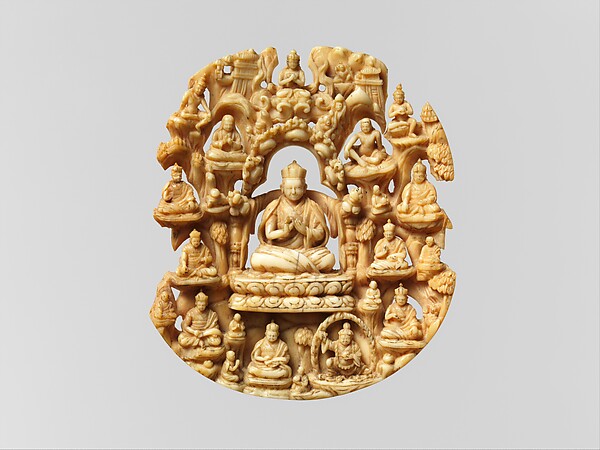
A few connections to follow
A selective reading map. Arrows describe the relationship stated in each row; this is not a complete lineage chart.
Kadam and Gelug: influence and development
- Atisha
- Dromtonpa and Kadam
- Tsongkhapa and Gelug
Shangpa: transmission
- Niguma, Sukhasiddhi and others
- Khyungpo Naljor
- Shangpa transmission
Nyingma and Sakya: explore separately
- Padmasambhava and early translations → Nyingma
- Khön family and Sakya Monastery → Sakya
Tsongkhapa · Central to Gelug
Tsongkhapa (1357–1419) was born in the region of present-day Huangzhong, Qinghai. Discipline, scriptural study and graduated practice are central to his legacy. Ganden’s founding in 1409 is a key milestone in Gelug history.
Begin with a guide to the Three Principal Aspects, then explore the structure of the Lamrim Chenmo. The illustrated artwork is a later religious portrait; the date of an image is distinct from its subject’s lifetime.
Atisha · A lamp for the path
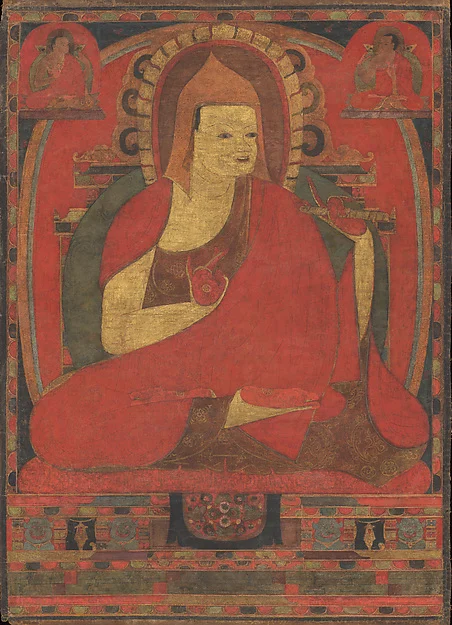
Atisha (982–1054) was an influential South Asian Buddhist scholar and practitioner. His Lamp for the Path offers a concise framework that profoundly influenced Tibetan lamrim traditions.
His life connects Indian learning with translation and teaching in Tibet. Kadam and later Gelug have close ties to his legacy, whose influence extends beyond one school. A separate story introduction explores his metaphorical lamp.
Padmasambhava · Early transmission and sacred biography
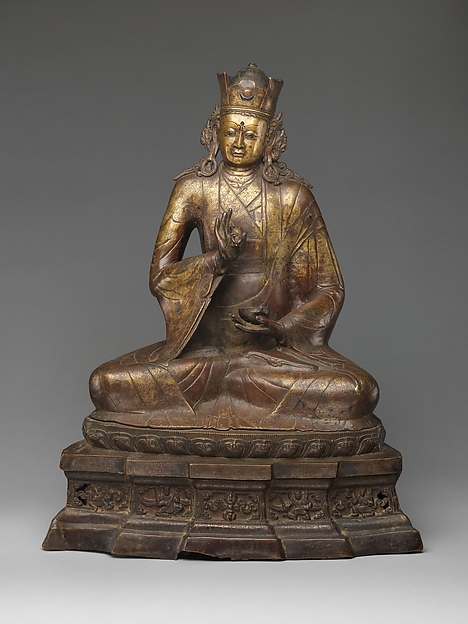
Padmasambhava, also called Guru Rinpoche, is closely associated with the eighth-century transmission of Buddhism, Samye and early tantric traditions in Tibet. He is especially important in Nyingma.
His biographies developed across different periods. Accounts of lotus birth and overcoming supernatural obstacles communicate religious meaning and should be identified as sacred biography rather than treated uniformly as verifiable history.
Marpa · Translation and transmission
Marpa is important to the transmission that developed into Dakpo Kagyu, connecting Indian teachers such as Naropa with Milarepa. His role as translator highlights language learning and teaching alongside personal lineage.
Begin with his transmission relationships and translation background before comparing biographical accounts.
Milarepa · Practice and songs
Milarepa is a celebrated Kagyu yogin, a disciple of Marpa and a teacher of Gampopa. Later biographies and songs vividly portray remorse, perseverance and practice.
Ask both what a story communicates and who recorded it, when. This allows appreciation of its literary force alongside awareness of its textual background.
Gampopa · Monastic learning and meditation
Gampopa brought Kadam teaching together with Milarepa’s meditation transmission. He is central to Dakpo Kagyu, whose branches developed through his disciples.
Read him after Marpa and Milarepa, then compare Karma, Drikung and Drukpa resources in the library.
Sakya Pandita · Learning and reasoning
Sakya Pandita is one of Sakya’s five founding masters, known for scholarship and writings. His work offers an introduction to the tradition’s attention to language, logic and Buddhist learning.
Pandita is a scholarly title, not merely part of a personal name. Begin with the five masters and an overview of Lamdre before selecting philosophical texts.
Niguma and Sukhasiddhi · Women in transmission
Niguma and Sukhasiddhi are important female masters revered in Shangpa Kagyu. Khyungpo Naljor received teachings from them, highlighting women’s place in transmission history.
Distinguish Shangpa from the Dakpo Kagyu transmission of Marpa and Gampopa. Public historical study is different from undertaking specific yogic practices.