
Kshitigarbha
"Until the hells are empty, I vow not to become a Buddha." He is the bodhisattva who goes to the places of greatest suffering to rescue those who are there.
Watch the video
Who he is
Kshitigarbha's name in Sanskrit is Kṣitigarbha, meaning "Treasury of the Earth". In Tibetan he is called Sayi Nyingpo. He is one of the Eight Great Bodhisattvas.
The name says this about him: like the earth, he is patient and unmoving; like a treasury, he holds endless good qualities.
What he does
After Shakyamuni Buddha passed away and before Maitreya Buddha is born, there is a long stretch of time with no Buddha living in the world. During this time Kshitigarbha is the one responsible for looking after the beings of the six realms, especially those who suffer most heavily in the hells.
What people pray to him for
Traditionally, people pray to Kshitigarbha for:
- Release from suffering, and blessings, for relatives who have died
- Removing heavy karmic obscurations
- Caring for one's parents and repaying their kindness
- Stable land, good harvests, and a safe home
Mantra
You can recite his name: Namo Kshitigarbha Bodhisattva.
Chinese Buddhists mostly recite his name and the Sutra of the Past Vows of Kshitigarbha.
Story: The daughter who saved her mother
The Kshitigarbha Sutra tells that, very long ago, there was a daughter of a Brahmin family. During her life, the girl's mother did not believe in cause and effect, and after she died she fell into hell.
The daughter was heartbroken. She sold the family's property, made many offerings, and recited the Buddha's name single-mindedly, praying to learn where her mother had gone. Later she learned this: because of her devotion to her mother and her merit, her mother had already left hell, and the beings who were suffering in hell that same day had been freed along with her.
So she made a vow: "From now on, through all of endless future time, I will find a way to rescue every being who is suffering." This daughter was Kshitigarbha in a past life.
How to recognize him
- In China: he looks like a monk, with a shaved head, a ringed staff in his right hand and a bright pearl resting on his left
- In Tibet: dressed as a bodhisattva, wearing a jeweled crown, holding a wish-fulfilling jewel or a lotus
- The Eight Great Bodhisattvas often appear as a group on either side of a Buddha; you tell them apart by what they hold in their hands
The images
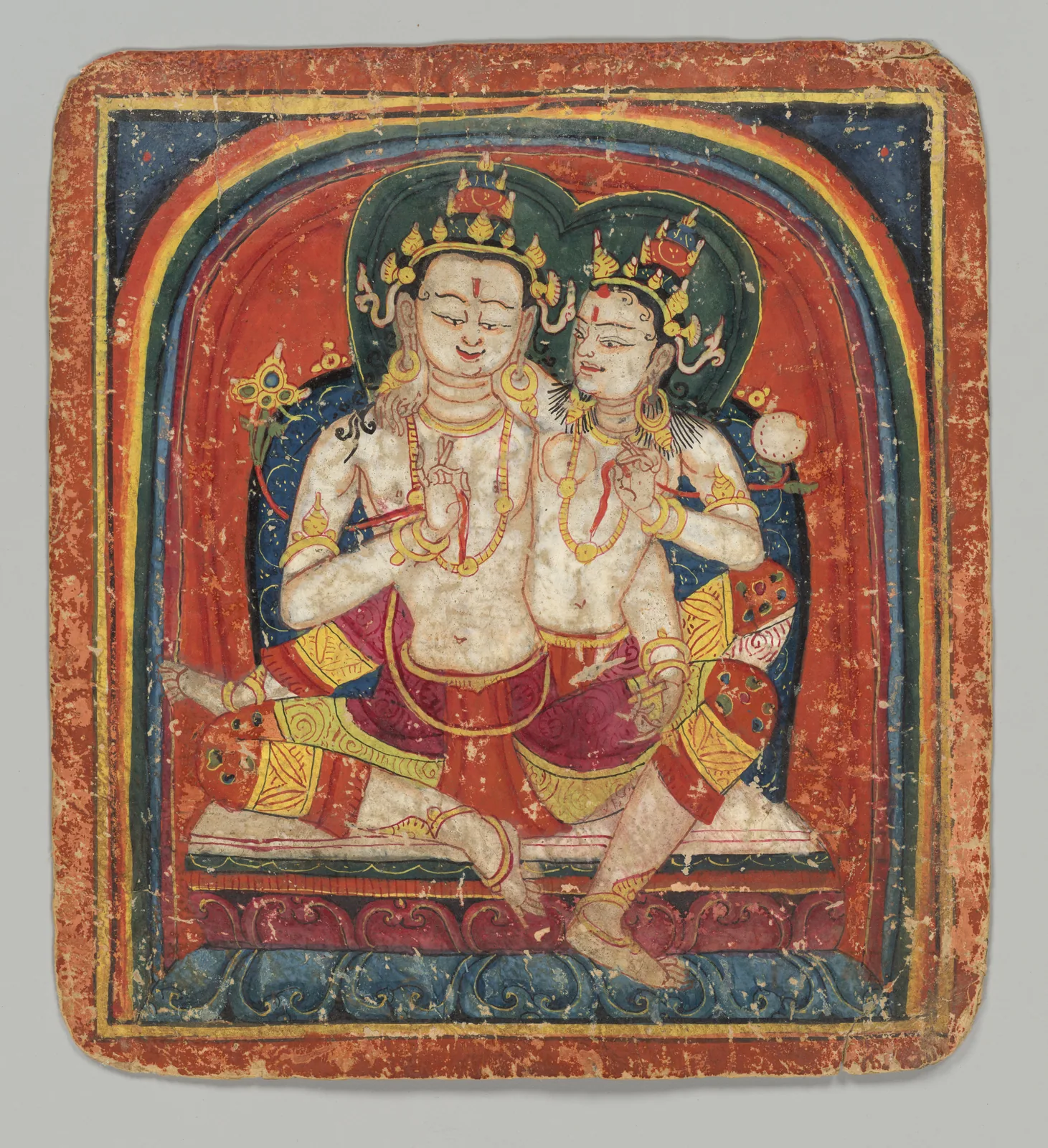
- Date: Early 15th century (Ming dynasty, around the Yongle reign)
- Origin and medium: Tibet · Initiation card (tsakali), color on paper
- Collection: The Metropolitan Museum of Art, accession no. 2000.282.6 · Public domain
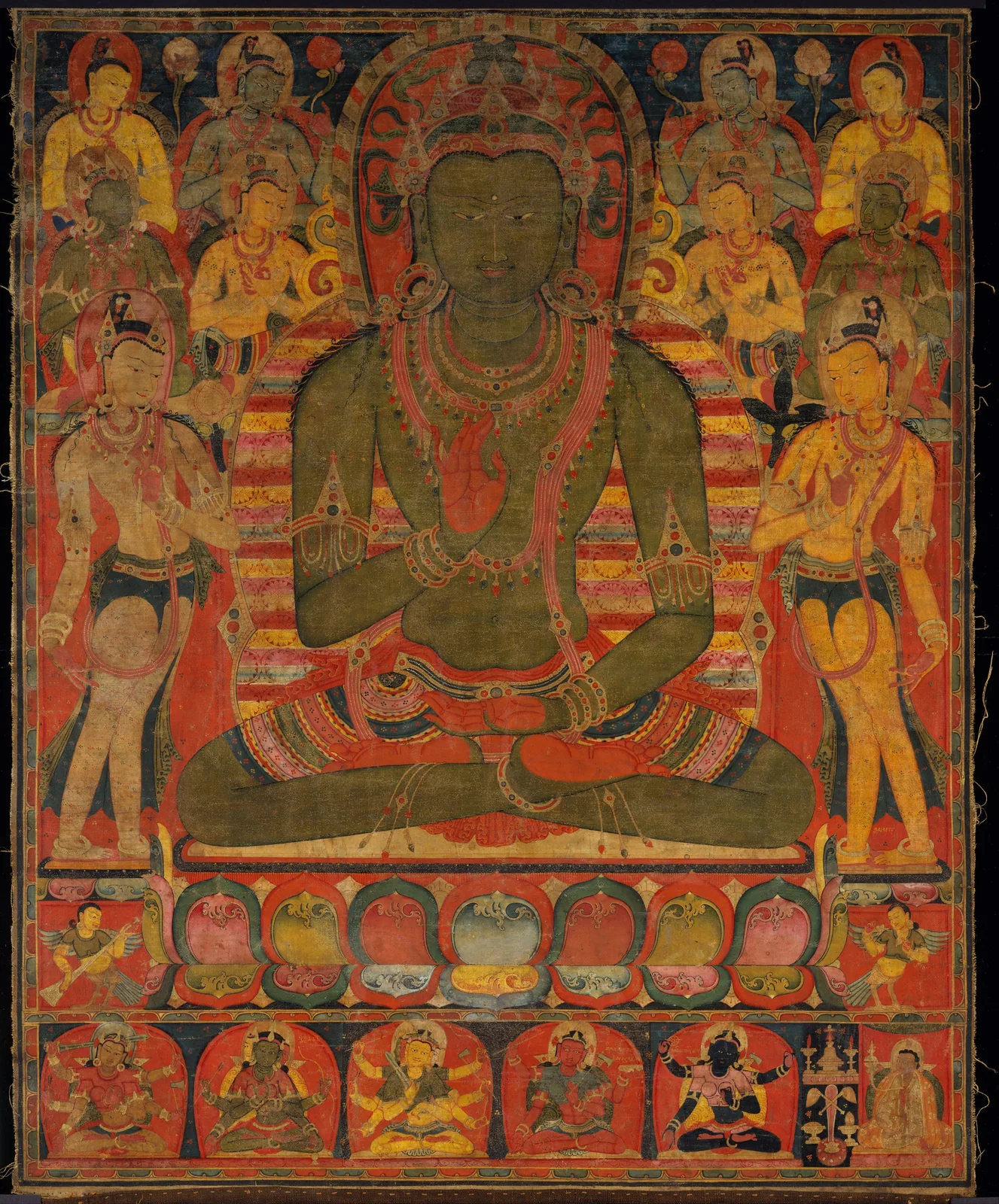
- Date: About 1200–1250 (roughly the Southern Song period)
- Origin and medium: Central Tibet · Thangka, distemper on cloth; the Buddha Amoghasiddhi with the Eight Great Bodhisattvas
- Collection: The Metropolitan Museum of Art, accession no. 1991.74 · Public domain
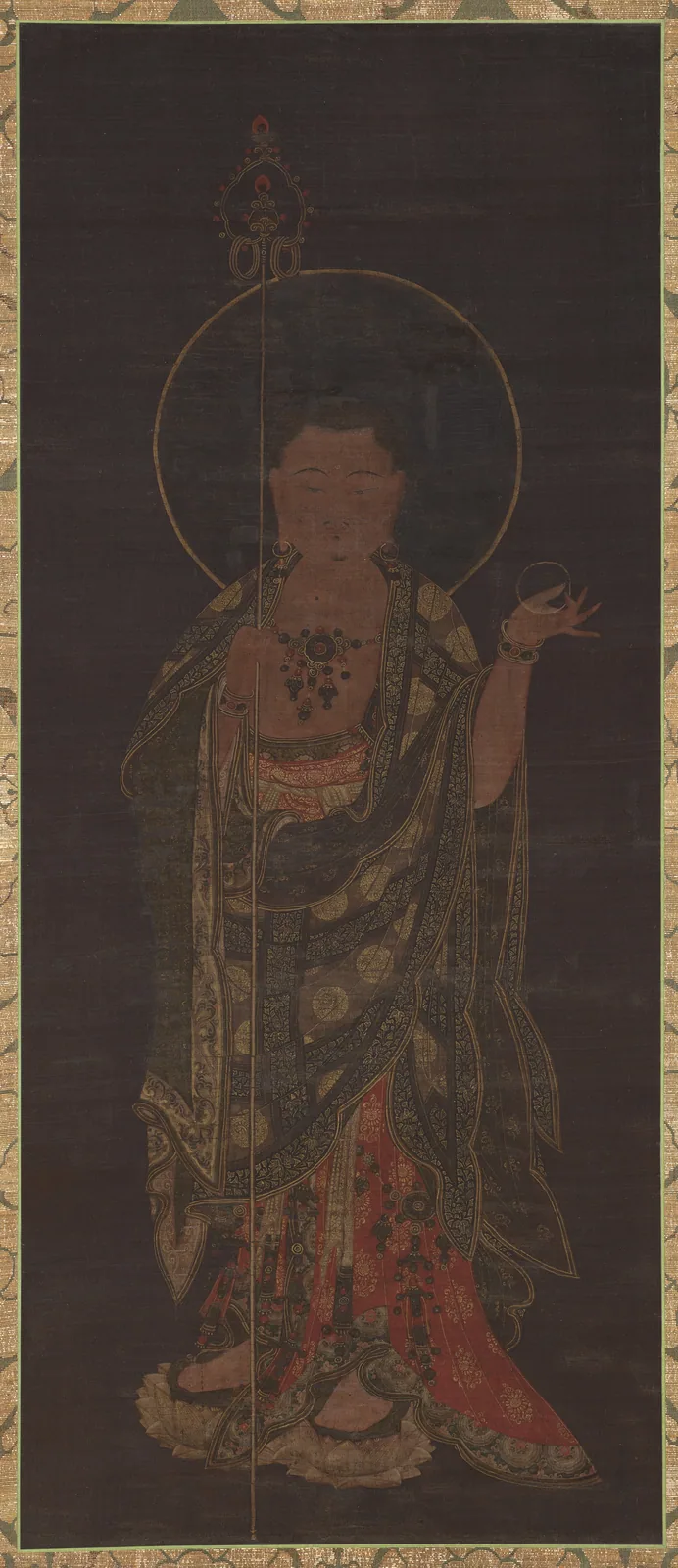
- Date: 1300–1350 (Goryeo dynasty)
- Origin and medium: Korea (Goryeo) · Painting; standing Kshitigarbha
- Collection: Cleveland Museum of Art, accession no. 2025.141 · CC0