
Six-Armed Mahakala
The most important Dharma protector of the Gelug school: fierce in appearance, with the compassionate heart of Avalokiteshvara (Chenrezig).
Watch the video
Who he is
Mahakala's Sanskrit name is Mahākāla. In Tibetan he is called Gönpo, meaning "protector." Mahakala has many forms. Six-Armed Mahakala is the most important protector of the Gelug school, and together with Yama Dharmaraja and Vaishravana he is counted as one of the three main protectors of the Gelug school.
Traditionally, he is said to be the wrathful form Avalokiteshvara took in order to subdue beings who are hard to tame.
What he does
A protector's duty is to guard the Dharma and clear away obstacles to practice. Monasteries have a dedicated protector chapel and perform protector rituals every day.
His fierceness is not aimed at people. It is aimed at disturbing emotions and obstacles. It is like a parent who shouts "Stop!" on seeing a child run toward the road: the voice is stern, the heart is loving.
What people pray to him for
Traditionally, people pray to Six-Armed Mahakala for:
- Clearing away obstacles in practice and in life
- Protection for monasteries, homes, and practitioners
- Letting the good deeds that should be done be carried through smoothly
Mantra
Traditionally, a protector's mantra and practice must be received from a qualified teacher. They are not given here.
Story: Why Compassion Takes a Wrathful Form
The story goes that Avalokiteshvara vowed to free all beings. But some beings were so stubborn that gentle methods could not tame them, no matter what. So a dark blue syllable HŪṂ appeared at Avalokiteshvara's heart and turned into Six-Armed Mahakala.
The practice of this protector was brought from India to Tibet in the eleventh century by the master Khyungpo Naljor. It later passed into the Gelug school, where he became the most important protector of Je Tsongkhapa's tradition.
How to recognize him
- Blue-black body, three eyes, hair standing straight up, wearing a crown of five skulls
- Six arms; the two central hands hold a curved knife and a skull cup at the chest
- The other four hands hold a rosary of human bone, a trident, a hand drum, and a lasso
- Treads on an elephant-headed god: a symbol of subduing obstacles
- Surrounded by flames
The images
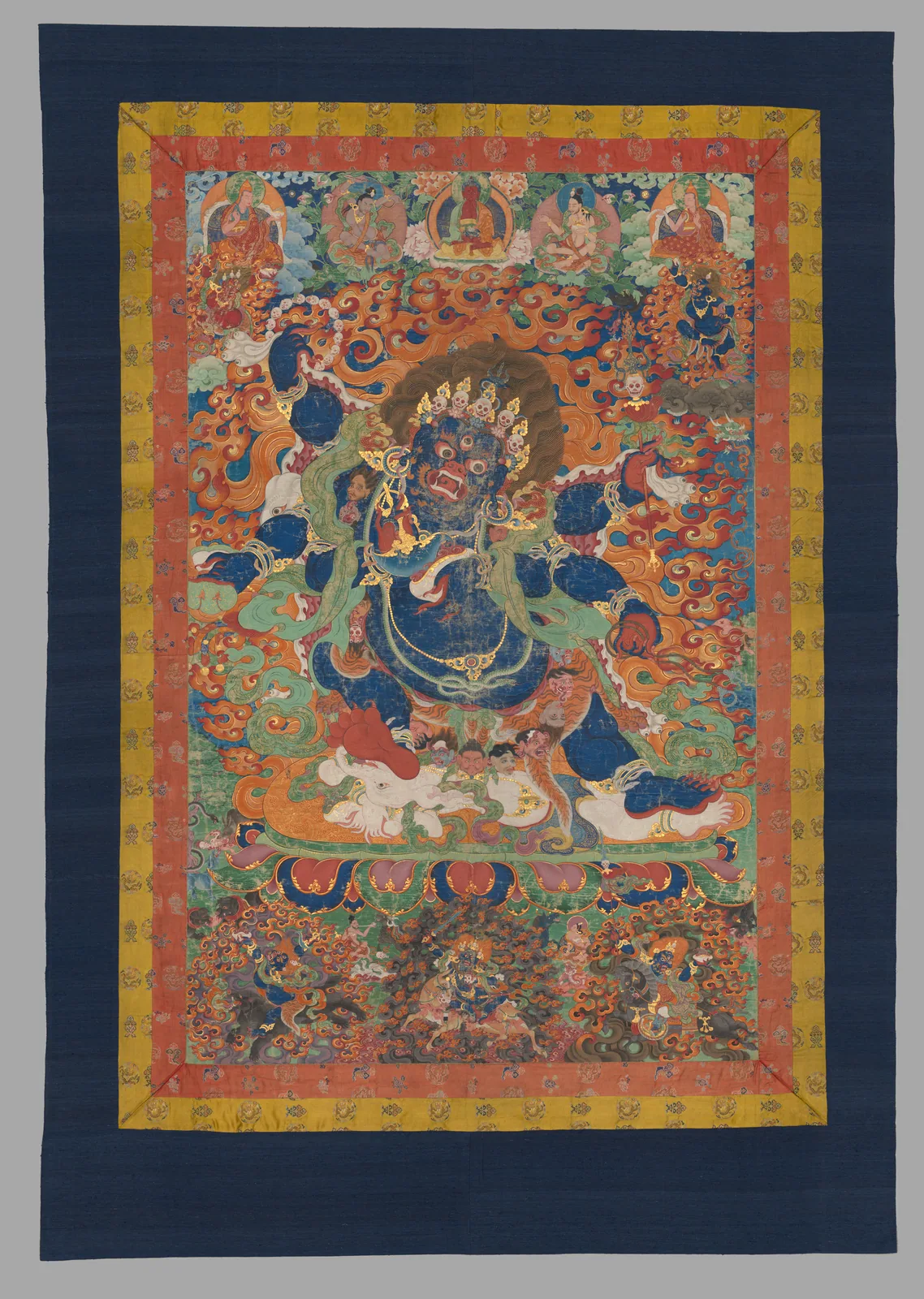
- Date: early 18th century (Qing dynasty)
- Origin and medium: Tibet · thangka, distemper on cloth
- Collection: The Metropolitan Museum of Art, accession no. 69.72 · Public domain
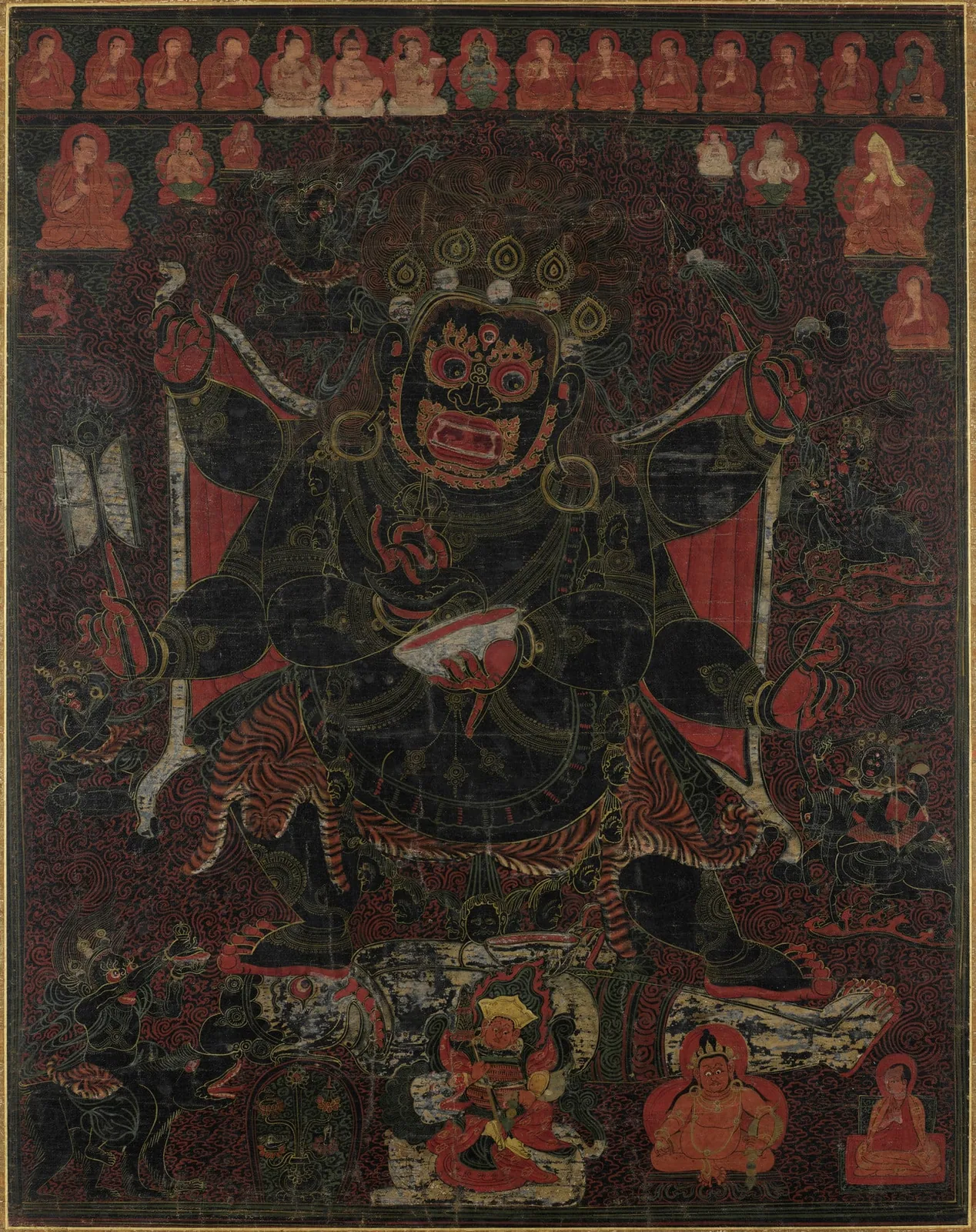
- Date: 15th century (Ming dynasty)
- Origin and medium: Tsang, Tibet · thangka, colors and gold on cloth; Six-Armed Mahakala with retinue and lineage masters
- Collection: Walters Art Museum, accession no. 35.329 · CC0
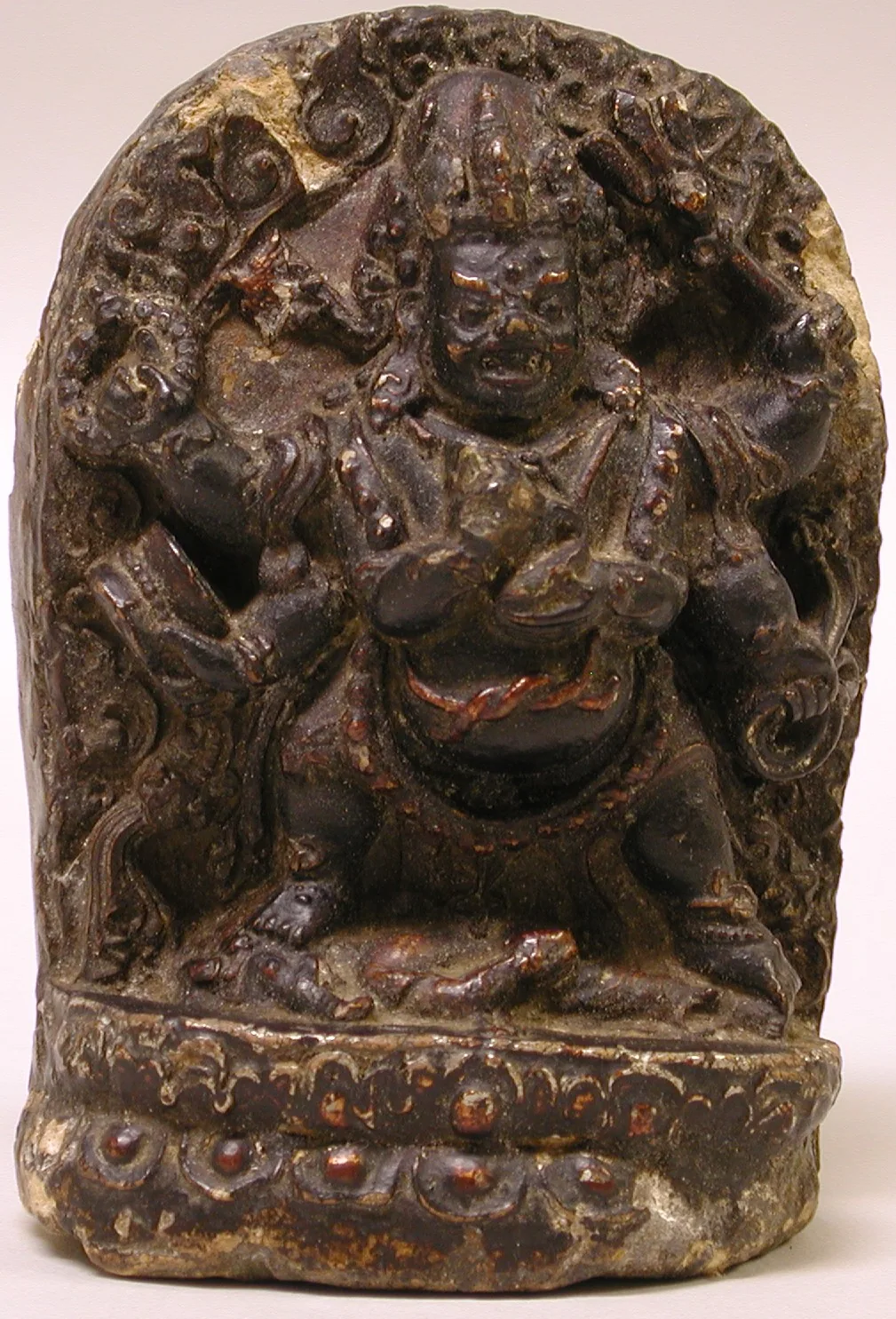
- Date: about 15th century (Ming dynasty)
- Origin and medium: Tibet · clay sculpture, painted black; height 13.3 cm
- Collection: The Metropolitan Museum of Art, accession no. 2004.553.4 · Public domain