
Yama Dharmaraja
A Dharma protector with the head of a water buffalo; the story goes that after Yamantaka subdued him, he vowed to guard the Dharma.
Watch the video
Who he is
Yama Dharmaraja's Sanskrit name is Yama Dharmarāja. In Tibetan he is called Chögyal, meaning "Dharma King." In the Indian tradition, Yama is the god who presides over death.
He is one of the three main protectors of the Gelug school. The three protectors correspond to three stages of practice: Yama Dharmaraja guards practitioners who are just beginning, Vaishravana guards the middle stage, and Six-Armed Mahakala guards practitioners who have given rise to bodhichitta.
What he does
He reminds people that "death can come at any time," so they should lose no time in practicing. The Gelug school holds that truly taking impermanence to heart is the starting point of all practice. He is also the special protector of those who practice Yamantaka.
What people pray to him for
Traditionally, people pray to Yama Dharmaraja for:
- Remembering impermanence at all times and not wasting their days
- Keeping their vows and not going astray
- Clearing away obstacles to practice
Mantra
Traditionally, a protector's mantra and practice must be received from a qualified teacher. They are not given here.
Story: Subdued by Manjushri
His origin is told in the article on Yamantaka: a practitioner was killed by robbers and, in great hatred, set a bull's head on his own neck, became the bull-headed Yama, and went about killing everywhere. Manjushri emanated as Yamantaka and subdued him.
Once subdued, Yama made a vow: from then on he would guard the Dharma and guard practitioners. That is why he is called "Dharma King."
Je Tsongkhapa established him as the protector of his own teachings. So in Gelug monasteries, Yamantaka and Yama Dharmaraja often appear together: one is a yidam (meditational deity), the other is a protector, and both have the head of a water buffalo.
The story of the bull-headed practitioner is a folk account. Gelug doctrine regards Yama Dharmaraja as an emanation of Manjushri, and he belongs among the enlightened protectors.
How to recognize him
- Blue-black body, water buffalo head, three eyes, two horns on his head
- Right hand raises a staff topped with a skull; left hand holds a lasso
- Stands on the back of a water buffalo, with a human figure pressed beneath the buffalo
- A female companion often stands beside him, holding a trident and a skull cup; in Tibetan ritual texts she is his consort, while Western catalogs often call her Yama's sister
- How he differs from Yamantaka: Yama Dharmaraja has only one face and two arms, and stands on a buffalo's back
The images
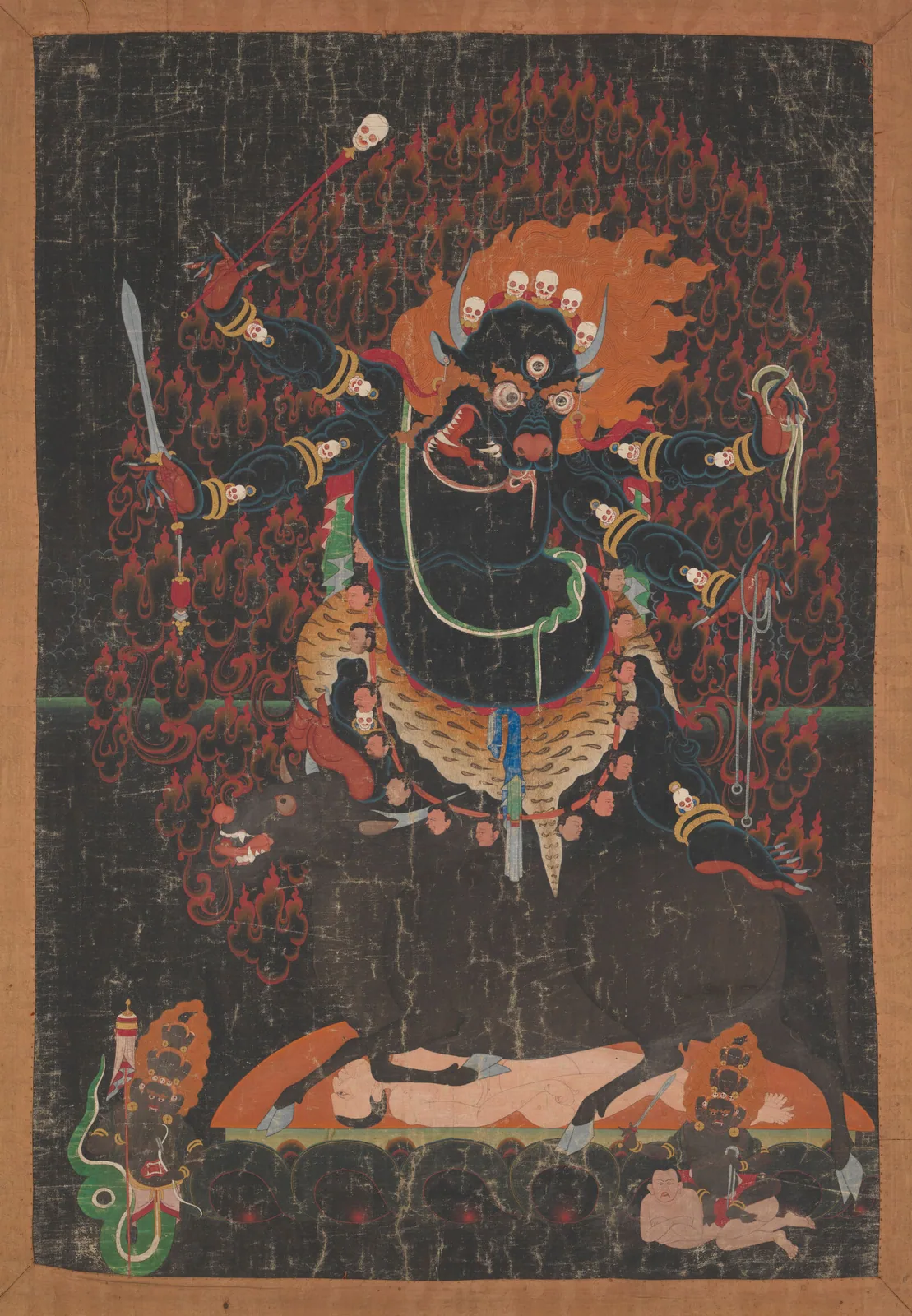
- Date: Date not given
- Origin and medium: Tibet · black-ground thangka, distemper on cloth; four-armed, buffalo-headed Yama standing on a buffalo's back
- Collection: Wellcome Collection, London, accession no. 45160i · Public Domain Mark
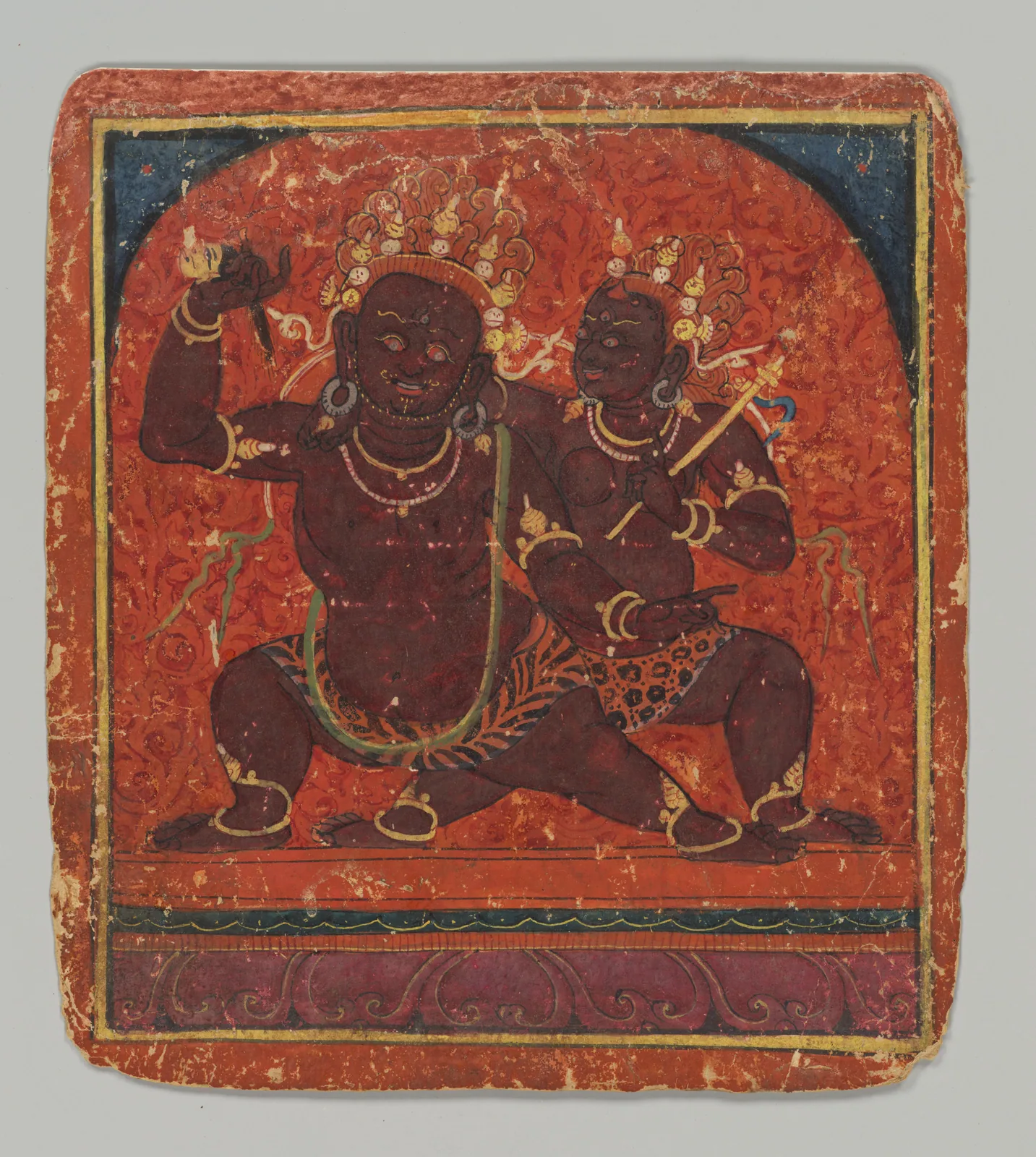
- Date: early 15th century (Ming dynasty, around the Yongle reign)
- Origin and medium: Tibet · tsakali (initiation card), colors on paper
- Collection: The Metropolitan Museum of Art, accession no. 2000.282.14 · Public domain
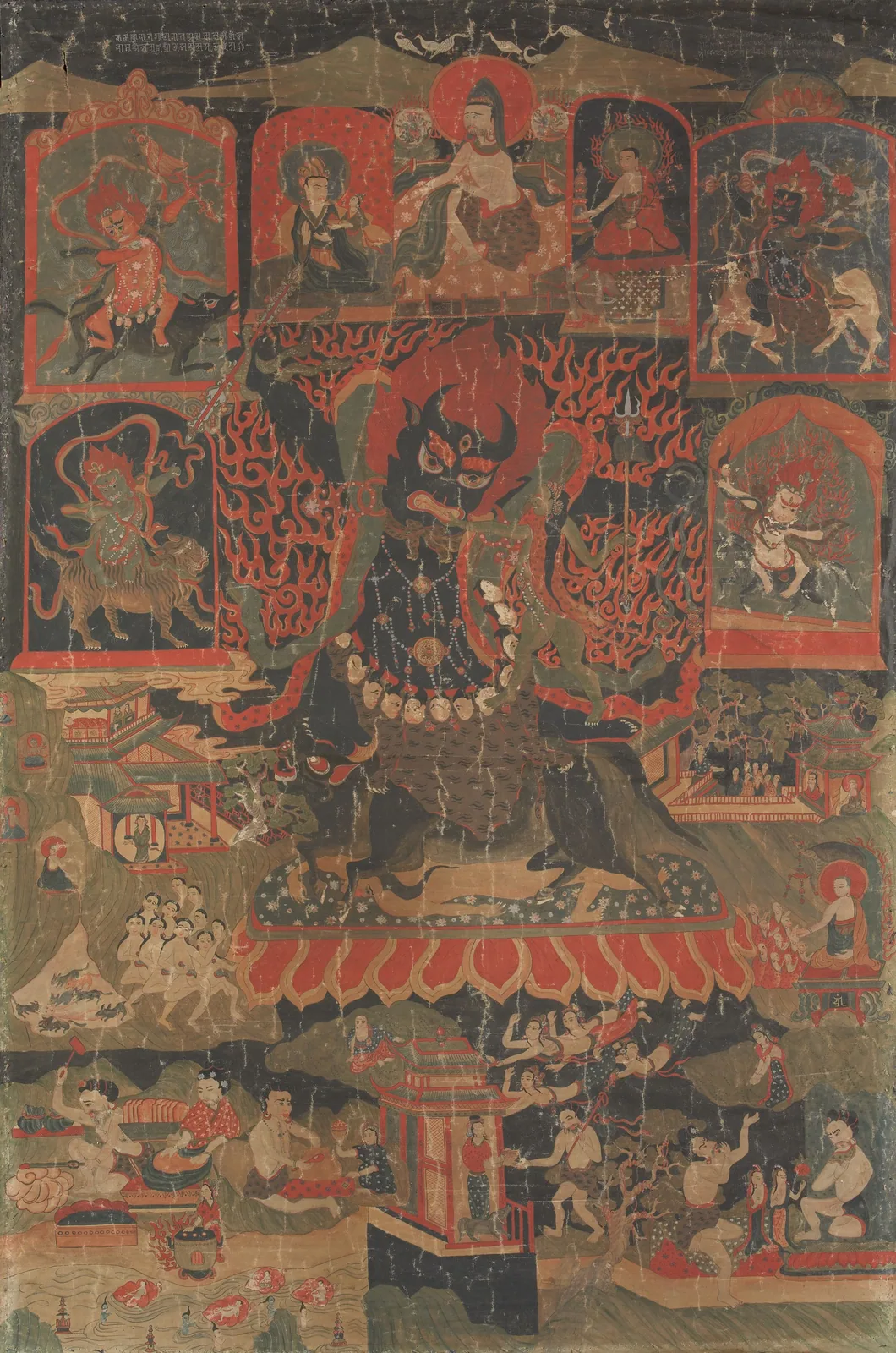
- Date: 19th century (Qing dynasty)
- Origin and medium: Nepal · mineral pigments and gold on cotton; Yama Dharmaraja and consort
- Collection: Yale University Art Gallery, accession no. 1988.76.18 · Marked by the museum as no copyright (CC0)