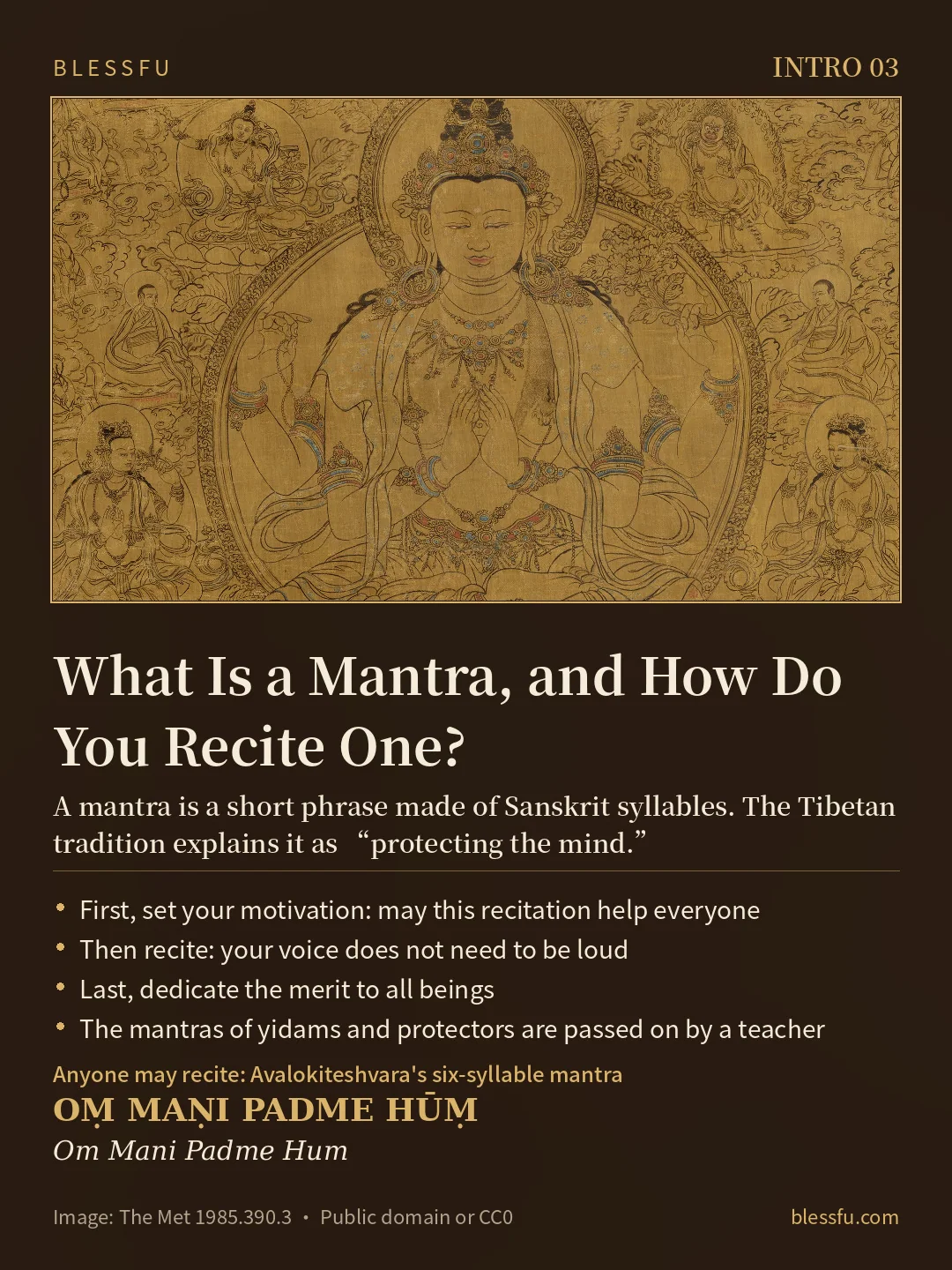
What Is a Mantra, and How Do You Recite One?
A mantra is a short phrase made of Sanskrit syllables. The Tibetan tradition explains it as “protecting the mind.”
Watch the video
What a mantra is
A mantra, also called "true words," is a short phrase made of Sanskrit syllables. Every Buddha and bodhisattva has their own mantra. You can think of it as that Buddha's or bodhisattva's heartfelt wish, preserved in the form of sound.
The Sanskrit word is mantra. The Tibetan tradition explains it as "protecting the mind": while you recite, the mind has something to lean on and is not so easily carried off by disturbing emotions.
A mantra is not a magic password. Whether reciting it helps depends on the state of mind of the person reciting.
Which mantras anyone may recite
The following are openly taught, and beginners can recite them with confidence:
| Buddha or bodhisattva | Mantra |
|---|---|
| Shakyamuni Buddha | OṂ MUNE MUNE MAHĀMUNAYE SVĀHĀ |
| Avalokiteshvara (Chenrezig) | OṂ MAṆI PADME HŪṂ |
| Manjushri | OṂ A RA PA CA NA DHĪḤ |
| Green Tara | OṂ TĀRE TUTTĀRE TURE SVĀHĀ |
Which mantras must first be passed on by a teacher
The mantras of yidams (meditational deities) such as Guhyasamaja, Chakrasamvara, Yamantaka (Vajrabhairava), and Vajrayogini traditionally may be practiced only after receiving an empowerment from a qualified teacher. The mantras of Dharma protectors are generally also passed on by a teacher. This site does not list mantras when it introduces these figures.
How to recite: three steps
- First, set your motivation: before reciting, take a moment to wish that this recitation may help both yourself and everyone else.
- Then recite: your voice does not need to be loud; it is enough that you can hear it clearly yourself. You can count with prayer beads, 108 to a string. You can also recite without beads.
- Last, dedicate the merit: when you finish, say silently: may this merit bring all beings freedom from suffering and happiness.
Common questions
What if my pronunciation is not accurate?
The same mantra sounds different in Sanskrit, in Tibetan, and in Chinese. The six-syllable mantra, for example, is often pronounced "Om Mani Peme Hung" in Tibet. Simply follow a reliable lineage; there is no need to agonize over it.
How many times should I recite?
There is no fixed rule. 21 times a day or 108 times a day are both fine. What matters is keeping it up every day.
When and where can I recite?
You can recite while walking, doing housework, or waiting for a bus. A respectful mind is enough.
At a glance