
Manjushri
The embodiment of wisdom; the sword in his hand is there to cut through confusion.
Watch the video
Who he is
Manjushri's full name means "Gentle Glory." In Tibetan he is called Jampelyang. Together with Avalokiteshvara (Chenrezig) and Vajrapani, he is one of the Three Protectors (Lords of the Three Families).
Mount Wutai in Shanxi is traditionally regarded as Manjushri's sacred abode. Devotees from Tibet and Mongolia also often go there on pilgrimage.
What he does
He stands for the wisdom of all the Buddhas. Wisdom here does not mean being clever or calculating. It is the ability to see things as they really are. Buddhism holds that the root of suffering is ignorance, which means not seeing clearly. That is exactly what Manjushri counters.
What people pray to him for
Traditionally, people pray to Manjushri for:
- Success in schoolwork, exams, and learning
- Stronger memory and understanding
- Progress in speaking and writing
- Telling right from wrong when things come up, and making the right decision
Mantra
OṂ A RA PA CA NA DHĪḤ
The last syllable, DHĪḤ, is Manjushri's seed syllable. The traditional way to recite is to say the whole mantra, then repeat DHĪḤ many times in a single breath. It is openly taught; anyone may recite it. When children in Tibet begin their schooling, this mantra is often the first thing they learn.
Story: Je Tsongkhapa and Manjushri
The Gelug school has an especially deep connection with Manjushri. Traditional accounts record that while Tsongkhapa was practicing in retreat, he saw Manjushri in person and asked him directly about the deepest meaning of emptiness. Many of Tsongkhapa's later major works are held to have benefited from this.
For this reason the Gelug school regards Tsongkhapa as an emanation of Manjushri. In monastery images of Tsongkhapa, the lotuses at his two shoulders carry a sword and a scripture, one on each. These are exactly the emblems of Manjushri.
How to recognize him
- Orange body, with the face of a sixteen-year-old youth
- Right hand raising a flaming sword high: it cuts through ignorance
- Left hand holding a lotus stem, with a scripture resting on the flower: the Perfection of Wisdom sutras, standing for wisdom
- In Chinese images, Manjushri often rides a blue lion
The images
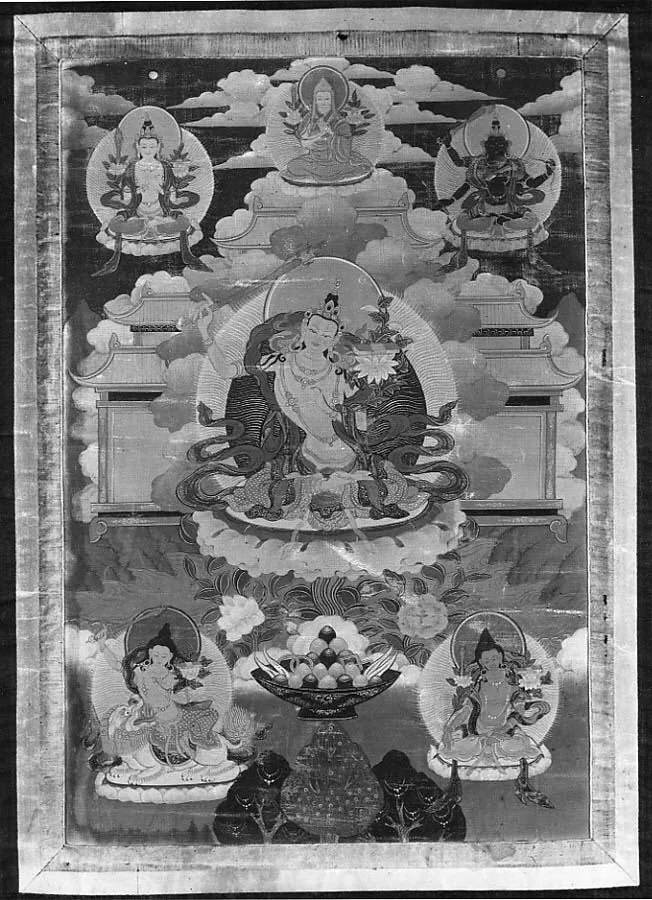
- Date: 17th–18th century (late Ming to Qing dynasty)
- Origin and medium: Tibet · color and gold on linen
- Collection: The Metropolitan Museum of Art, accession no. 60.43.9 · Public domain
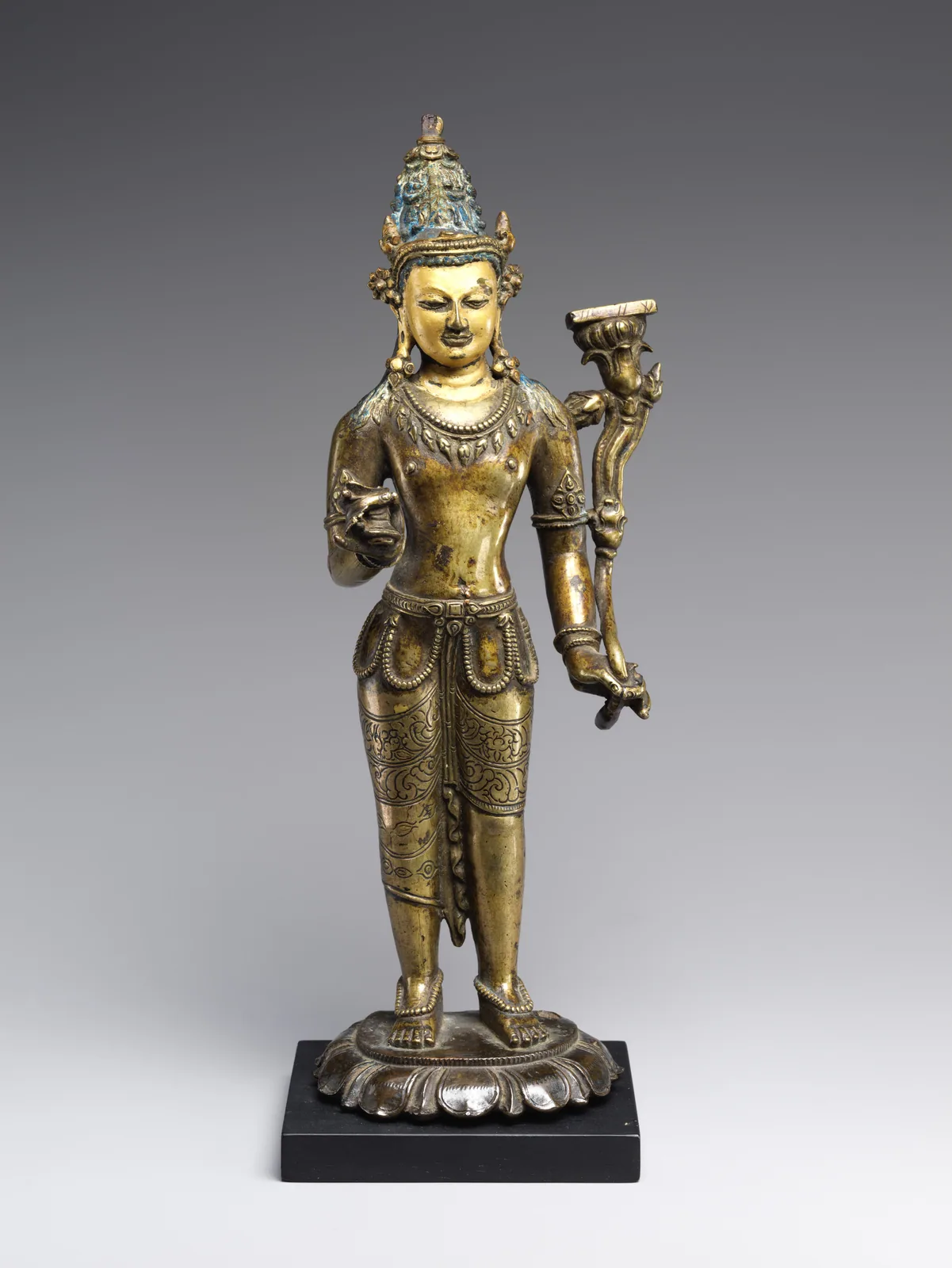
- Date: 12th century (roughly the Southern Song period)
- Origin and medium: Tibet · brass figure, with traces of gilding and paint
- Collection: The Metropolitan Museum of Art, accession no. 1983.554.2 · Public domain
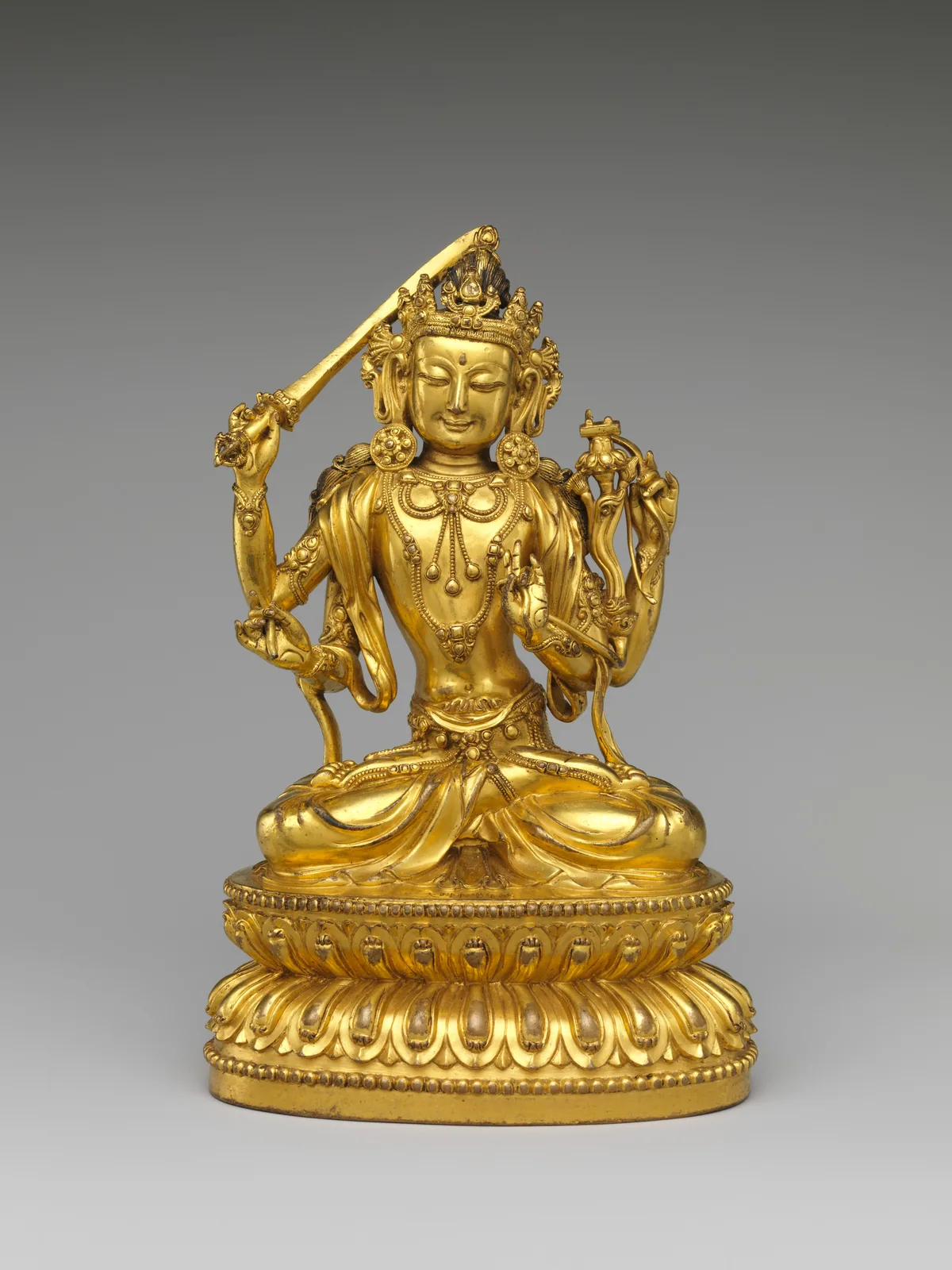
- Date: 1403–1424 (Ming dynasty, Yongle reign)
- Origin and medium: China, imperial workshop · gilt bronze figure, with a Yongle reign mark
- Collection: The Metropolitan Museum of Art, accession no. 2001.59 · Public domain