
Prajnaparamita
Wisdom itself in the form of a female Buddha, known as "the mother of all Buddhas".
Watch the video
Who she is
Prajnaparamita's name in Sanskrit is Prajñāpāramitā, meaning "wisdom gone to the other shore". In Tibetan she is called Yum Chenmo, meaning "Great Mother".
She is actually the embodiment of a sutra. The Perfection of Wisdom sutras taught by the Buddha are devoted to the wisdom of emptiness. Later generations pictured this sutra, and this wisdom, as a female Buddha.
What she does
She stands for the wisdom that realizes emptiness. Every Buddha became a Buddha through this wisdom, just as a child is born from a mother. That is why she is called the "Mother of the Buddhas".
What people pray to her for
Traditionally, people pray to Prajnaparamita for:
- Opening up wisdom and understanding the deeper meaning of the Buddha's teachings
- Breaking through clinging and fixed opinions
- Complete merit from reciting, copying and enshrining the Perfection of Wisdom sutras and the Heart Sutra
Mantra
TADYATHĀ OṂ GATE GATE PĀRAGATE PĀRASAṂGATE BODHI SVĀHĀ
This is the mantra at the end of the Heart Sutra. It is openly taught; anyone may recite it.
Story: The sutra brought back from the naga palace
The story goes that after the Buddha finished teaching the Perfection of Wisdom sutras, one version was taken by the nagas (serpent beings) to their palace at the bottom of the sea for safekeeping.
Several hundred years later, a great scholar appeared in India: the bodhisattva Nagarjuna. The naga king invited him to the naga palace to teach. There he saw this sutra, and he brought one part of it, the Perfection of Wisdom in One Hundred Thousand Lines, back to the human world. From then on the Perfection of Wisdom teachings spread widely.
This legend is also where the name "Nagarjuna" comes from. In the Kangyur, the Tibetan Buddhist canon, the Perfection of Wisdom sutras come right after the Vinaya section and fill more than twenty volumes. Monasteries and households in Tibet often enshrine and recite them specially.
How to recognize her
- Golden-yellow body, dressed as a bodhisattva
- Often four arms: the two central hands make the teaching gesture at the chest or the meditation gesture in the lap
- Of the other two hands, one holds a book of scripture and the other holds a vajra or prayer beads
- The book of scripture is her most important mark
The images
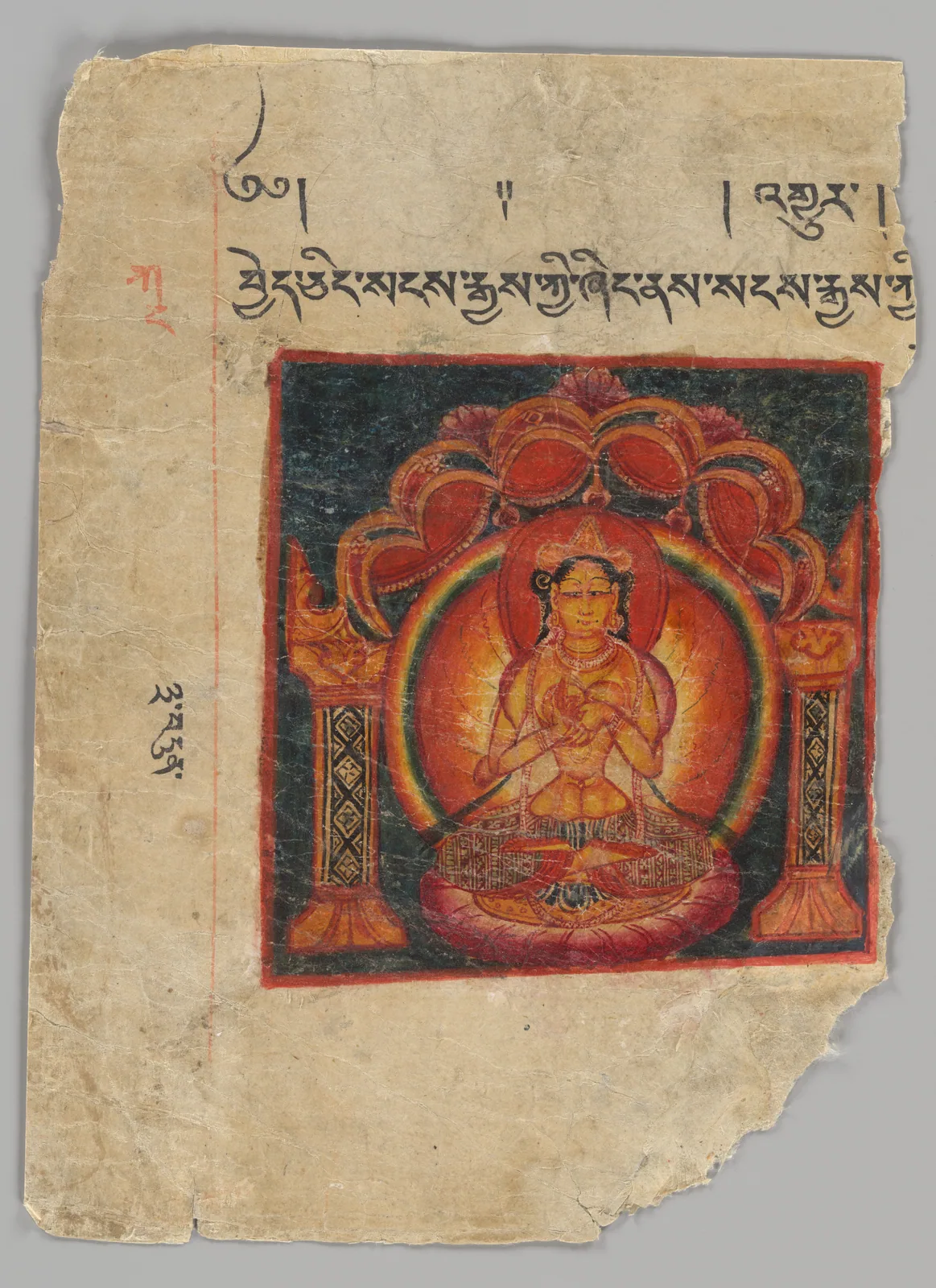
- Date: 11th–12th century (roughly the Song dynasty)
- Origin and medium: Western Tibet · Illustration from a Perfection of Wisdom manuscript, color on paper
- Collection: The Metropolitan Museum of Art, accession no. 2020.77 · Public domain
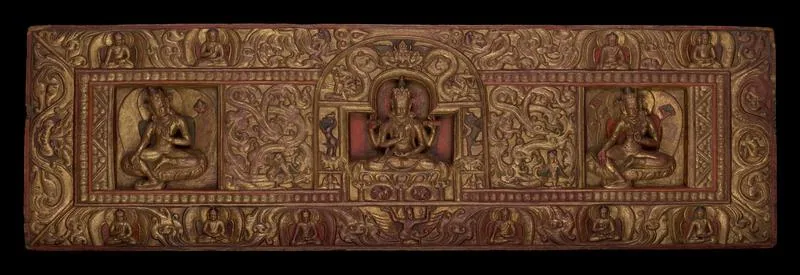
- Date: About 1200 (roughly the Southern Song period)
- Origin and medium: Tibet · Carved wooden book cover, painted and gilded; at the center is Prajnaparamita holding a book of scripture and a vajra
- Collection: Minneapolis Institute of Art, accession no. 97.47 · Public domain
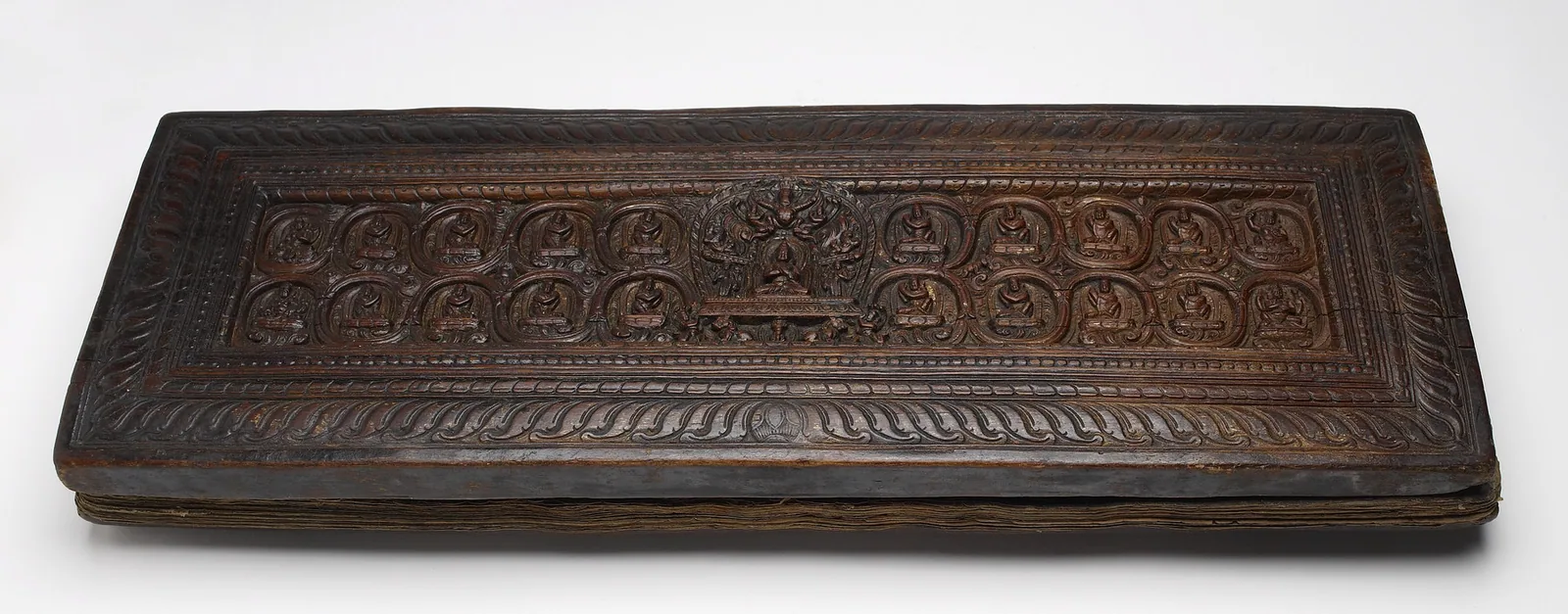
- Date: 13th century (roughly Southern Song to Yuan dynasty)
- Origin and medium: Tibet · Manuscript of the Perfection of Wisdom in Eight Thousand Lines, gold lettering on indigo-blue paper; Prajnaparamita appears in the relief carving on the upper book cover
- Collection: Walters Art Museum, accession no. W.856 · CC0