
Sarasvati
The goddess of wisdom, music, fine writing and eloquence, holding a lute in her arms.
Watch the video
Who she is
Sarasvati's name in Sanskrit is Sarasvatī, and in Tibetan she is called Yangchenma. She began as the goddess of a great river in ancient India. The sound of flowing water was linked with speech, poetry and music, and so she became the guardian of learning and the arts.
Buddhism sees her as a goddess of wisdom, closely connected with Manjushri. The Gelug school holds her in especially high regard: according to traditional accounts, Je Tsongkhapa devoted himself to the practice of Sarasvati when he was young, and saw her in person.
What she does
She grants the wisdom that has to do with "sound and written words": remembering well, speaking clearly and writing beautifully.
What people pray to her for
Traditionally, people pray to Sarasvati for:
- Success in study, exams and writing
- Growth in eloquence, writing skill and memory
- Talent and inspiration in music and the arts
- Speaking fittingly, with words that carry weight
Mantra
In the Gelug school, Sarasvati's mantra and practice must be passed on by a teacher, and the mantra is written differently in different lineages. It is not listed here.
Beginners can recite the Praise to Sarasvati written by Tsongkhapa, or recite Manjushri's mantra before studying.
Story: Tsongkhapa's praise
According to traditional accounts, when Tsongkhapa was in his early twenties and studying in Ü-Tsang (central Tibet), he devoted himself to the practice of Sarasvati and saw her with his own eyes. He wrote a great many works in his lifetime, and his writing is both beautiful and precise. Tradition holds that the two are connected.
He wrote a praise to Sarasvati, which has been passed down to this day.
How to recognize her
- White body, with a young and lovely face
- Holding a lute (the Indian vina) in both arms and playing it
- A relaxed sitting posture; she is often shown squatting on a lotus with both knees raised and her ankles crossed
The image
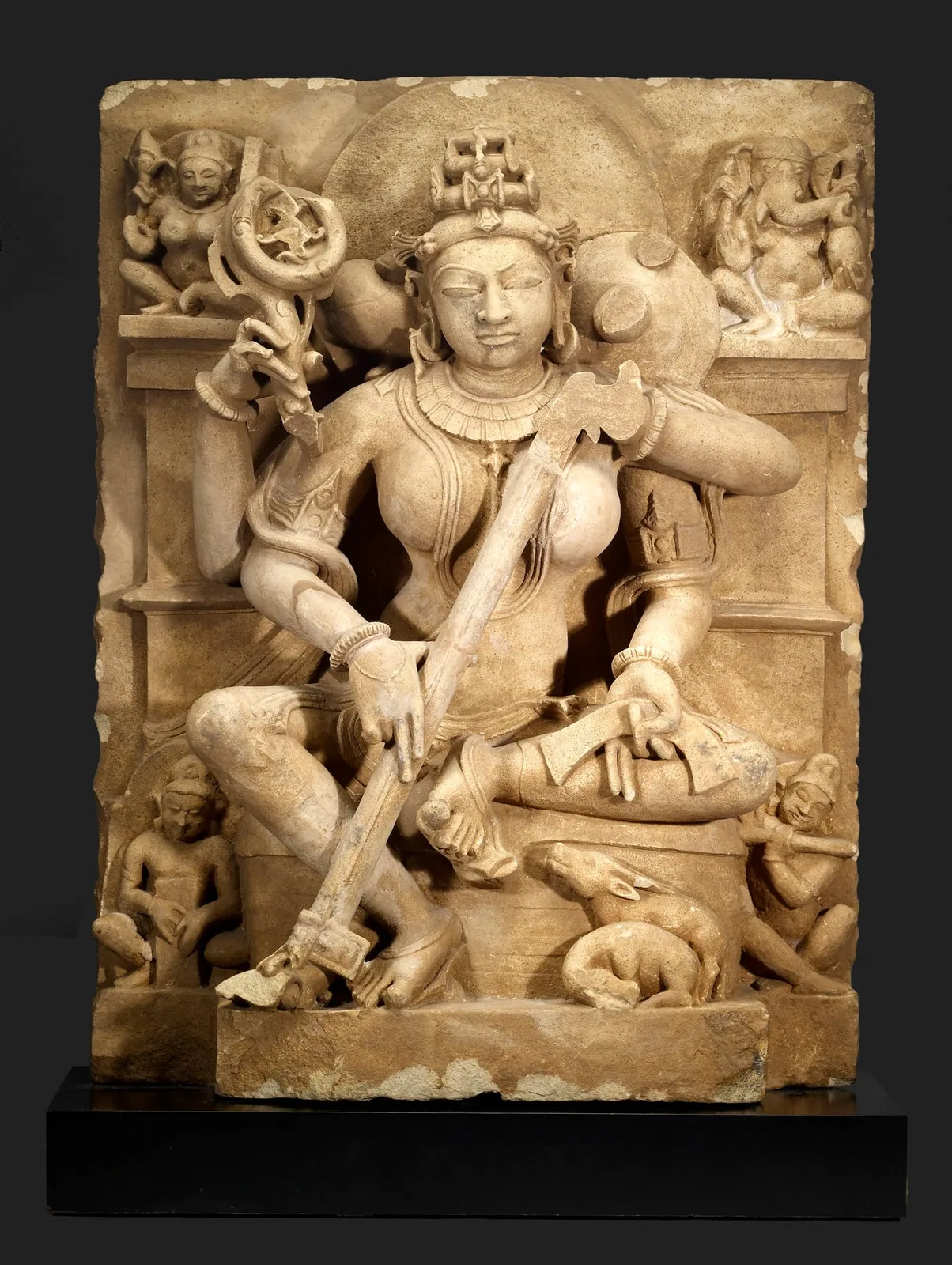
- Date: 10th–11th century (roughly the Northern Song period)
- Origin and medium: Uttar Pradesh, India · Sandstone carving; four arms, holding a vina and a palm-leaf manuscript
- Collection: Walters Art Museum, accession no. 25.50 · CC0