
Virudhaka, Heavenly King of the South
The heavenly king who guards the south, gripping a sword.
Watch the video
Who he is
Virudhaka's Sanskrit name is Virūḍhaka. In Tibetan he is called Phagkyepo, which means "growth." He guards the south.
The Four Heavenly Kings live halfway up Mount Meru. Each guards one direction. They are the most commonly seen Dharma protectors in Buddhism. In Tibetan monasteries they are painted, almost without exception, on both sides of the porch at the entrance to the main hall. In Chinese temples the first hall is called the "Hall of the Heavenly Kings."
What he does
He guards the south and makes the roots of goodness in living beings grow. The sword in his hand stands for wisdom. It is used to cut through disturbing emotions and to keep the Dharma from being violated.
What people pray to him for
Traditionally, people pray to Virudhaka, Heavenly King of the South, for:
- Growth in roots of goodness and in merit
- Progress in work and in studies
- Cutting off bad habits and disturbing emotions
Mantra
Traditionally, the mantras and practices of protectors must be received from a qualified teacher. They are not given here.
Story: "Favorable winds and timely rains" in China
After the Four Heavenly Kings came to China, ordinary people gave the objects in their hands a set of lucky meanings. Put together, they make the four-word saying feng tiao yu shun, "favorable winds and timely rains":
- Virudhaka holds a sword. A sword has an edge (feng), which sounds the same as "wind" (feng).
- Dhritarashtra holds a lute. The strings of a lute have to be tuned (tiao).
- Vaishravana holds an umbrella. An umbrella keeps off the rain (yu).
- Virupaksha has a dragon or a snake coiled around his hand, which is taken to mean "going smoothly" (shun).
This is how ordinary people in China understood them, not something the sutras say. Yet it made the Four Heavenly Kings figures that everyone recognizes in a temple. In Tibet they are painted a little differently: Vaishravana holds a victory banner and a jewel-spitting mongoose, and Virupaksha holds a snake and a stupa.
How to recognize him
- Blue or blue-green body, wearing a general's armor
- A sword gripped in his right hand
- A stern, commanding face
The image
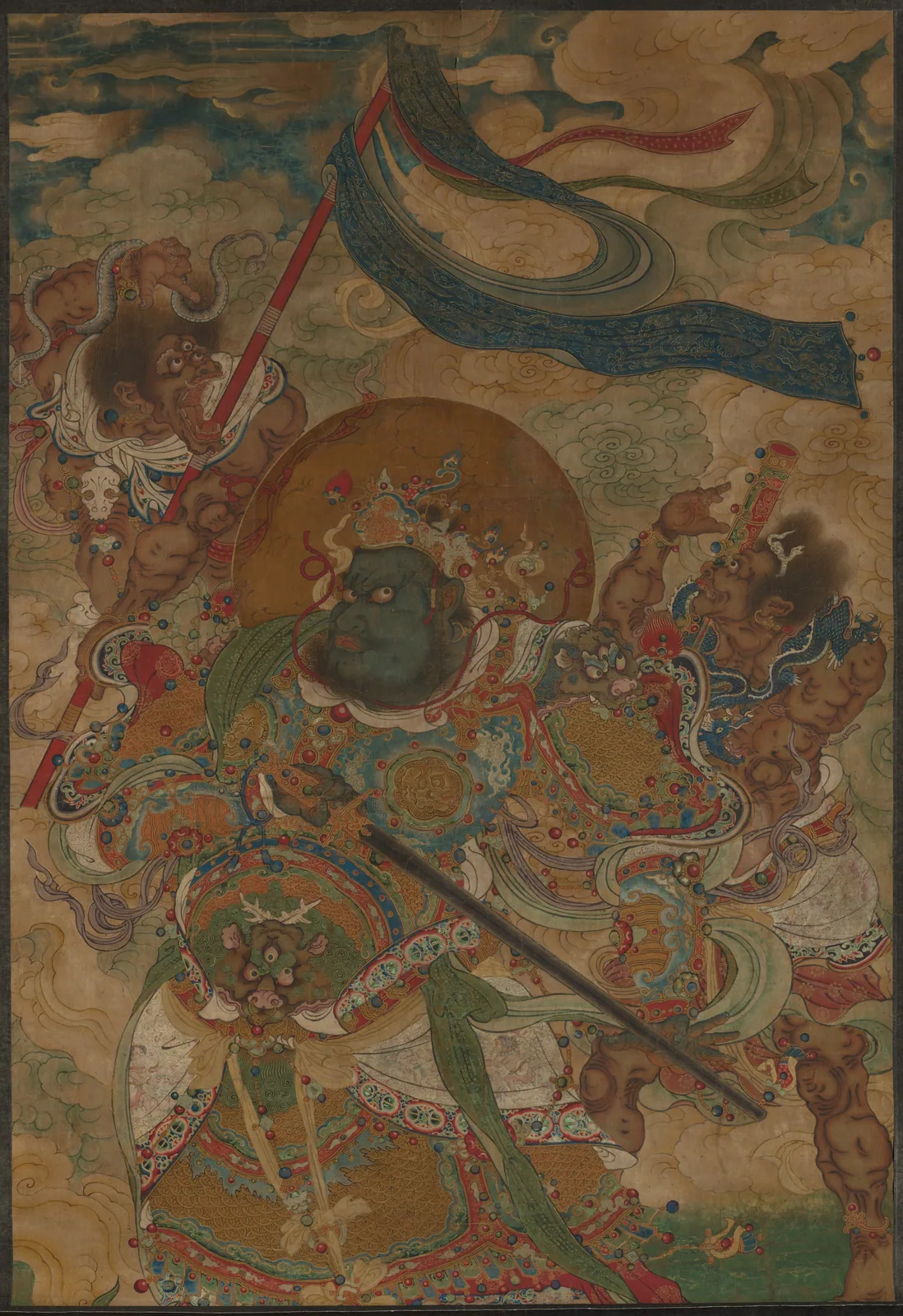
- Date: Ming dynasty (1368–1644)
- Origin and medium: China · hanging scroll, ink and color on silk
- Collection: Cleveland Museum of Art, accession no. 1918.544 · CC0