
White Jambhala, Black Jambhala and Red Jambhala
The other three of the five Jambhalas, each with his own origin and his own specialty.
Watch the video
Who they are
The five Jambhalas of Tibetan Buddhism are yellow, white, black, red and green. Yellow Jambhala is the most common and was introduced in the previous article. This one introduces the white, black and red ones.
- White Jambhala: White body, riding a dragon. The story goes that he arose from the tears of compassion of Avalokiteshvara (Chenrezig).
- Black Jambhala: Blue-black body, short, naked, in wrathful form. He holds a skull cup and a jewel-spitting mongoose.
- Red Jambhala: Red body, holding a jewel and a jewel-spitting mongoose. His lineage is passed down mainly in the Sakya school.
What they do
All three grant resources, each with a different emphasis:
- White Jambhala leans toward removing the suffering of poverty and illness, and purifying the harmful karma that brings poverty.
- People commonly say that Black Jambhala works the fastest, and that he looks after the poorest and most desperate people in particular.
- People commonly say that Red Jambhala leans toward good relations with others and personal appeal, so that a person receives help and support.
What people pray to them for
Traditionally, people pray to White Jambhala, Black Jambhala and Red Jambhala for:
- An end to poverty and the suffering that comes with it
- Relief in an emergency
- Good relations with others, and help from the right people
Mantra
Each of the three Jambhalas has his own mantra, and each practice has its own requirements. Traditionally these are passed on by a teacher. They are not given here.
Story: Atisha and White Jambhala
The origin of White Jambhala is connected with Atisha. The story goes that Atisha met a man on the road who was about to die of hunger. He had no food with him at all, so he made up his mind to cut flesh from his own body for the man to eat. The man could not bear it: "How could I eat the flesh of a monk?"
Atisha could not help him, and he was so saddened that he wept. At that moment Avalokiteshvara appeared before him and took the form of White Jambhala, who from then on has devoted himself to helping the poor. Another widely told version says that White Jambhala arose from Avalokiteshvara's tears of compassion.
So White Jambhala is seen as the form that Avalokiteshvara's compassion takes especially for the poor.
How to recognize them
- White Jambhala: white body, one face, two hands, riding on the back of a dragon
- Black Jambhala: blue-black body, short and naked, trampling a yellow wealth deity underfoot
- Red Jambhala: red body, holding a jewel and a jewel-spitting mongoose
- The shared mark of all five Jambhalas is the jewel-spitting mongoose
The images
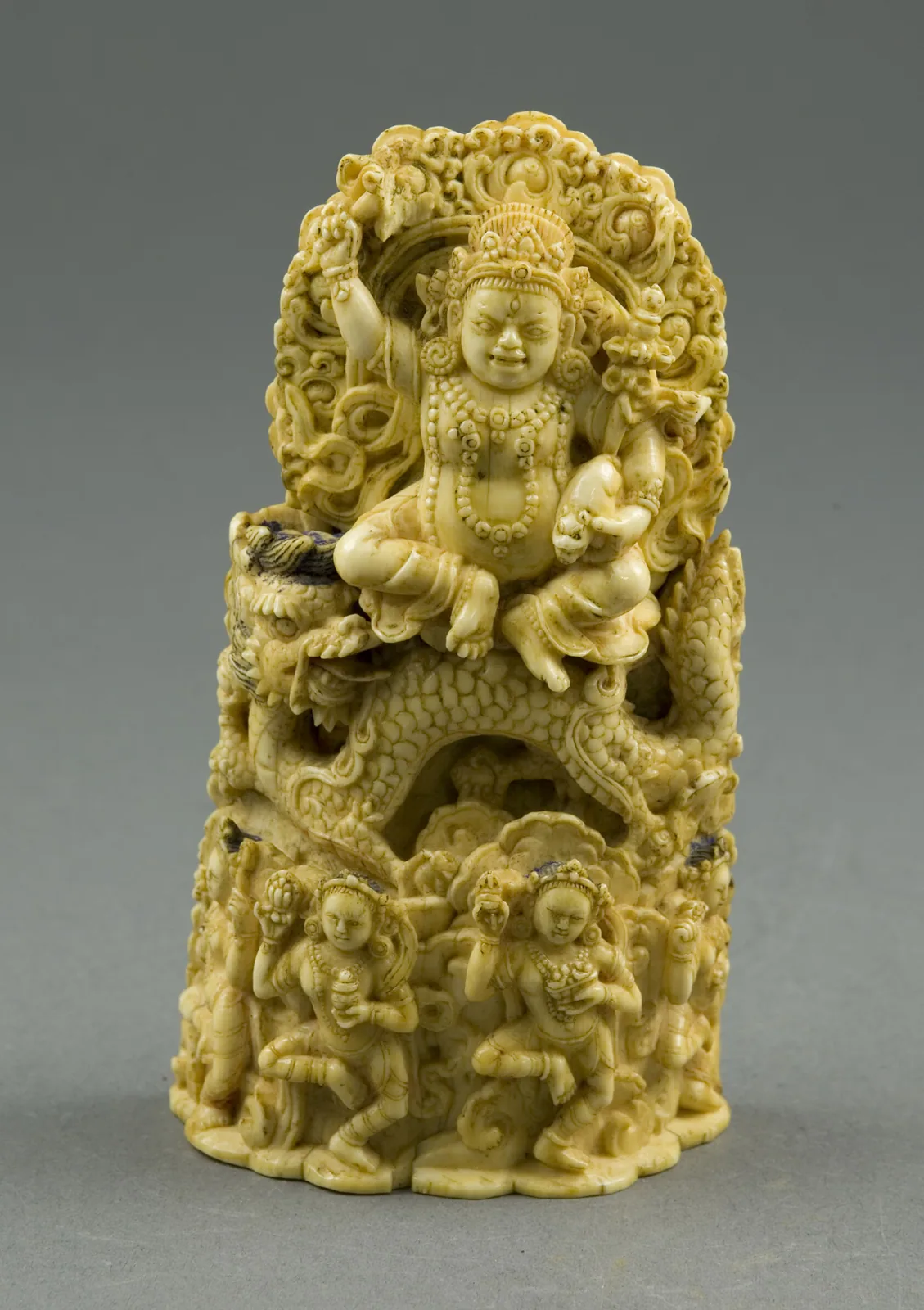
- Date: 15th century (Ming dynasty)
- Origin and medium: Tibet · statue, Jambhala riding a dragon
- Collection: Art Institute of Chicago, accession no. 1996.30 · CC0
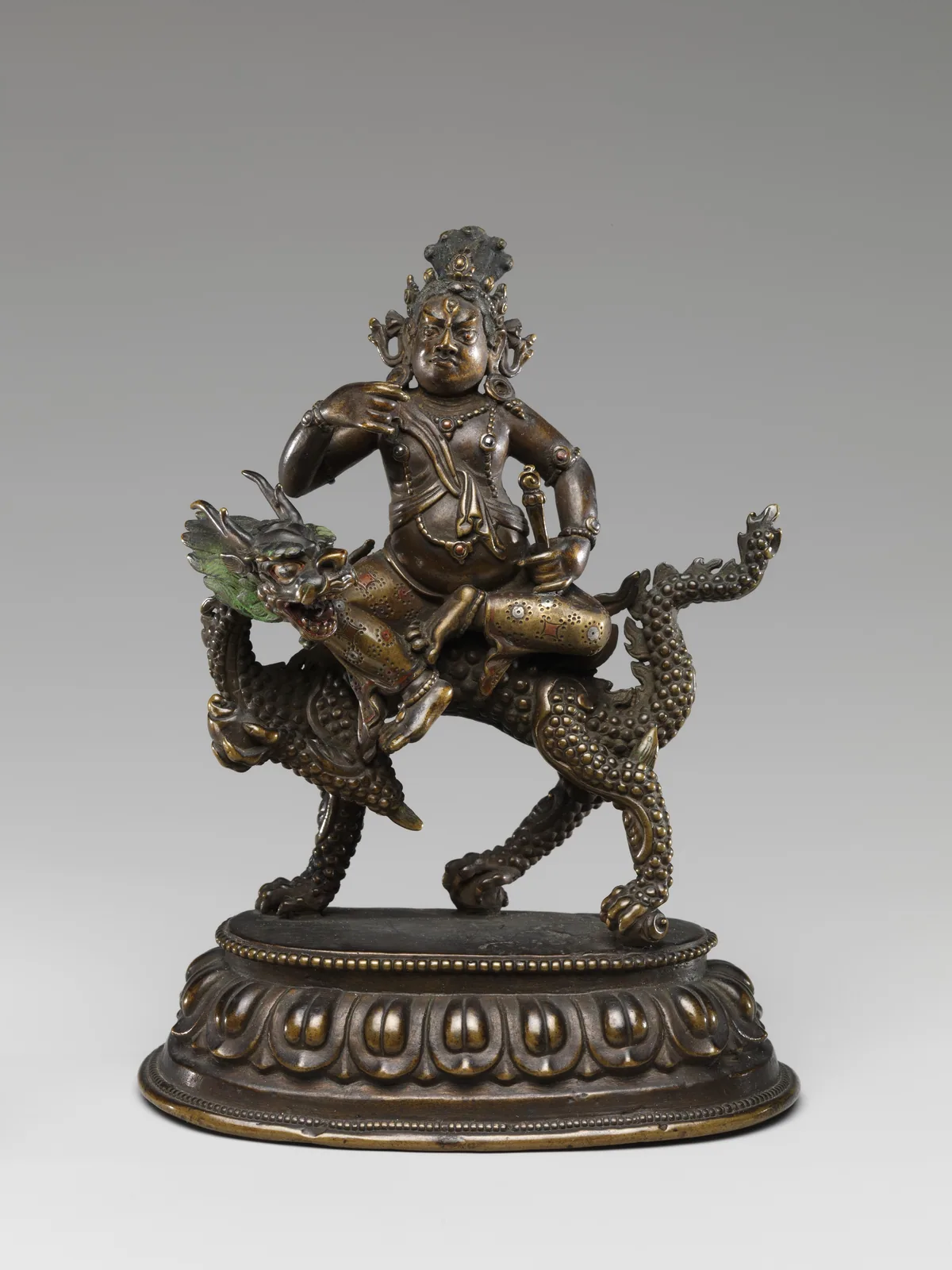
- Date: 18th–19th century (Qing dynasty)
- Origin and medium: Mongolia · brass figure, White Jambhala riding a dragon
- Collection: The Metropolitan Museum of Art, accession no. 48.30.12 · Public domain
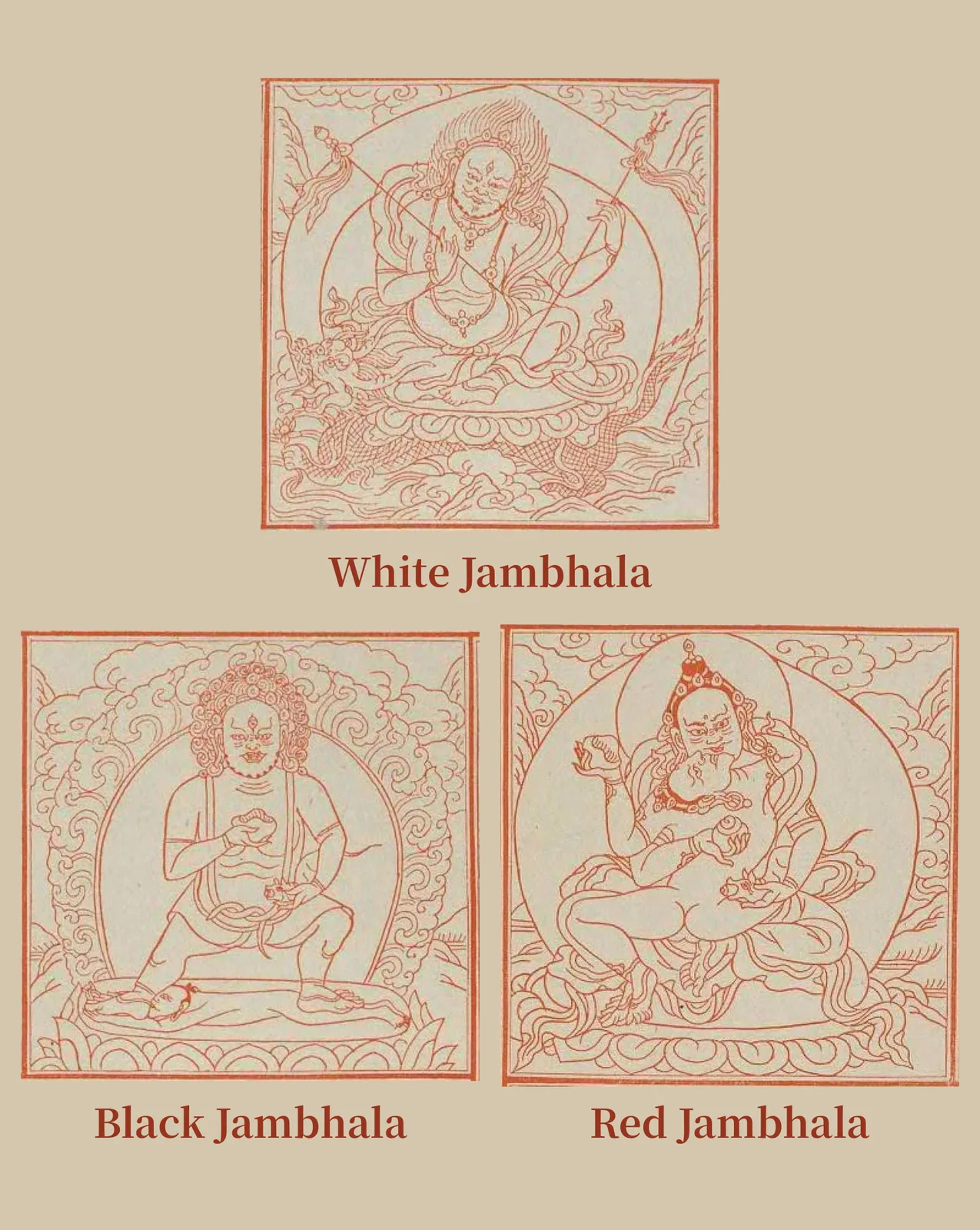
- Date: 18th century (Qing dynasty) original woodblocks; reproduced in print in 1903
- Origin and medium: Beijing · woodblock prints (line drawings in red): White Jambhala, Black Jambhala and Red Jambhala, one print each
- Source: The "Three Hundred Icons", leaf 89, figures 266 (White Jambhala) and 267 (Black Jambhala), and leaf 90, figure 268 (Red Jambhala). The set was compiled by the Gelug master Changkya Rolpai Dorje and cut in Beijing; the copy used here is the 1903 St Petersburg reproduction (edited by S. F. Oldenburg, Bibliotheca Buddhica V), scanned on the Internet Archive
- Original copy: The reproduction was made from a Beijing print held by the Asiatic Museum, St Petersburg.
- Scan pages: https://archive.org/details/sbornik300burkhanov/page/n184/mode/1up (leaf 89), https://archive.org/details/sbornik300burkhanov/page/n186/mode/1up (leaf 90)