
A Quiet Little Moment
Try gentle attention to a sound or the feeling of supported feet, returning kindly after distraction.
Watch lesson 11
Open the full image, then touch and hold to save on a phone, or right-click and save on a computer.
Let’s begin
Last time we changed one small thing. Today we will notice something for a little while.
Can thoughts still appear when we sit quietly?
Story time
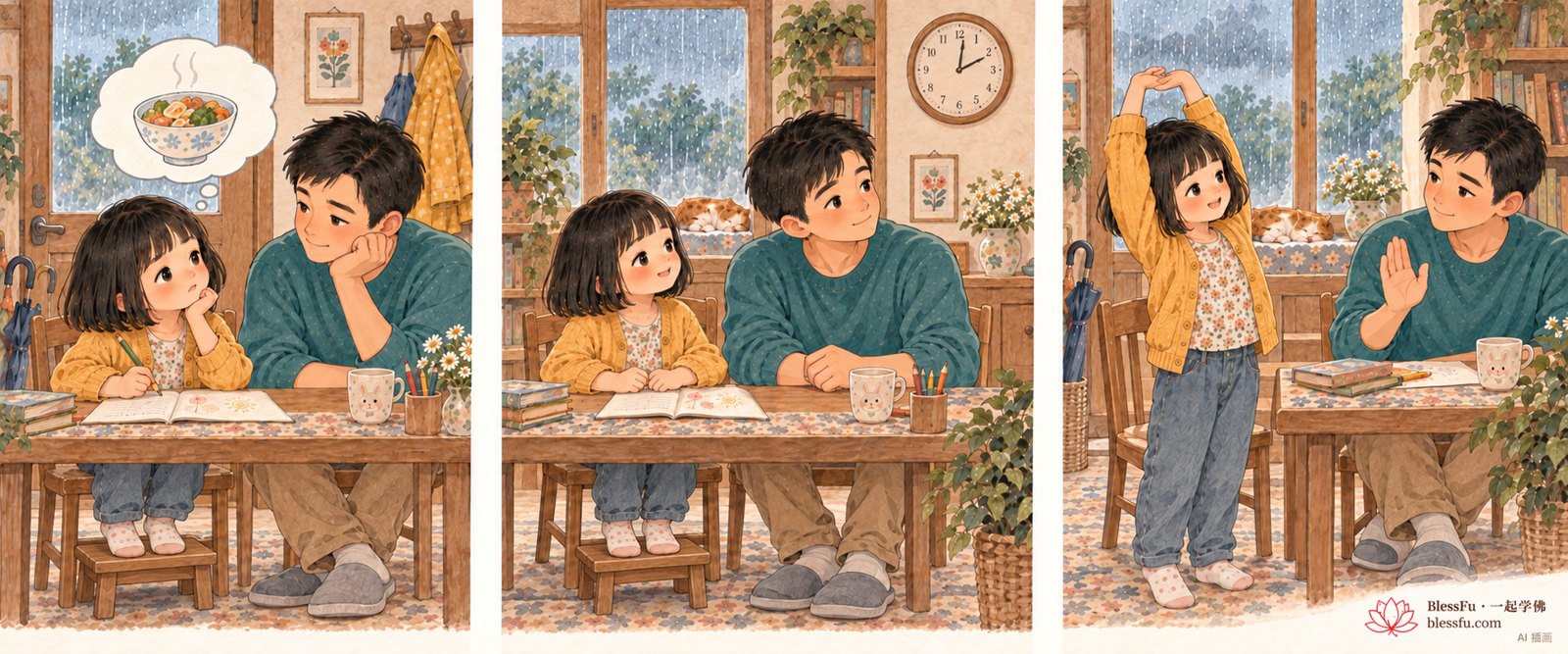
Xiaohe thought a quiet practice meant having no thoughts. As soon as she sat down, she thought of lunch. 'I've failed!' she said. Dad replied, 'You noticed your attention had wandered. Now we can listen again.'
They sat comfortably on chairs with eyes open and feet supported. For a few seconds they listened: traffic outside, a clock inside. Xiaohe thought of lunch again, then gently returned to the ticking. She did not scold herself.
Before a minute was up, Xiaohe wanted to stretch. They stopped and moved. 'What did you notice?' Dad asked. 'Thoughts came, and I could hear the sounds again,' she said. There was no need to chase thoughts away, and no prize for sitting longest.
Think together
This is an introductory attention game, not a complete meditation practice. Noticing, recognizing distraction and returning gently can all be part of learning.
- Did thinking about lunch mean failure?
- What can you do if the exercise feels uncomfortable?
Try an activity
Choose freely: listen to ordinary sounds, or notice your feet touching the floor. Try 10–20 seconds. You may stop, move or keep your eyes open. Share one observation without competing.
Take it home
Try a brief practice with a family member if you both want to. Extend it only if comfortable; a full minute is not required.
For adults: read-aloud script and guidance
Do not require closed eyes, breath-holding or controlled breathing. Stop if the child is uncomfortable. Looking at a familiar object is another option. This is not treatment and must not replace practical care.
Nine-slide lesson outline
1. A Quiet Little Moment
Learn together, one small step.
Try gentle attention to a sound or the feeling of supported feet, returning kindly after distraction.
Last time we changed one small thing. Today we will notice something for a little while.
2. Look closely
Can thoughts still appear when we sit quietly?
Last time we changed one small thing. Today we will notice something for a little while.
Can thoughts still appear when we sit quietly?
3. Story 1 / 3
Xiaohe thought a quiet practice meant having no thoughts. As soon as she sat down, she thought of lunch. 'I've failed!' she said. Dad replied, 'You noticed your attention had wandered. Now we can listen again.'
Xiaohe thought a quiet practice meant having no thoughts. As soon as she sat down, she thought of lunch. 'I've failed!' she said. Dad replied, 'You noticed your attention had wandered. Now we can listen again.'
4. Story 2 / 3
They sat comfortably on chairs with eyes open and feet supported. For a few seconds they listened: traffic outside, a clock inside. Xiaohe thought of lunch again, then gently returned to the ticking. She did not scold herself.
They sat comfortably on chairs with eyes open and feet supported. For a few seconds they listened: traffic outside, a clock inside. Xiaohe thought of lunch again, then gently returned to the ticking. She did not scold herself.
5. Story 3 / 3
Before a minute was up, Xiaohe wanted to stretch. They stopped and moved. 'What did you notice?' Dad asked. 'Thoughts came, and I could hear the sounds again,' she said. There was no need to chase thoughts away, and no prize for sitting longest.
Before a minute was up, Xiaohe wanted to stretch. They stopped and moved. 'What did you notice?' Dad asked. 'Thoughts came, and I could hear the sounds again,' she said. There was no need to chase thoughts away, and no prize for sitting longest.
6. A Buddhist idea
No empty mind required.
No sitting competition.
This is an introductory attention game, not a complete meditation practice. Noticing, recognizing distraction and returning gently can all be part of learning.
7. Talk together
Did thinking about lunch mean failure?
What can you do if the exercise feels uncomfortable?
Listen to different answers. Ask why. Children may discuss the characters rather than private experiences.
8. Try an activity
Listen or feel your feet.
Try just a few seconds.
Choose freely: listen to ordinary sounds, or notice your feet touching the floor. Try 10–20 seconds. You may stop, move or keep your eyes open. Share one observation without competing.
Try a brief practice with a family member if you both want to. Extend it only if comfortable; a full minute is not required.
9. For grown-ups
Read aloud, discuss and try a small activity.
Stories and exercises: BlessFu
Illustrations: AI-assisted
Full references and guidance are in the companion booklet.
Do not require closed eyes, breath-holding or controlled breathing. Stop if the child is uncomfortable. Looking at a familiar object is another option. This is not treatment and must not replace practical care.
Next we will ask whether every thought must be believed.
Story and references
Theme reference: Matt Lindén, SEE Learning: Understanding Our Emotions, Study Buddhism, on attention and awareness. The short eyes-open game is independently written by BlessFu; it is not a quoted meditation instruction or an endorsed SEE Learning lesson.
https://studybuddhism.com/en/essentials/universal-values/see-learning-understanding-our-emotions
Next we will ask whether every thought must be believed.