
A Thank-You Tree
Notice one specific kind of help and choose a voluntary way to appreciate it.
Watch lesson 18
Open the full image, then touch and hold to save on a phone, or right-click and save on a computer.
Let’s begin
We know kindness has boundaries. We can appreciate help and still make our own choices.
Whose work helped bring a slice of bread to the table?
Story time
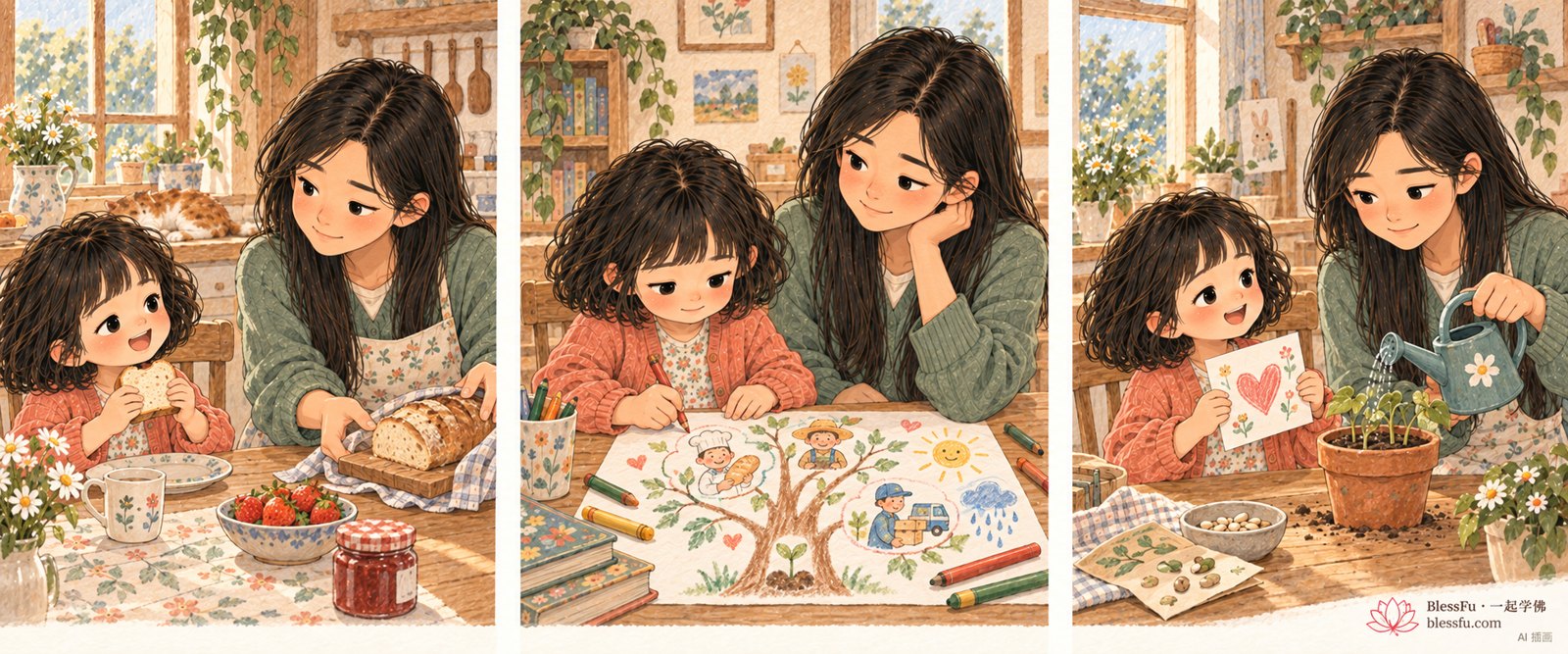
Xiaohe took a bite of breakfast bread. “Delicious!” Mother asked, “Who helped, besides the person who put it on the table?” Xiaohe thought. “The baker!” Then she remembered the farmer growing wheat, the delivery driver, and the sunshine and rain that helped the wheat grow.
They drew a thank-you tree. Its branches held small pictures, not scores: a wheat field, an oven, a delivery van and a hand passing a plate. “We cannot meet everyone who has helped us,” said Mother, “but we can try to notice the help.” Xiaohe added the little spoon she had set out herself.
“I would like to make a thank-you card,” Xiaohe said. Mother joined her in watering a small bean plant, then they looked at the card. Thanks could be spoken, drawn or quietly remembered. Xiaohe did not have to agree to every request to show appreciation.
Think together
Noticing help is one way to practise gratitude. Thanks is not measured by the size of a gift, and it is not a trade or a debt. We can choose how to express care while keeping our boundaries.
- Why did Xiaohe include a farmer and a delivery driver?
- Besides giving a present, how could someone express thanks?
Try an activity
Draw a thank-you tree with pictures of three small kinds of help. Use story characters if you prefer; no real names are needed. Circle one thank-you you would like to say or do, or choose not to express it yet.
Take it home
At dinner, optionally say, “Thank you for helping me…” and name the help. If nobody wants a turn, finish with a story instead.
For adults: read-aloud script and guidance
Do not demand obedience by listing others’ sacrifices. Children need not thank someone who harmed them. Not saying thanks aloud is not evidence of an ungrateful heart. Notice care, work and natural conditions without keeping a debt tally.
Nine-slide lesson outline
1. A Thank-You Tree
Learn together, one small step.
Notice one specific kind of help and choose a voluntary way to appreciate it.
We know kindness has boundaries. We can appreciate help and still make our own choices.
2. Look closely
Whose work helped bring a slice of bread to the table?
We know kindness has boundaries. We can appreciate help and still make our own choices.
Whose work helped bring a slice of bread to the table?
3. Story 1 / 3
Xiaohe took a bite of breakfast bread. “Delicious!” Mother asked, “Who helped, besides the person who put it on the table?” Xiaohe thought. “The baker!” Then she remembered the farmer growing wheat, the delivery driver, and the sunshine and rain that helped the wheat grow.
Xiaohe took a bite of breakfast bread. “Delicious!” Mother asked, “Who helped, besides the person who put it on the table?” Xiaohe thought. “The baker!” Then she remembered the farmer growing wheat, the delivery driver, and the sunshine and rain that helped the wheat grow.
4. Story 2 / 3
They drew a thank-you tree. Its branches held small pictures, not scores: a wheat field, an oven, a delivery van and a hand passing a plate. “We cannot meet everyone who has helped us,” said Mother, “but we can try to notice the help.” Xiaohe added the little spoon she had set out herself.
They drew a thank-you tree. Its branches held small pictures, not scores: a wheat field, an oven, a delivery van and a hand passing a plate. “We cannot meet everyone who has helped us,” said Mother, “but we can try to notice the help.” Xiaohe added the little spoon she had set out herself.
5. Story 3 / 3
“I would like to make a thank-you card,” Xiaohe said. Mother joined her in watering a small bean plant, then they looked at the card. Thanks could be spoken, drawn or quietly remembered. Xiaohe did not have to agree to every request to show appreciation.
“I would like to make a thank-you card,” Xiaohe said. Mother joined her in watering a small bean plant, then they looked at the card. Thanks could be spoken, drawn or quietly remembered. Xiaohe did not have to agree to every request to show appreciation.
6. A Buddhist idea
Thanks can be simple,
and freely chosen.
Noticing help is one way to practise gratitude. Thanks is not measured by the size of a gift, and it is not a trade or a debt. We can choose how to express care while keeping our boundaries.
7. Talk together
Why did Xiaohe include a farmer and a delivery driver?
Besides giving a present, how could someone express thanks?
Listen to different answers. Ask why. Children may discuss the characters rather than private experiences.
8. Try an activity
Draw a tree with three small kinds of help.
Draw a thank-you tree with pictures of three small kinds of help. Use story characters if you prefer; no real names are needed. Circle one thank-you you would like to say or do, or choose not to express it yet.
At dinner, optionally say, “Thank you for helping me…” and name the help. If nobody wants a turn, finish with a story instead.
9. For grown-ups
Read aloud, discuss and try a small activity.
Stories and exercises: BlessFu
Illustrations: AI-assisted
Full references and guidance are in the companion booklet.
Do not demand obedience by listing others’ sacrifices. Children need not thank someone who harmed them. Not saying thanks aloud is not evidence of an ungrateful heart. Notice care, work and natural conditions without keeping a debt tally.
In the next batch, everyday changes will help us explore more Buddhist ideas.
Story and references
Theme reference: Matt Lindén, “SEE Learning: Cultivating Social Skills,” Study Buddhism, an abridgment of the Emory University SEE Learning framework. Used only for broad themes of care, listening, diversity and appreciation. This is a universal ethics reference, not a Buddhist scripture. Stories, dialogue and activities are original BlessFu writing, not a translation or an endorsed course.
https://studybuddhism.com/en/essentials/universal-values/see-learning-cultivating-social-skills
In the next batch, everyday changes will help us explore more Buddhist ideas.