
After Blossoms, New Leaves
Notice a change and allow appreciation and sadness to exist together.
Watch lesson 19
Open the full image, then touch and hold to save on a phone, or right-click and save on a computer.
Let’s begin
Last time we drew a thank-you tree. Today we visit a real tree.
Why does the flowering tree look different this week?
Story time
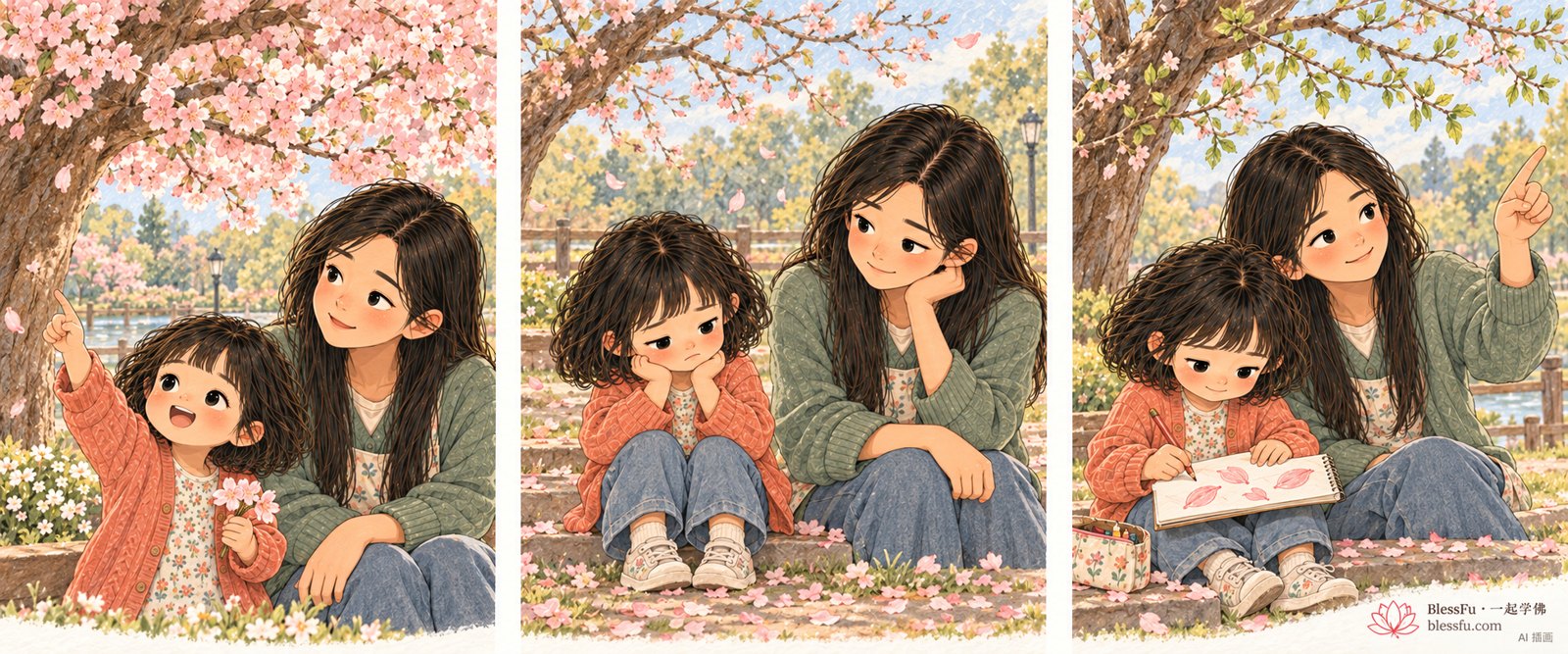
A park tree was covered in pink blossoms. Xiaohe and Mother stood underneath, looking up for a long time. “I hope it is exactly like this next time,” said Xiaohe. Mother replied, “We can look carefully at today’s flowers and remember how they look.”
A few days later, wind had scattered many petals. Xiaohe felt disappointed. “Why are so many gone?” Mother crouched down and listened instead of asking her to be cheerful. “You liked the flowers, so you miss them. Trees and flowers change day by day.” They looked at the fallen petals together.
Mother noticed tiny green leaves on the branches. Xiaohe drew the petals and new leaves in her sketchbook. She still missed the blossoms and also wondered how the leaves would grow. Appreciating something did not mean keeping it unchanged forever. She could notice this moment carefully.
Think together
Buddhist teachings on impermanence remind us that things formed through causes and conditions change. We begin by observing blossoms and leaves. Change does not promise that everything immediately improves; sadness can still receive care.
- Why was Xiaohe disappointed?
- Can she notice new leaves and still miss the blossoms?
Try an activity
Draw three boxes: the tree a few days ago, the tree today, and something to observe next. Put a question mark in the last box if you wish. You need not predict correctly.
Take it home
Choose a plant with a caregiver and draw a little change after a few days. Do not pick blossoms or branches. Daily records are optional.
For adults: read-aloud script and guidance
Say, “It is understandable to miss something you liked.” Do not introduce frightening death imagery or use impermanence to silence grief. Listen to real losses without promising that sadness will quickly pass.
Nine-slide lesson outline
1. After Blossoms, New Leaves
Learn together, one small step.
Notice a change and allow appreciation and sadness to exist together.
Last time we drew a thank-you tree. Today we visit a real tree.
2. Look closely
Why does the flowering tree look different this week?
Last time we drew a thank-you tree. Today we visit a real tree.
Why does the flowering tree look different this week?
3. Story 1 / 3
A park tree was covered in pink blossoms. Xiaohe and Mother stood underneath, looking up for a long time. “I hope it is exactly like this next time,” said Xiaohe. Mother replied, “We can look carefully at today’s flowers and remember how they look.”
A park tree was covered in pink blossoms. Xiaohe and Mother stood underneath, looking up for a long time. “I hope it is exactly like this next time,” said Xiaohe. Mother replied, “We can look carefully at today’s flowers and remember how they look.”
4. Story 2 / 3
A few days later, wind had scattered many petals. Xiaohe felt disappointed. “Why are so many gone?” Mother crouched down and listened instead of asking her to be cheerful. “You liked the flowers, so you miss them. Trees and flowers change day by day.” They looked at the fallen petals together.
A few days later, wind had scattered many petals. Xiaohe felt disappointed. “Why are so many gone?” Mother crouched down and listened instead of asking her to be cheerful. “You liked the flowers, so you miss them. Trees and flowers change day by day.” They looked at the fallen petals together.
5. Story 3 / 3
Mother noticed tiny green leaves on the branches. Xiaohe drew the petals and new leaves in her sketchbook. She still missed the blossoms and also wondered how the leaves would grow. Appreciating something did not mean keeping it unchanged forever. She could notice this moment carefully.
Mother noticed tiny green leaves on the branches. Xiaohe drew the petals and new leaves in her sketchbook. She still missed the blossoms and also wondered how the leaves would grow. Appreciating something did not mean keeping it unchanged forever. She could notice this moment carefully.
6. A Buddhist idea
Notice change, appreciate now,
and allow your feelings.
Buddhist teachings on impermanence remind us that things formed through causes and conditions change. We begin by observing blossoms and leaves. Change does not promise that everything immediately improves; sadness can still receive care.
7. Talk together
Why was Xiaohe disappointed?
Can she notice new leaves and still miss the blossoms?
Listen to different answers. Ask why. Children may discuss the characters rather than private experiences.
8. Try an activity
Draw a plant observation sheet.
Draw three boxes: the tree a few days ago, the tree today, and something to observe next. Put a question mark in the last box if you wish. You need not predict correctly.
Choose a plant with a caregiver and draw a little change after a few days. Do not pick blossoms or branches. Daily records are optional.
9. For grown-ups
Read aloud, discuss and try a small activity.
Stories and exercises: BlessFu
Illustrations: AI-assisted
Full references and guidance are in the companion booklet.
Say, “It is understandable to miss something you liked.” Do not introduce frightening death imagery or use impermanence to silence grief. Listen to real losses without promising that sadness will quickly pass.
Next, we follow the journey of a meal.
Story and references
Theme reference: Alexander Berzin, Static and Nonstatic Phenomena. Theme only: change in conditioned phenomena; adult relationship examples and detailed classifications are not adapted. Stories, dialogue, questions and activities are original BlessFu writing, not a scripture translation or an endorsed course.
Next, we follow the journey of a meal.