
Kindness Can Say No
Practise refusing clearly, moving away and asking an adult for help.
Watch lesson 17
Open the full image, then touch and hold to save on a phone, or right-click and save on a computer.
Let’s begin
We respect different people. Today we keep some of that respect for ourselves.
Someone grabs for the glue stick you are using. Must you hand it over?
Story time
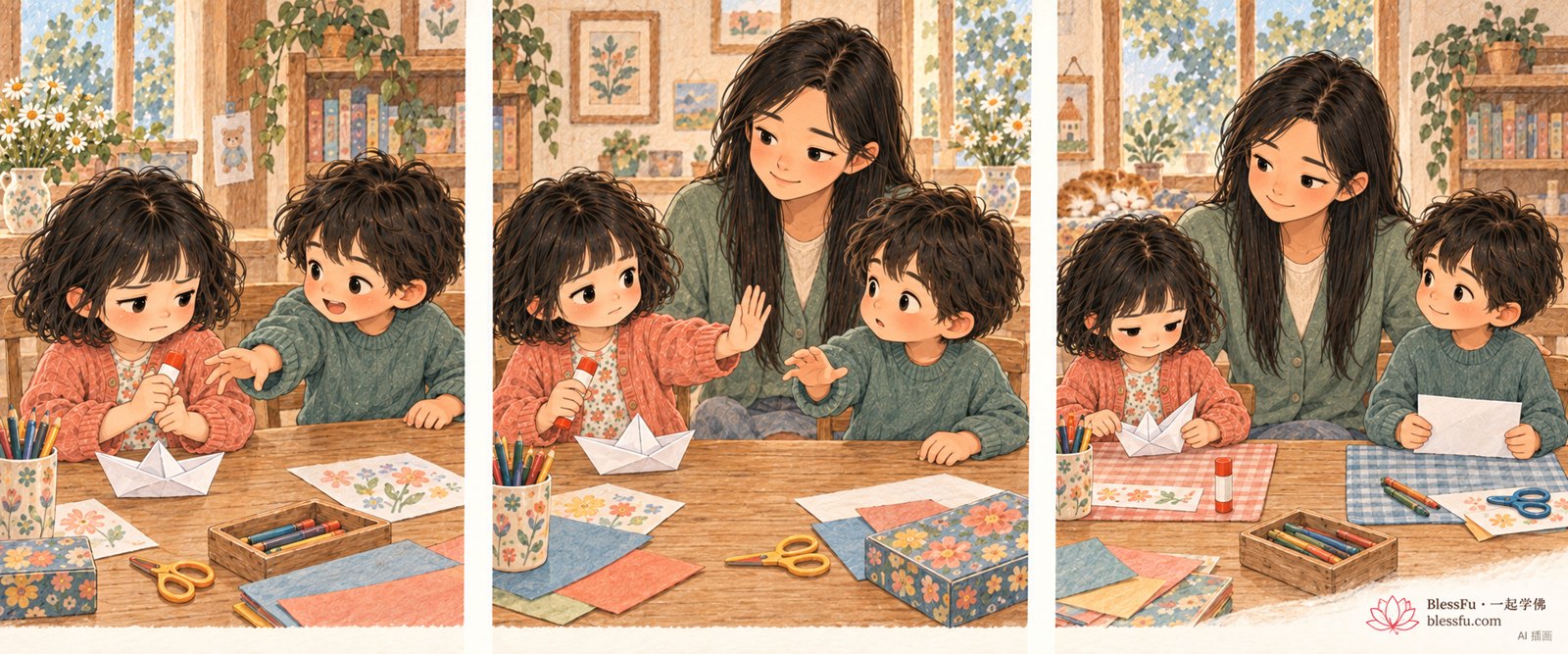
Xiaohe was sticking a little flag onto a paper boat. Lele reached for the glue stick in her hand. “Give it to me!” Xiaohe held on and felt uncomfortable. She remembered sharing, and worried that saying no would be unkind. But she had not finished her boat.
Xiaohe stepped back. “Please do not grab. I am using it. You can have a turn when I finish.” Lele reached again, so she called the nearby teacher: “I need help.” The teacher came over and made space between them. She did not tell Xiaohe to hand it over just to be generous.
The teacher gave each child a work mat and agreed on a waiting place with Lele. Xiaohe finished her flag, then put the glue stick in the middle. She could choose to take turns and still refuse grabbing. Asking for help did not label Lele a bad person; it let an adult help keep the rules.
Think together
Caring includes caring for yourself. You may firmly refuse uncomfortable or unsafe behaviour. Stepping back, leaving and asking an adult for help are options. Sharing should be voluntary.
- Did Xiaohe have to insult Lele to say no?
- If Xiaohe could not find words, how should an adult help?
Try an activity
Use toys to demonstrate three options: “Please stop,” “I will move away,” and “I need help.” Use an easy borrowing scenario without acting out grabbing or physical contact. The child may simply watch the adult.
Take it home
Practise asking before borrowing and stopping when someone says no. Adults model respecting reasonable refusals.
For adults: read-aloud script and guidance
Do not force hugs, apologies, forgiveness or continued interaction with someone the child fears. Adults are responsible for stopping harm; a child’s words cannot guarantee safety. Not managing to refuse is never the child’s fault.
Nine-slide lesson outline
1. Kindness Can Say No
Learn together, one small step.
Practise refusing clearly, moving away and asking an adult for help.
We respect different people. Today we keep some of that respect for ourselves.
2. Look closely
Someone grabs for the glue stick you are using. Must you hand it over?
We respect different people. Today we keep some of that respect for ourselves.
Someone grabs for the glue stick you are using. Must you hand it over?
3. Story 1 / 3
Xiaohe was sticking a little flag onto a paper boat. Lele reached for the glue stick in her hand. “Give it to me!” Xiaohe held on and felt uncomfortable. She remembered sharing, and worried that saying no would be unkind. But she had not finished her boat.
Xiaohe was sticking a little flag onto a paper boat. Lele reached for the glue stick in her hand. “Give it to me!” Xiaohe held on and felt uncomfortable. She remembered sharing, and worried that saying no would be unkind. But she had not finished her boat.
4. Story 2 / 3
Xiaohe stepped back. “Please do not grab. I am using it. You can have a turn when I finish.” Lele reached again, so she called the nearby teacher: “I need help.” The teacher came over and made space between them. She did not tell Xiaohe to hand it over just to be generous.
Xiaohe stepped back. “Please do not grab. I am using it. You can have a turn when I finish.” Lele reached again, so she called the nearby teacher: “I need help.” The teacher came over and made space between them. She did not tell Xiaohe to hand it over just to be generous.
5. Story 3 / 3
The teacher gave each child a work mat and agreed on a waiting place with Lele. Xiaohe finished her flag, then put the glue stick in the middle. She could choose to take turns and still refuse grabbing. Asking for help did not label Lele a bad person; it let an adult help keep the rules.
The teacher gave each child a work mat and agreed on a waiting place with Lele. Xiaohe finished her flag, then put the glue stick in the middle. She could choose to take turns and still refuse grabbing. Asking for help did not label Lele a bad person; it let an adult help keep the rules.
6. A Buddhist idea
Kindness has boundaries.
Sharing is a choice.
Caring includes caring for yourself. You may firmly refuse uncomfortable or unsafe behaviour. Stepping back, leaving and asking an adult for help are options. Sharing should be voluntary.
7. Talk together
Did Xiaohe have to insult Lele to say no?
If Xiaohe could not find words, how should an adult help?
Listen to different answers. Ask why. Children may discuss the characters rather than private experiences.
8. Try an activity
Let toys practise refusing and asking for help.
Use toys to demonstrate three options: “Please stop,” “I will move away,” and “I need help.” Use an easy borrowing scenario without acting out grabbing or physical contact. The child may simply watch the adult.
Practise asking before borrowing and stopping when someone says no. Adults model respecting reasonable refusals.
9. For grown-ups
Read aloud, discuss and try a small activity.
Stories and exercises: BlessFu
Illustrations: AI-assisted
Full references and guidance are in the companion booklet.
Do not force hugs, apologies, forgiveness or continued interaction with someone the child fears. Adults are responsible for stopping harm; a child’s words cannot guarantee safety. Not managing to refuse is never the child’s fault.
Next, we notice small kinds of help in everyday life.
Story and references
Theme reference: Matt Lindén, “SEE Learning: Cultivating Social Skills,” Study Buddhism, an abridgment of the Emory University SEE Learning framework. Used only for broad themes of care, listening, diversity and appreciation. This is a universal ethics reference, not a Buddhist scripture. Stories, dialogue and activities are original BlessFu writing, not a translation or an endorsed course.
https://studybuddhism.com/en/essentials/universal-values/see-learning-cultivating-social-skills
Next, we notice small kinds of help in everyday life.