
Buddhas, Bodhisattvas and Teachers
Begin to distinguish three terms and practise respectful questions.
Watch lesson 31
Open the full image, then touch and hold to save on a phone, or right-click and save on a computer.
Let’s begin
Tsongkhapa studied carefully. Let us explore some names we often hear.
Is everyone who teaches us a Buddha or bodhisattva?
Story time
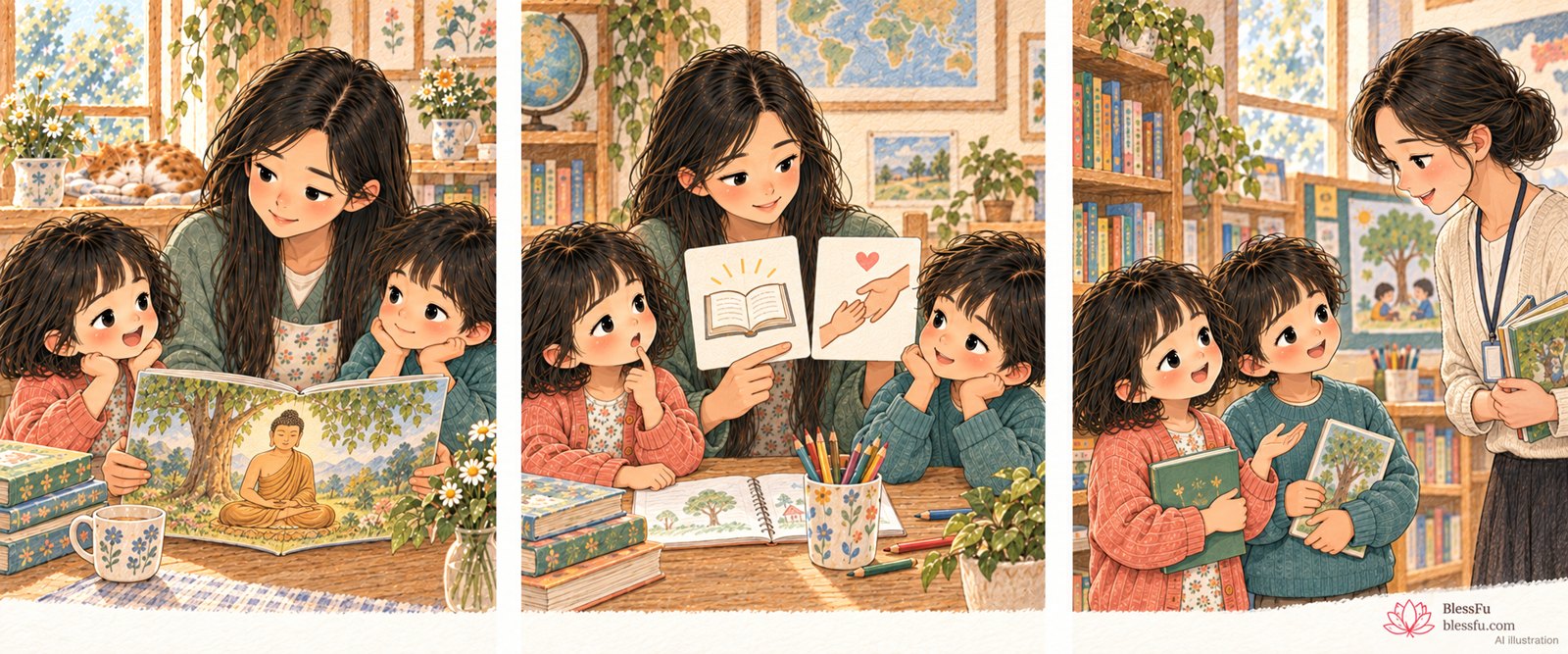
Xiaohe opens a picture book and sees a Buddha seated beneath a tree. “Is he a teacher?” Mum says, “Shakyamuni Buddha taught about suffering and the way beyond it. In Buddhism, a Buddha is fully awakened. That means more than knowing many facts.”
“What about a bodhisattva?” Xiaohe asks. Mum shows a card of helping hands. “In Mahayana Buddhism, a bodhisattva develops bodhichitta: the aim to become a Buddha for all beings. We can learn from that generous direction without rushing to give ourselves a title.”
At school, Xiaohe asks her teacher about a problem. “Let us look again,” the teacher says. Xiaohe learns that respect leaves room for questions. A teacher helps us learn; clothes or titles alone cannot show that someone is awakened. She draws a question mark in her notebook.
Think together
Definitions have nuances across Buddhist traditions and texts. This lesson uses an introductory Mahayana explanation. One kind act does not prove spiritual attainment. Respect for teachers includes listening carefully, asking questions and considering whether advice is sound.
- How could you ask about a word you do not understand?
- What does a teacher show by saying, “Let us check”?
Try an activity
Make three columns: Buddha, bodhisattva, teacher. An adult can add: fully awakened; awakening for all beings; helping us learn. Draw one question you want to ask. These columns explain words, not ranks for people you know.
Take it home
Choose an unfamiliar word and check a reliable book together. Talk about which explanation helped.
For adults: read-aloud script and guidance
Read the definitions before the original family story. Do not label a child a realized bodhisattva after one helpful act or assume a living teacher never makes mistakes. Children can refuse uncomfortable contact or secrecy and ask a trusted adult for help. This is not a refuge or vow ceremony.
Nine-slide lesson outline
1. Buddhas, Bodhisattvas and Teachers
Learn together, one small step.
Begin to distinguish three terms and practise respectful questions.
Tsongkhapa studied carefully. Let us explore some names we often hear.
2. Look closely
Is everyone who teaches us a Buddha or bodhisattva?
Tsongkhapa studied carefully. Let us explore some names we often hear.
Is everyone who teaches us a Buddha or bodhisattva?
3. Story 1 / 3
Xiaohe opens a picture book and sees a Buddha seated beneath a tree. “Is he a teacher?” Mum says, “Shakyamuni Buddha taught about suffering and the way beyond it. In Buddhism, a Buddha is fully awakened. That means more than knowing many facts.”
Xiaohe opens a picture book and sees a Buddha seated beneath a tree. “Is he a teacher?” Mum says, “Shakyamuni Buddha taught about suffering and the way beyond it. In Buddhism, a Buddha is fully awakened. That means more than knowing many facts.”
4. Story 2 / 3
“What about a bodhisattva?” Xiaohe asks. Mum shows a card of helping hands. “In Mahayana Buddhism, a bodhisattva develops bodhichitta: the aim to become a Buddha for all beings. We can learn from that generous direction without rushing to give ourselves a title.”
“What about a bodhisattva?” Xiaohe asks. Mum shows a card of helping hands. “In Mahayana Buddhism, a bodhisattva develops bodhichitta: the aim to become a Buddha for all beings. We can learn from that generous direction without rushing to give ourselves a title.”
5. Story 3 / 3
At school, Xiaohe asks her teacher about a problem. “Let us look again,” the teacher says. Xiaohe learns that respect leaves room for questions. A teacher helps us learn; clothes or titles alone cannot show that someone is awakened. She draws a question mark in her notebook.
At school, Xiaohe asks her teacher about a problem. “Let us look again,” the teacher says. Xiaohe learns that respect leaves room for questions. A teacher helps us learn; clothes or titles alone cannot show that someone is awakened. She draws a question mark in her notebook.
6. A Buddhist idea
Listen and ask,
so understanding can grow.
Definitions have nuances across Buddhist traditions and texts. This lesson uses an introductory Mahayana explanation. One kind act does not prove spiritual attainment. Respect for teachers includes listening carefully, asking questions and considering whether advice is sound.
7. Talk together
How could you ask about a word you do not understand?
What does a teacher show by saying, “Let us check”?
Listen to different answers. Ask why. Children may discuss the characters rather than private experiences.
8. Try an activity
Make three word cards and draw a question.
Make three columns: Buddha, bodhisattva, teacher. An adult can add: fully awakened; awakening for all beings; helping us learn. Draw one question you want to ask. These columns explain words, not ranks for people you know.
Choose an unfamiliar word and check a reliable book together. Talk about which explanation helped.
9. For grown-ups
Read aloud, discuss and try a small activity.
Stories and exercises: BlessFu
Illustrations: AI-assisted
Full references and guidance are in the companion booklet.
Read the definitions before the original family story. Do not label a child a realized bodhisattva after one helpful act or assume a living teacher never makes mistakes. Children can refuse uncomfortable contact or secrecy and ask a trusted adult for help. This is not a refuge or vow ceremony.
Next, meet Avalokiteshvara and explore compassion.
Story and references
Study Buddhism: Bodhisattva and Buddha glossary entries. Additional definition: https://studybuddhism.com/en/glossary/buddha . Terms only; family scenes and activities are original. All illustrations are AI-assisted educational images, not historical photographs, formal iconographic templates or ritual instructions. Sources checked 2026-09-15.
Next, meet Avalokiteshvara and explore compassion.