
Tsongkhapa: Learning a Little Deeper
Meet Tsongkhapa as a learner and choose a question to explore.
Watch lesson 30
Open the full image, then touch and hold to save on a phone, or right-click and save on a computer.
Let’s begin
We met fables, scriptural stories and teachers. We finish with someone who kept learning.
Does knowing words by heart mean fully understanding them?
Story time
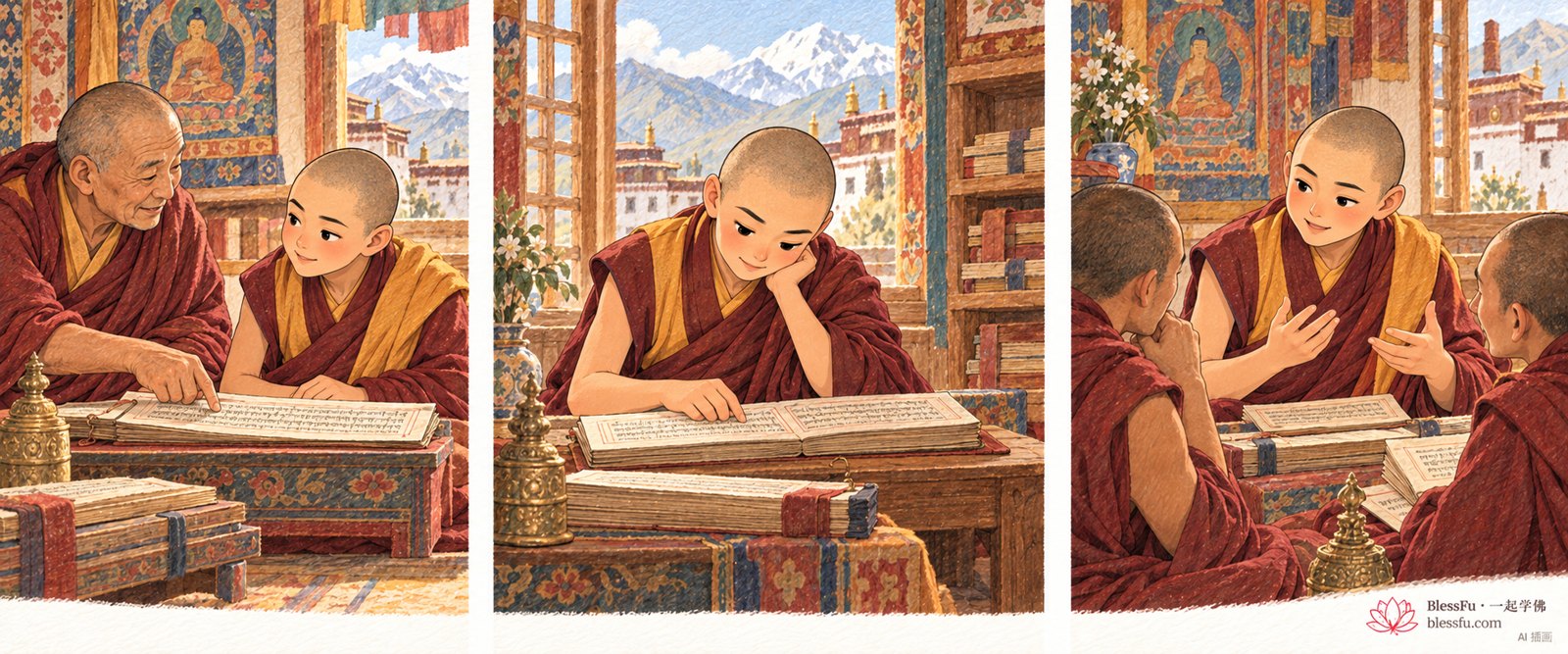
Tsongkhapa lived in the fourteenth and fifteenth centuries and is closely associated with the beginnings of the Gelug tradition. He studied in Amdo, then travelled to central Tibet to learn from teachers of different traditions. These three pictures imagine scenes of learning.
His studies included reading, listening to explanations and debate. His biography also describes asking for teaching again on texts he had already studied. Could hearing something again, or thinking from another angle, reveal something we missed?
He later wrote and taught, connecting learning with practice. We do not have to learn everything at once. Choose one question that matters to you. Explain your current idea, look for a trustworthy source and try telling a family member. Keep asking about what is still unclear.
Think together
Listening, reflection and practice allow understanding to deepen. Tsongkhapa’s learning from different teachers invites serious inquiry and respect for other traditions. Remembering a term is a beginning. We can also explore its meaning and everyday connections.
- Does asking about the same passage again mean someone is a poor learner?
- How could you tell that you remember words but do not yet understand them?
Try an activity
Make a “My little question” sheet. Draw or write a question, your current idea and someone you could ask. Find an age-appropriate source with an adult, then explain it in your own words.
Take it home
Choose a word from earlier lessons, such as compassion, contentment or cooperation. Tell a family member an everyday example and listen to their ideas.
For adults: read-aloud script and guidance
Based on the study sections of Tsongkhapa biographies. Extraordinary accounts are not standards children must meet. Avoid excessive memorisation or loss of sleep. Pictures are imagined scenes, not historical photographs. Questions are BlessFu teaching material, not quotations from Tsongkhapa.
Nine-slide lesson outline
1. Tsongkhapa: Learning a Little Deeper
Learn together, one small step.
Meet Tsongkhapa as a learner and choose a question to explore.
We met fables, scriptural stories and teachers. We finish with someone who kept learning.
2. Look closely
Does knowing words by heart mean fully understanding them?
We met fables, scriptural stories and teachers. We finish with someone who kept learning.
Does knowing words by heart mean fully understanding them?
3. Story 1 / 3
Tsongkhapa lived in the fourteenth and fifteenth centuries and is closely associated with the beginnings of the Gelug tradition. He studied in Amdo, then travelled to central Tibet to learn from teachers of different traditions. These three pictures imagine scenes of learning.
Tsongkhapa lived in the fourteenth and fifteenth centuries and is closely associated with the beginnings of the Gelug tradition. He studied in Amdo, then travelled to central Tibet to learn from teachers of different traditions. These three pictures imagine scenes of learning.
4. Story 2 / 3
His studies included reading, listening to explanations and debate. His biography also describes asking for teaching again on texts he had already studied. Could hearing something again, or thinking from another angle, reveal something we missed?
His studies included reading, listening to explanations and debate. His biography also describes asking for teaching again on texts he had already studied. Could hearing something again, or thinking from another angle, reveal something we missed?
5. Story 3 / 3
He later wrote and taught, connecting learning with practice. We do not have to learn everything at once. Choose one question that matters to you. Explain your current idea, look for a trustworthy source and try telling a family member. Keep asking about what is still unclear.
He later wrote and taught, connecting learning with practice. We do not have to learn everything at once. Choose one question that matters to you. Explain your current idea, look for a trustworthy source and try telling a family member. Keep asking about what is still unclear.
6. A Buddhist idea
Learning can deepen
with respect for other traditions.
Listening, reflection and practice allow understanding to deepen. Tsongkhapa’s learning from different teachers invites serious inquiry and respect for other traditions. Remembering a term is a beginning. We can also explore its meaning and everyday connections.
7. Talk together
Does asking about the same passage again mean someone is a poor learner?
How could you tell that you remember words but do not yet understand them?
Listen to different answers. Ask why. Children may discuss the characters rather than private experiences.
8. Try an activity
Make a “My little question” sheet.
Make a “My little question” sheet. Draw or write a question, your current idea and someone you could ask. Find an age-appropriate source with an adult, then explain it in your own words.
Choose a word from earlier lessons, such as compassion, contentment or cooperation. Tell a family member an everyday example and listen to their ideas.
9. For grown-ups
Read aloud, discuss and try a small activity.
Stories and exercises: BlessFu
Illustrations: AI-assisted
Full references and guidance are in the companion booklet.
Based on the study sections of Tsongkhapa biographies. Extraordinary accounts are not standards children must meet. Avoid excessive memorisation or loss of sleep. Pictures are imagined scenes, not historical photographs. Questions are BlessFu teaching material, not quotations from Tsongkhapa.
Next, we meet buddhas, bodhisattvas, teachers and the four major Tibetan traditions.
Story and references
Source: Alexander Berzin, The Life of Tsongkhapa, Study Buddhism; Joona Repo, Tsongkhapa, Treasury of Lives (2011). Only dates and the broad course of study, learning across traditions and continuing inquiry are used. No miracles are retold. Illustrations and children’s questions are original teaching design, not quotations.
https://studybuddhism.com/en/tibetan-buddhism/spiritual-teachers/tsongkhapa/the-life-of-tsongkhapa
Next, we meet buddhas, bodhisattvas, teachers and the four major Tibetan traditions.