
Avalokiteshvara: Listen and Care
Recognize a theme of compassion and ask before helping.
Watch lesson 32
Open the full image, then touch and hold to save on a phone, or right-click and save on a computer.
Let’s begin
We explored different names. Now meet a bodhisattva often shown in Buddhist art.
If someone sits alone, do we know what they need?
Story time
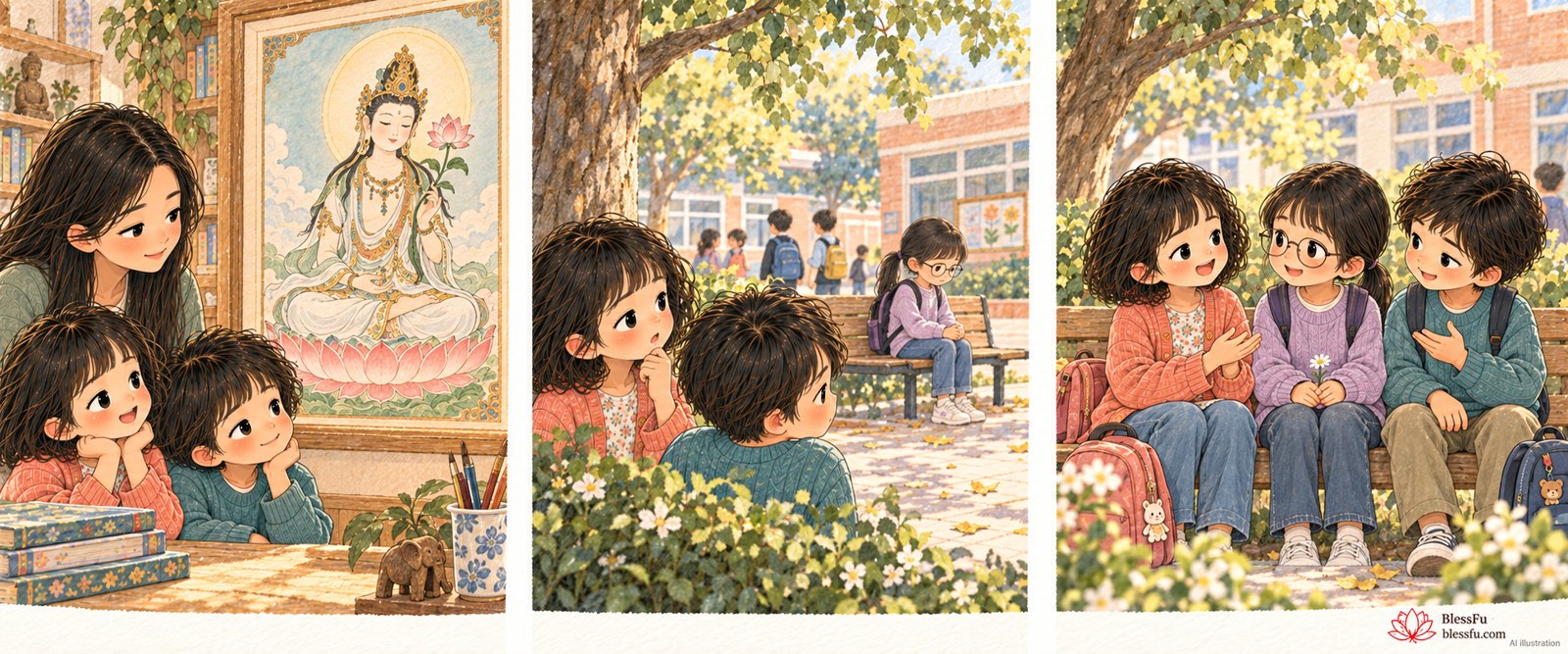
Xiaohe and her brother look at a picture of Avalokiteshvara holding a lotus. Mum says, “In Chinese, this bodhisattva is called Guanyin; in Tibetan, Chenrezig. There are different forms, including two and four arms. This lotus-holding picture introduces compassion.”
After school, a new classmate with glasses sits alone on a bench. Xiaohe’s brother wants to pull her into a game. “Let us ask first,” Xiaohe suggests. “Would you like company, or a little quiet time?” She waits, giving her space to answer.
“I would like to talk. I do not know everyone yet,” she says. The three sit together. Xiaohe listens as she describes her favourite books. Caring can begin with something small: notice a person, hear what they need, then offer suitable help.
Think together
Avalokiteshvara is closely associated with compassion in Buddhist art and devotion. This lesson connects that theme with everyday listening. Being alone does not always mean being unhappy. A gentle question can check our guess, and the answer may be no.
- What if the classmate wants some quiet time?
- What helps someone feel listened to?
Try an activity
Draw an ear and a pair of hands: first ask, then help. Role-play two situations: wanting to borrow pencils and wanting to draw quietly. Ask about each need and accept the answer.
Take it home
Ask a family member, “Would you like help or company?” Accept it if they do not need either.
For adults: read-aloud script and guidance
The lotus-holder is a traditional form; this AI teaching illustration is not an icon-making template. Story and dialogue are original. There are no promises of miracles or chanting effects. Practise with family or familiar peers, not unfamiliar adults.
Nine-slide lesson outline
1. Avalokiteshvara: Listen and Care
Learn together, one small step.
Recognize a theme of compassion and ask before helping.
We explored different names. Now meet a bodhisattva often shown in Buddhist art.
2. Look closely
If someone sits alone, do we know what they need?
We explored different names. Now meet a bodhisattva often shown in Buddhist art.
If someone sits alone, do we know what they need?
3. Story 1 / 3
Xiaohe and her brother look at a picture of Avalokiteshvara holding a lotus. Mum says, “In Chinese, this bodhisattva is called Guanyin; in Tibetan, Chenrezig. There are different forms, including two and four arms. This lotus-holding picture introduces compassion.”
Xiaohe and her brother look at a picture of Avalokiteshvara holding a lotus. Mum says, “In Chinese, this bodhisattva is called Guanyin; in Tibetan, Chenrezig. There are different forms, including two and four arms. This lotus-holding picture introduces compassion.”
4. Story 2 / 3
After school, a new classmate with glasses sits alone on a bench. Xiaohe’s brother wants to pull her into a game. “Let us ask first,” Xiaohe suggests. “Would you like company, or a little quiet time?” She waits, giving her space to answer.
After school, a new classmate with glasses sits alone on a bench. Xiaohe’s brother wants to pull her into a game. “Let us ask first,” Xiaohe suggests. “Would you like company, or a little quiet time?” She waits, giving her space to answer.
5. Story 3 / 3
“I would like to talk. I do not know everyone yet,” she says. The three sit together. Xiaohe listens as she describes her favourite books. Caring can begin with something small: notice a person, hear what they need, then offer suitable help.
“I would like to talk. I do not know everyone yet,” she says. The three sit together. Xiaohe listens as she describes her favourite books. Caring can begin with something small: notice a person, hear what they need, then offer suitable help.
6. A Buddhist idea
Care listens to needs
instead of deciding for others.
Avalokiteshvara is closely associated with compassion in Buddhist art and devotion. This lesson connects that theme with everyday listening. Being alone does not always mean being unhappy. A gentle question can check our guess, and the answer may be no.
7. Talk together
What if the classmate wants some quiet time?
What helps someone feel listened to?
Listen to different answers. Ask why. Children may discuss the characters rather than private experiences.
8. Try an activity
Draw a two-step “ask, then help” card.
Draw an ear and a pair of hands: first ask, then help. Role-play two situations: wanting to borrow pencils and wanting to draw quietly. Ask about each need and accept the answer.
Ask a family member, “Would you like help or company?” Accept it if they do not need either.
9. For grown-ups
Read aloud, discuss and try a small activity.
Stories and exercises: BlessFu
Illustrations: AI-assisted
Full references and guidance are in the companion booklet.
The lotus-holder is a traditional form; this AI teaching illustration is not an icon-making template. Story and dialogue are original. There are no promises of miracles or chanting effects. Practise with family or familiar peers, not unfamiliar adults.
Next, Manjushri helps us talk about wisdom.
Story and references
Himalayan Art Resources, Avalokiteshvara, item 399: compassion and surrounding lotus-holder figures. Names and iconographic theme only; no collection image copied. This lesson uses a two-armed lotus-holder. All illustrations are AI-assisted educational images, not historical photographs, formal iconographic templates or ritual instructions. Sources checked 2026-09-15.
Next, Manjushri helps us talk about wisdom.