
Manjushri: Ask and Look Again
Explore a wisdom symbol and distinguish observation from a guess.
Watch lesson 33
Open the full image, then touch and hold to save on a phone, or right-click and save on a computer.
Let’s begin
Listening helps us care. Curiosity can also help us see clearly.
Does one round stone prove that every stone is round?
Story time
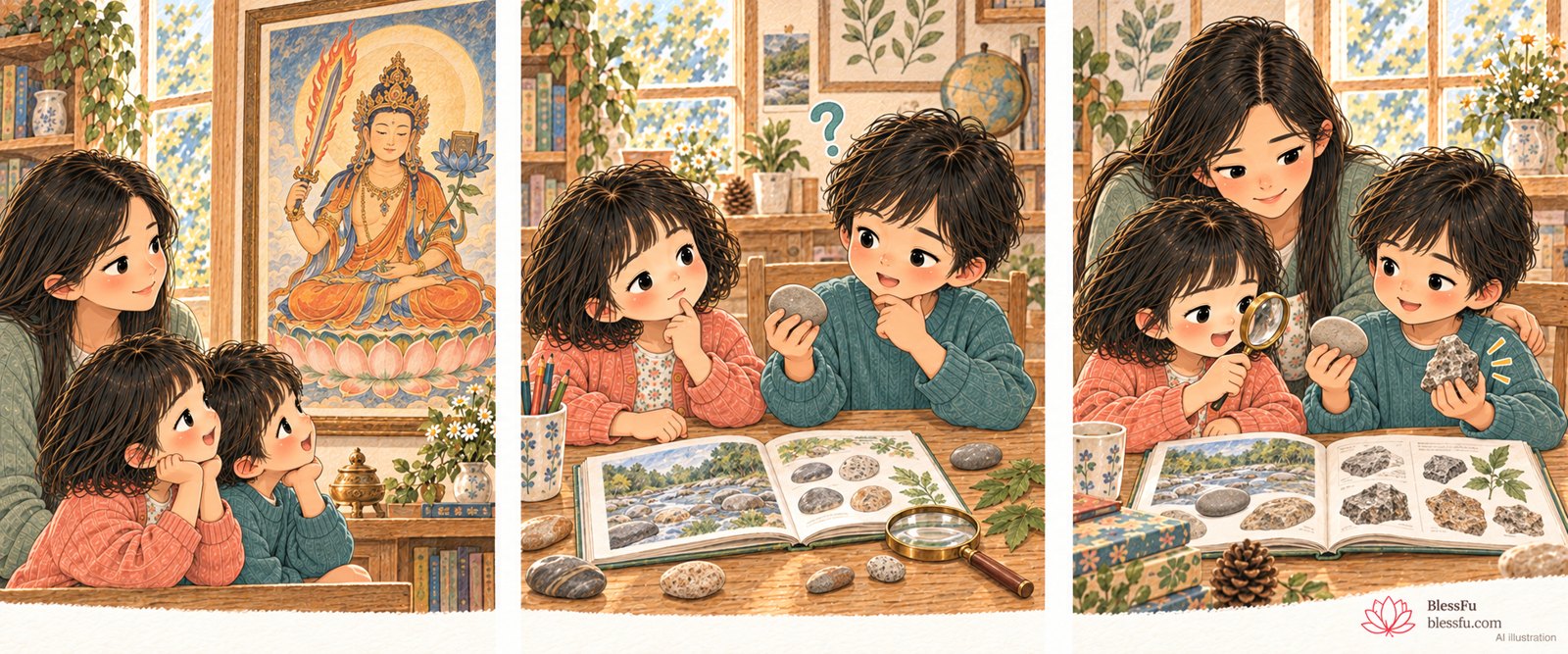
In the picture, Manjushri holds a sword, and a book rests on a lotus. “Why a sword?” the boy asks. Mum explains, “Here it represents wisdom cutting through ignorance. The book also relates to wisdom. The picture is not telling us to use weapons.”
The boy picks up a smooth stone. “All stones must be round!” Xiaohe does not laugh. She writes it as a guess. “Shall we look at some others?” They find a nature book and another stone with rough, angular edges.
Under the magnifying glass, the edges look different. “Some stones are round, and some are not. I had only looked at one,” the boy says. Mum smiles. New evidence can help us change our minds. They name their notebook: Ask, Then Look.
Think together
Manjushri represents wisdom. Buddhist wisdom reaches deeper than comparing objects; this is a small introductory exercise. Separate what you observe from what you guess. It is fine to be uncertain. Reasons help more than simply shouting, “I am right!”
- What helped the boy change his idea?
- What can we say before we have enough evidence?
Try an activity
Draw two differently shaped stones and two boxes: “I observed” and “I guessed.” Put one observation and one guess in the boxes. An adult may write for you.
Take it home
Find two fallen leaves. Describe one visible similarity and one difference, then ask a question you cannot yet answer.
For adults: read-aloud script and guidance
Symbol explanations refer to museum descriptions; the family story is original. Keep the sword within the picture: no weapon play or fire experiments. Observation is an introductory exercise, not a realization of emptiness. Avoid ranking children by cleverness or exam results.
Nine-slide lesson outline
1. Manjushri: Ask and Look Again
Learn together, one small step.
Explore a wisdom symbol and distinguish observation from a guess.
Listening helps us care. Curiosity can also help us see clearly.
2. Look closely
Does one round stone prove that every stone is round?
Listening helps us care. Curiosity can also help us see clearly.
Does one round stone prove that every stone is round?
3. Story 1 / 3
In the picture, Manjushri holds a sword, and a book rests on a lotus. “Why a sword?” the boy asks. Mum explains, “Here it represents wisdom cutting through ignorance. The book also relates to wisdom. The picture is not telling us to use weapons.”
In the picture, Manjushri holds a sword, and a book rests on a lotus. “Why a sword?” the boy asks. Mum explains, “Here it represents wisdom cutting through ignorance. The book also relates to wisdom. The picture is not telling us to use weapons.”
4. Story 2 / 3
The boy picks up a smooth stone. “All stones must be round!” Xiaohe does not laugh. She writes it as a guess. “Shall we look at some others?” They find a nature book and another stone with rough, angular edges.
The boy picks up a smooth stone. “All stones must be round!” Xiaohe does not laugh. She writes it as a guess. “Shall we look at some others?” They find a nature book and another stone with rough, angular edges.
5. Story 3 / 3
Under the magnifying glass, the edges look different. “Some stones are round, and some are not. I had only looked at one,” the boy says. Mum smiles. New evidence can help us change our minds. They name their notebook: Ask, Then Look.
Under the magnifying glass, the edges look different. “Some stones are round, and some are not. I had only looked at one,” the boy says. Mum smiles. New evidence can help us change our minds. They name their notebook: Ask, Then Look.
6. A Buddhist idea
New evidence
can change an earlier idea.
Manjushri represents wisdom. Buddhist wisdom reaches deeper than comparing objects; this is a small introductory exercise. Separate what you observe from what you guess. It is fine to be uncertain. Reasons help more than simply shouting, “I am right!”
7. Talk together
What helped the boy change his idea?
What can we say before we have enough evidence?
Listen to different answers. Ask why. Children may discuss the characters rather than private experiences.
8. Try an activity
Draw what you observed and what you guessed.
Draw two differently shaped stones and two boxes: “I observed” and “I guessed.” Put one observation and one guess in the boxes. An adult may write for you.
Find two fallen leaves. Describe one visible similarity and one difference, then ask a question you cannot yet answer.
9. For grown-ups
Read aloud, discuss and try a small activity.
Stories and exercises: BlessFu
Illustrations: AI-assisted
Full references and guidance are in the companion booklet.
Symbol explanations refer to museum descriptions; the family story is original. Keep the sword within the picture: no weapon play or fire experiments. Observation is an introductory exercise, not a realization of emptiness. Avoid ranking children by cleverness or exam results.
Next, meet Tara and explore a small act of courage.
Story and references
Rubin Museum of Himalayan Art, Manjushri collection entry: wisdom and sword symbolism. The illustration does not reproduce that object; the observation story is original. All illustrations are AI-assisted educational images, not historical photographs, formal iconographic templates or ritual instructions. Sources checked 2026-09-15.
Next, meet Tara and explore a small act of courage.