
Tara: One Brave Little Step
Recognize Green Tara and try a safe, gentle act of care.
Watch lesson 34
Open the full image, then touch and hold to save on a phone, or right-click and save on a computer.
Let’s begin
Wisdom helps us think. What could a thoughtful next step look like?
Can we be a little nervous and still do something kind?
Story time
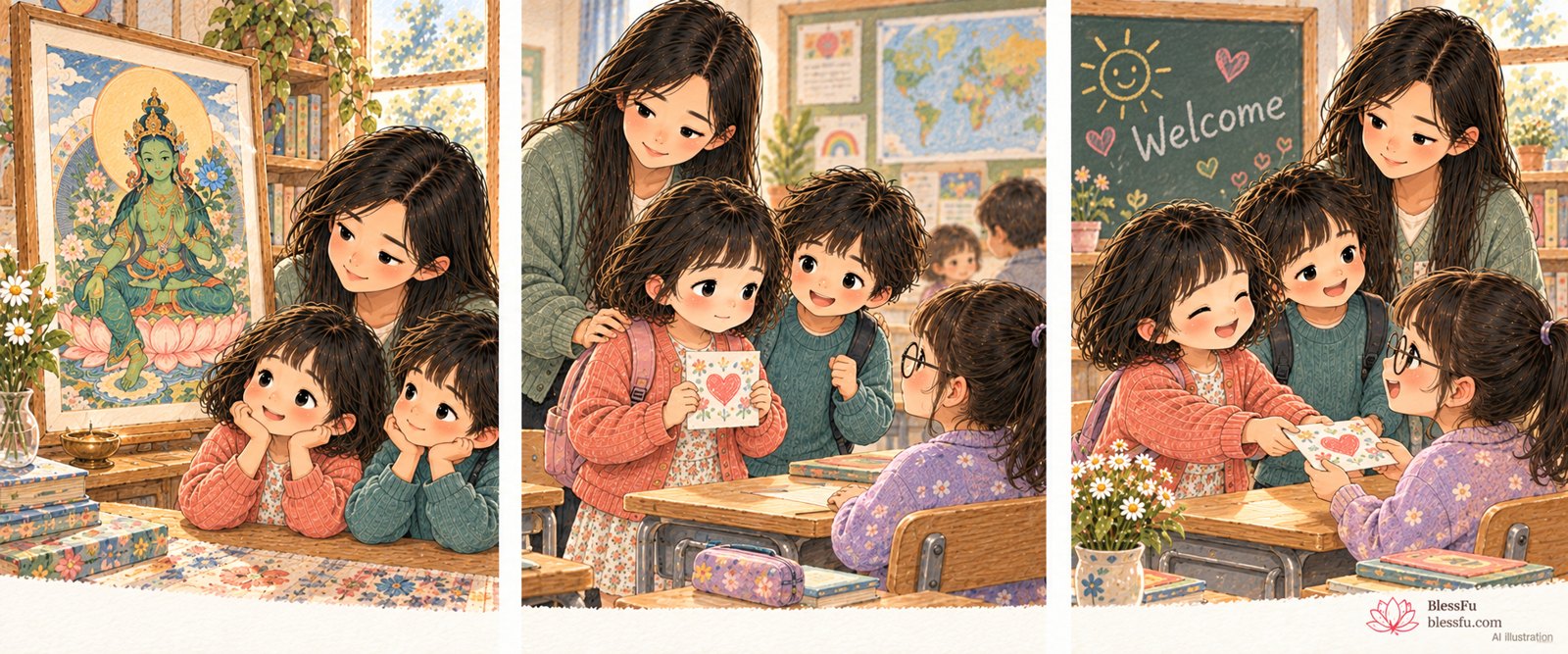
Mum and the children look at Green Tara: a green figure, a flower nearby, one leg extending down. “This is a familiar form of Green Tara,” Mum says. “We will use the picture to talk about caring action and courage.” It is an educational illustration, not an event happening now.
Xiaohe has drawn a welcome card for a new classmate. At the classroom, she feels nervous. “I do not know what to say.” Mum practises with her: “Hello, I am Xiaohe. Would you like this card?” Her brother says, “You can take your time.”
Xiaohe walks over and introduces herself gently. The classmate smiles and accepts the card. Courage need not be a grand gesture; it can be a polite greeting. If someone does not want to chat, she can also say, “That is okay. Maybe another time.”
Think together
Tara is widely revered in Tibetan Buddhism. Here the image introduces a simple exercise in courageous care. Courage does not mean never feeling afraid, and a religious image does not guarantee success. Even small actions need safety and respect for another person’s choice.
- Who helps Xiaohe when she feels nervous?
- Does bravery have to mean danger or a huge action?
Try an activity
Design a little welcome card and practise a greeting. You may begin with a toy. You can keep the card if you do not want to give it away.
Take it home
Try a safe small step: greet someone familiar or ask a family member to help you express a need. Share how it felt without comparing bravery.
For adults: read-aloud script and guidance
Pose reference: Himalayan Art Resources. This is cultural and character education, not deity visualization, empowerment or ritual instruction. It makes no disaster-prevention promise. Do not pressure a shy child to perform; watching or pausing is welcome.
Nine-slide lesson outline
1. Tara: One Brave Little Step
Learn together, one small step.
Recognize Green Tara and try a safe, gentle act of care.
Wisdom helps us think. What could a thoughtful next step look like?
2. Look closely
Can we be a little nervous and still do something kind?
Wisdom helps us think. What could a thoughtful next step look like?
Can we be a little nervous and still do something kind?
3. Story 1 / 3
Mum and the children look at Green Tara: a green figure, a flower nearby, one leg extending down. “This is a familiar form of Green Tara,” Mum says. “We will use the picture to talk about caring action and courage.” It is an educational illustration, not an event happening now.
Mum and the children look at Green Tara: a green figure, a flower nearby, one leg extending down. “This is a familiar form of Green Tara,” Mum says. “We will use the picture to talk about caring action and courage.” It is an educational illustration, not an event happening now.
4. Story 2 / 3
Xiaohe has drawn a welcome card for a new classmate. At the classroom, she feels nervous. “I do not know what to say.” Mum practises with her: “Hello, I am Xiaohe. Would you like this card?” Her brother says, “You can take your time.”
Xiaohe has drawn a welcome card for a new classmate. At the classroom, she feels nervous. “I do not know what to say.” Mum practises with her: “Hello, I am Xiaohe. Would you like this card?” Her brother says, “You can take your time.”
5. Story 3 / 3
Xiaohe walks over and introduces herself gently. The classmate smiles and accepts the card. Courage need not be a grand gesture; it can be a polite greeting. If someone does not want to chat, she can also say, “That is okay. Maybe another time.”
Xiaohe walks over and introduces herself gently. The classmate smiles and accepts the card. Courage need not be a grand gesture; it can be a polite greeting. If someone does not want to chat, she can also say, “That is okay. Maybe another time.”
6. A Buddhist idea
Courage can be small,
and care respects choice.
Tara is widely revered in Tibetan Buddhism. Here the image introduces a simple exercise in courageous care. Courage does not mean never feeling afraid, and a religious image does not guarantee success. Even small actions need safety and respect for another person’s choice.
7. Talk together
Who helps Xiaohe when she feels nervous?
Does bravery have to mean danger or a huge action?
Listen to different answers. Ask why. Children may discuss the characters rather than private experiences.
8. Try an activity
Draw a welcome card and try a gentle greeting.
Design a little welcome card and practise a greeting. You may begin with a toy. You can keep the card if you do not want to give it away.
Try a safe small step: greet someone familiar or ask a family member to help you express a need. Share how it felt without comparing bravery.
9. For grown-ups
Read aloud, discuss and try a small activity.
Stories and exercises: BlessFu
Illustrations: AI-assisted
Full references and guidance are in the companion booklet.
Pose reference: Himalayan Art Resources. This is cultural and character education, not deity visualization, empowerment or ritual instruction. It makes no disaster-prevention promise. Do not pressure a shy child to perform; watching or pausing is welcome.
Next, explore four Tibetan Buddhist traditions.
Story and references
Himalayan Art Resources, Tara, Green (Confusions): colour, gestures and posture. Everyday story and courage activity are original, not a scriptural narrative. All illustrations are AI-assisted educational images, not historical photographs, formal iconographic templates or ritual instructions. Sources checked 2026-09-15.
Next, explore four Tibetan Buddhist traditions.