
Eight Auspicious Patterns
Meet the eight names and explore the lotus and Dharma wheel.
Watch lesson 39
Open the full image, then touch and hold to save on a phone, or right-click and save on a computer.
Let’s begin
Looking slowly helps us discover art. Today we find a familiar group of patterns.
Can a pattern do more than look beautiful?
Story time
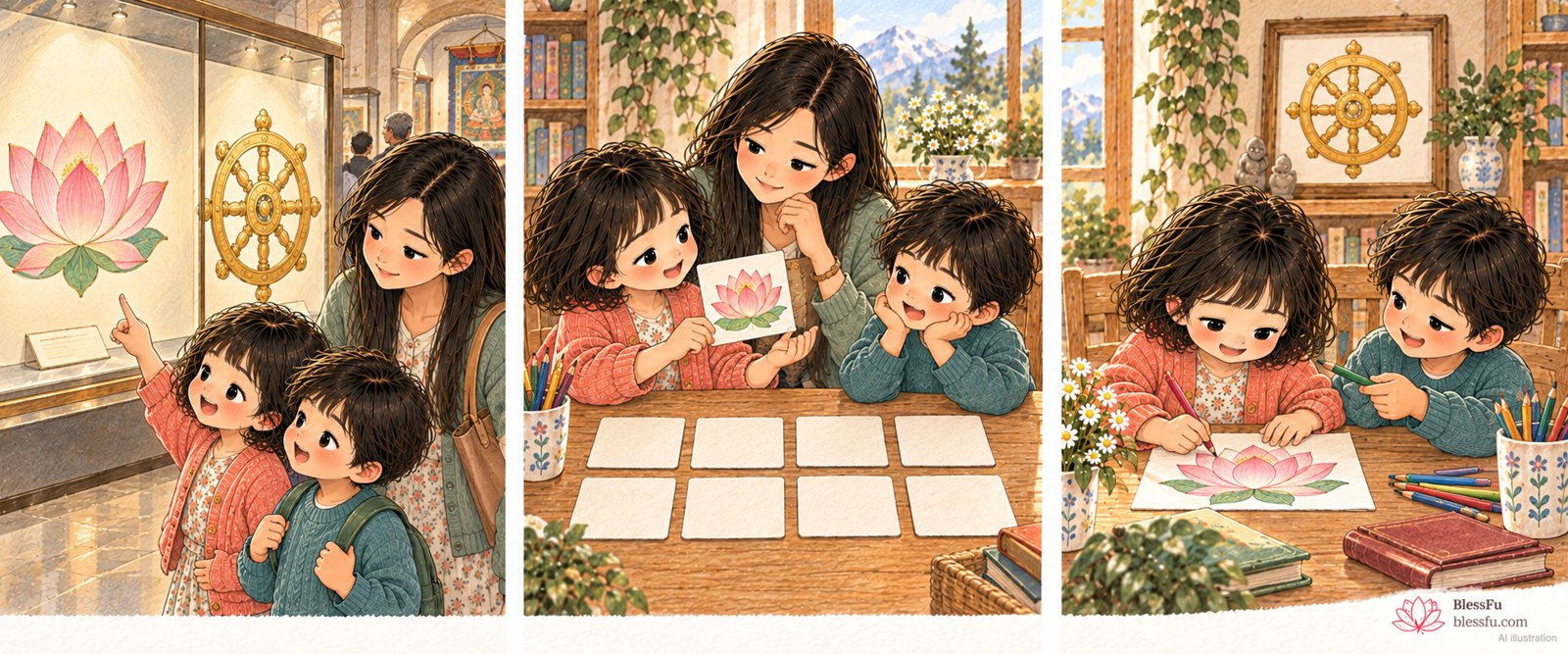
Xiaohe spots a lotus near a display. Her brother points to a golden wheel. “Is it like a car wheel?” Mum explains that this is a Dharma wheel. Both belong to the eight auspicious symbols. They begin with two instead of trying to memorize everything.
At home they prepare eight blank cards. Mum writes: parasol, golden fish, treasure vase, lotus, right-turning white conch, endless knot, victory banner and Dharma wheel. “May I start with the lotus?” Xiaohe asks. “Of course. We can study one carefully.”
While drawing, her brother offers a green pencil for the leaves. Mum says, “Traditional patterns have meanings. Sharing pencils is a kind action you choose.” Xiaohe adds a note: “A beautiful pattern can remind me to notice my actions.”
Think together
Brief pointers, not the only interpretations: parasol—shelter; fish—fearlessness; vase—abundance; lotus—purity; conch—Dharma sound; knot—wisdom and method together; banner—overcoming obstacles; wheel—Buddhist teaching. Owning or drawing a symbol does not guarantee good luck.
- Why begin with two symbols rather than memorize all eight?
- How is sharing a pencil different from drawing a pattern?
Try an activity
An adult writes the eight names on cards. Choose two and find their shapes in the reference catalogue. Draw a looking card for the lotus or wheel and name one kind action you want to try.
Take it home
Find a similar pattern in a book or decoration. Note where it appears before deciding what it represents.
For adults: read-aloud script and guidance
Names follow Himalayan Art Resources. Meaning pointers briefly summarize a traditional explanation published by FPMT; consult the source for context. Our illustration focuses on the lotus and wheel; blank cards invite writing. Symbols are not prizes or guarantees of luck.
Nine-slide lesson outline
1. Eight Auspicious Patterns
Learn together, one small step.
Meet the eight names and explore the lotus and Dharma wheel.
Looking slowly helps us discover art. Today we find a familiar group of patterns.
2. Look closely
Can a pattern do more than look beautiful?
Looking slowly helps us discover art. Today we find a familiar group of patterns.
Can a pattern do more than look beautiful?
3. Story 1 / 3
Xiaohe spots a lotus near a display. Her brother points to a golden wheel. “Is it like a car wheel?” Mum explains that this is a Dharma wheel. Both belong to the eight auspicious symbols. They begin with two instead of trying to memorize everything.
Xiaohe spots a lotus near a display. Her brother points to a golden wheel. “Is it like a car wheel?” Mum explains that this is a Dharma wheel. Both belong to the eight auspicious symbols. They begin with two instead of trying to memorize everything.
4. Story 2 / 3
At home they prepare eight blank cards. Mum writes: parasol, golden fish, treasure vase, lotus, right-turning white conch, endless knot, victory banner and Dharma wheel. “May I start with the lotus?” Xiaohe asks. “Of course. We can study one carefully.”
At home they prepare eight blank cards. Mum writes: parasol, golden fish, treasure vase, lotus, right-turning white conch, endless knot, victory banner and Dharma wheel. “May I start with the lotus?” Xiaohe asks. “Of course. We can study one carefully.”
5. Story 3 / 3
While drawing, her brother offers a green pencil for the leaves. Mum says, “Traditional patterns have meanings. Sharing pencils is a kind action you choose.” Xiaohe adds a note: “A beautiful pattern can remind me to notice my actions.”
While drawing, her brother offers a green pencil for the leaves. Mum says, “Traditional patterns have meanings. Sharing pencils is a kind action you choose.” Xiaohe adds a note: “A beautiful pattern can remind me to notice my actions.”
6. A Buddhist idea
Learn a little at a time.
Brief pointers, not the only interpretations: parasol—shelter; fish—fearlessness; vase—abundance; lotus—purity; conch—Dharma sound; knot—wisdom and method together; banner—overcoming obstacles; wheel—Buddhist teaching. Owning or drawing a symbol does not guarantee good luck.
7. Talk together
Why begin with two symbols rather than memorize all eight?
How is sharing a pencil different from drawing a pattern?
Listen to different answers. Ask why. Children may discuss the characters rather than private experiences.
8. Try an activity
Make two looking cards.
An adult writes the eight names on cards. Choose two and find their shapes in the reference catalogue. Draw a looking card for the lotus or wheel and name one kind action you want to try.
Find a similar pattern in a book or decoration. Note where it appears before deciding what it represents.
9. For grown-ups
Read aloud, discuss and try a small activity.
Stories and exercises: BlessFu
Illustrations: AI-assisted
Full references and guidance are in the companion booklet.
Names follow Himalayan Art Resources. Meaning pointers briefly summarize a traditional explanation published by FPMT; consult the source for context. Our illustration focuses on the lotus and wheel; blank cards invite writing. Symbols are not prizes or guarantees of luck.
Next, a khata introduces welcome and good wishes.
Story and references
Names: Himalayan Art Resources, Eight Auspicious Symbols. Meaning pointers: FPMT, The Eight Auspicious Signs, https://fpmt.org/mandala/archives/mandala-for-2014/july/eight-auspicious-signs/ . Brief paraphrase, not a translation; story and activity are original. AI-assisted teaching illustrations, not historical photographs, a real temple record or ritual instructions. Sources checked 2026-09-15.
Next, a khata introduces welcome and good wishes.