
What Is Inside a Thangka?
Recognize a thangka and separate observation from guesses.
Watch lesson 38
Open the full image, then touch and hold to save on a phone, or right-click and save on a computer.
Let’s begin
We practised observing and asking. Let us use both while looking at art.
Should we begin with “I notice” or “It must mean”?
Story time
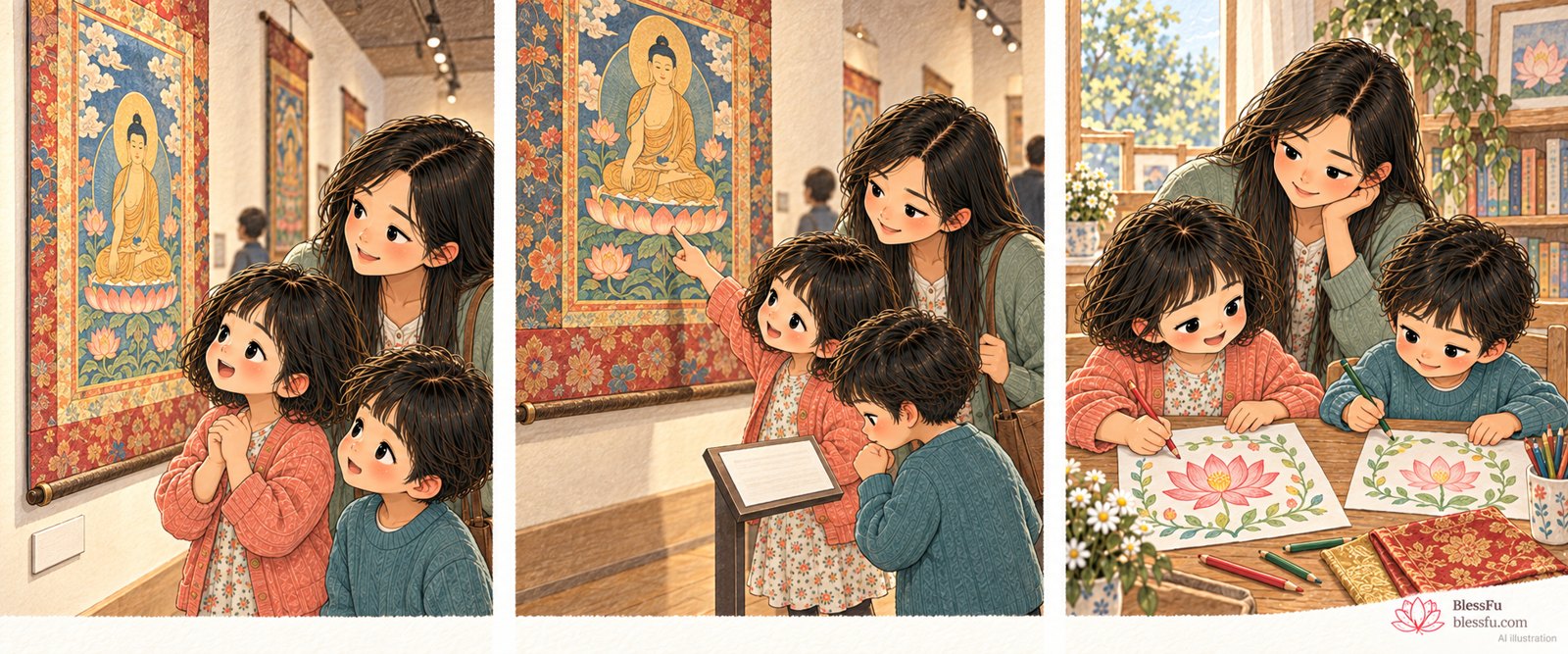
Xiaohe and her brother see a painting mounted in patterned fabric. Mum explains that a thangka is a Tibetan scroll painting, often on cloth; textile versions also exist. The boy notices the border and a Buddha seated at the centre of the picture.
“I see a lotus,” Xiaohe says. “Every leaf must hide a secret!” her brother adds. Mum smiles. “Let us read the label. What we see and what we guess are different.” They keep their hands away and step back to look at the whole painting.
At home, the children draw a lotus and invent a border of leaves. “My looking notes!” Xiaohe says. Mum agrees: “This is an observation and art exercise. It does not mean we have learned to make a traditional thangka.”
Think together
Thangkas can support religious learning and practice, and some address historical or medical subjects. Figures and arrangements often follow traditions. A colour or pattern cannot always be explained by guessing; use the title, context and a reliable guide.
- Which statement is an observation: seeing a lotus or guessing that every leaf hides a secret?
- Why look at the whole painting after a detail?
Try an activity
Make two columns: “I notice” and “I wonder.” Add two drawings or notes to each. Create an ordinary leaf border. Do not copy sacred syllables or label the exercise a traditional thangka.
Take it home
Find a caption in an art book with a family member. Look for title, material and date; leave a question mark where you are unsure.
For adults: read-aloud script and guidance
Preview the source before showing children its making-of-thangka material. Select suitable images and allow children to skip unsettling ones. Our simplified illustration does not reproduce a museum object. Do not judge a child’s drawing as a correct or incorrect sacred image.
Nine-slide lesson outline
1. What Is Inside a Thangka?
Learn together, one small step.
Recognize a thangka and separate observation from guesses.
We practised observing and asking. Let us use both while looking at art.
2. Look closely
Should we begin with “I notice” or “It must mean”?
We practised observing and asking. Let us use both while looking at art.
Should we begin with “I notice” or “It must mean”?
3. Story 1 / 3
Xiaohe and her brother see a painting mounted in patterned fabric. Mum explains that a thangka is a Tibetan scroll painting, often on cloth; textile versions also exist. The boy notices the border and a Buddha seated at the centre of the picture.
Xiaohe and her brother see a painting mounted in patterned fabric. Mum explains that a thangka is a Tibetan scroll painting, often on cloth; textile versions also exist. The boy notices the border and a Buddha seated at the centre of the picture.
4. Story 2 / 3
“I see a lotus,” Xiaohe says. “Every leaf must hide a secret!” her brother adds. Mum smiles. “Let us read the label. What we see and what we guess are different.” They keep their hands away and step back to look at the whole painting.
“I see a lotus,” Xiaohe says. “Every leaf must hide a secret!” her brother adds. Mum smiles. “Let us read the label. What we see and what we guess are different.” They keep their hands away and step back to look at the whole painting.
5. Story 3 / 3
At home, the children draw a lotus and invent a border of leaves. “My looking notes!” Xiaohe says. Mum agrees: “This is an observation and art exercise. It does not mean we have learned to make a traditional thangka.”
At home, the children draw a lotus and invent a border of leaves. “My looking notes!” Xiaohe says. Mum agrees: “This is an observation and art exercise. It does not mean we have learned to make a traditional thangka.”
6. A Buddhist idea
Look before guessing.
Thangkas can support religious learning and practice, and some address historical or medical subjects. Figures and arrangements often follow traditions. A colour or pattern cannot always be explained by guessing; use the title, context and a reliable guide.
7. Talk together
Which statement is an observation: seeing a lotus or guessing that every leaf hides a secret?
Why look at the whole painting after a detail?
Listen to different answers. Ask why. Children may discuss the characters rather than private experiences.
8. Try an activity
Make looking notes.
Make two columns: “I notice” and “I wonder.” Add two drawings or notes to each. Create an ordinary leaf border. Do not copy sacred syllables or label the exercise a traditional thangka.
Find a caption in an art book with a family member. Look for title, material and date; leave a question mark where you are unsure.
9. For grown-ups
Read aloud, discuss and try a small activity.
Stories and exercises: BlessFu
Illustrations: AI-assisted
Full references and guidance are in the companion booklet.
Preview the source before showing children its making-of-thangka material. Select suitable images and allow children to skip unsettling ones. Our simplified illustration does not reproduce a museum object. Do not judge a child’s drawing as a correct or incorrect sacred image.
Next, we meet eight auspicious patterns.
Story and references
Reference: Rubin Museum / Project Himalayan Art, The Making of a Thangka Painting and its medical-thangka introduction. Art-form facts only; story and exercises are original. No collection image is reproduced. AI-assisted teaching illustrations, not historical photographs, a real temple record or ritual instructions. Sources checked 2026-09-15.
Next, we meet eight auspicious patterns.