
A Khata and a Welcome
Learn what a khata is and express welcome and gratitude.
Watch lesson 40
Open the full image, then touch and hold to save on a phone, or right-click and save on a computer.
Let’s begin
Auspicious patterns appear in art and textiles. Today we meet a ceremonial scarf.
Does welcoming someone require an expensive gift?
Story time
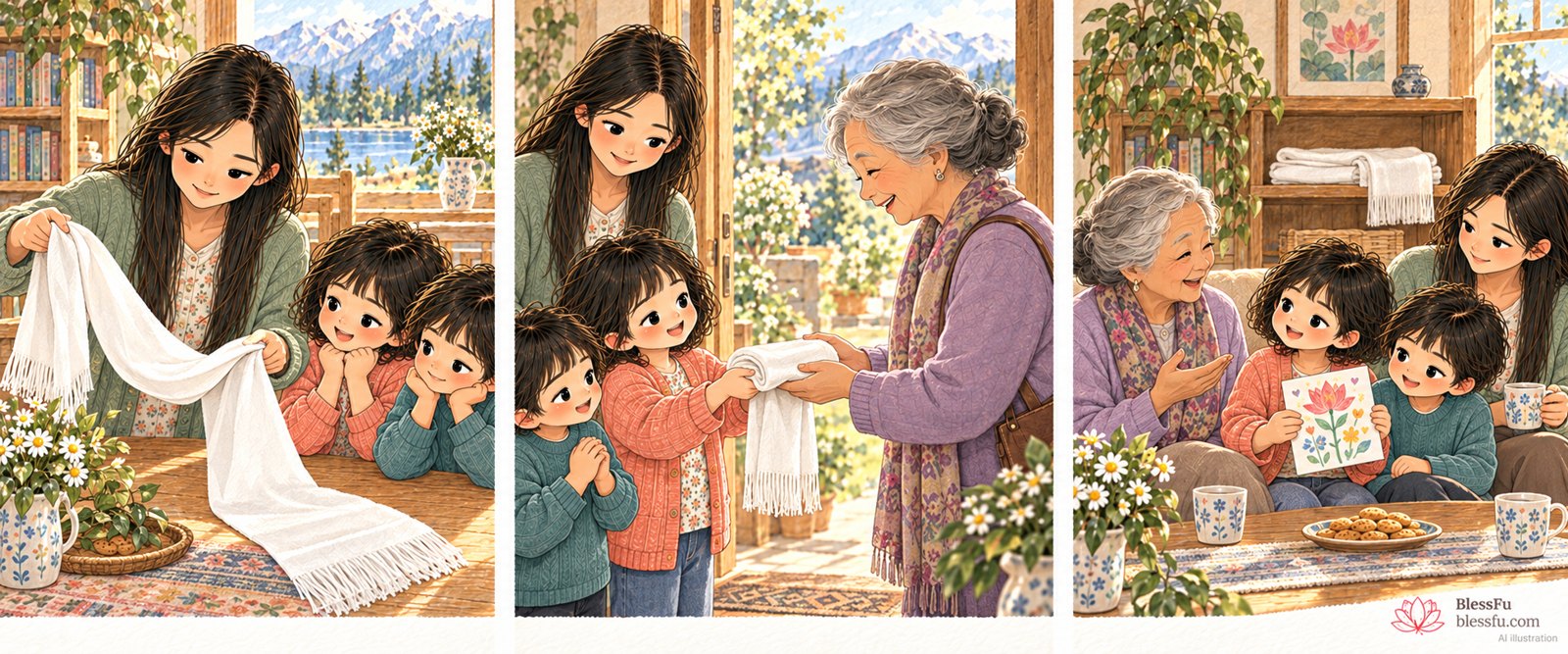
Mum opens a clean pale scarf with fringed ends. “This is a khata. It is often used in Tibetan culture to express respect, welcome and good wishes.” Xiaohe looks at her everyday scarf: similar shapes can have different uses.
An older family friend comes to visit. Mum explains their welcome and asks if the guest would like to receive it. With Mum beside her, Xiaohe offers the folded scarf with both hands. “Welcome. I wish you well.” The guest receives it warmly. This is not an exam.
Once they sit down, the children show a flower card they drew together. “Thank you for visiting.” Mum puts the scarf away carefully. Xiaohe discovers that gifts can express care, and so can sincere thanks and listening to a guest.
Think together
A khata is a ceremonial scarf, often white or ivory, with other colours and materials also used. Gestures vary by place, occasion and recipient. Ask someone familiar with local practice instead of treating one version as a rule for everyone.
- How could we welcome a guest without a khata?
- Why ask whether the guest wishes to take part?
Try an activity
Draw a long scarf and add a specific wish, such as “Have a safe journey.” Practise offering a paper card with both hands. No purchase is needed; do not tie fabric around a child’s neck.
Take it home
Welcome someone home with a sincere sentence and listen to how their day went.
For adults: read-aloud script and guidance
This invented family welcome is not a full demonstration of offering a khata to a teacher. Care for real scarves with sacred text or images respectfully; do not cut them up for crafts. Use a paper card for practice. Greeting someone is enough if they prefer not to participate.
Nine-slide lesson outline
1. A Khata and a Welcome
Learn together, one small step.
Learn what a khata is and express welcome and gratitude.
Auspicious patterns appear in art and textiles. Today we meet a ceremonial scarf.
2. Look closely
Does welcoming someone require an expensive gift?
Auspicious patterns appear in art and textiles. Today we meet a ceremonial scarf.
Does welcoming someone require an expensive gift?
3. Story 1 / 3
Mum opens a clean pale scarf with fringed ends. “This is a khata. It is often used in Tibetan culture to express respect, welcome and good wishes.” Xiaohe looks at her everyday scarf: similar shapes can have different uses.
Mum opens a clean pale scarf with fringed ends. “This is a khata. It is often used in Tibetan culture to express respect, welcome and good wishes.” Xiaohe looks at her everyday scarf: similar shapes can have different uses.
4. Story 2 / 3
An older family friend comes to visit. Mum explains their welcome and asks if the guest would like to receive it. With Mum beside her, Xiaohe offers the folded scarf with both hands. “Welcome. I wish you well.” The guest receives it warmly. This is not an exam.
An older family friend comes to visit. Mum explains their welcome and asks if the guest would like to receive it. With Mum beside her, Xiaohe offers the folded scarf with both hands. “Welcome. I wish you well.” The guest receives it warmly. This is not an exam.
5. Story 3 / 3
Once they sit down, the children show a flower card they drew together. “Thank you for visiting.” Mum puts the scarf away carefully. Xiaohe discovers that gifts can express care, and so can sincere thanks and listening to a guest.
Once they sit down, the children show a flower card they drew together. “Thank you for visiting.” Mum puts the scarf away carefully. Xiaohe discovers that gifts can express care, and so can sincere thanks and listening to a guest.
6. A Buddhist idea
A welcome can be simple.
A khata is a ceremonial scarf, often white or ivory, with other colours and materials also used. Gestures vary by place, occasion and recipient. Ask someone familiar with local practice instead of treating one version as a rule for everyone.
7. Talk together
How could we welcome a guest without a khata?
Why ask whether the guest wishes to take part?
Listen to different answers. Ask why. Children may discuss the characters rather than private experiences.
8. Try an activity
Draw a welcome scarf.
Draw a long scarf and add a specific wish, such as “Have a safe journey.” Practise offering a paper card with both hands. No purchase is needed; do not tie fabric around a child’s neck.
Welcome someone home with a sincere sentence and listen to how their day went.
9. For grown-ups
Read aloud, discuss and try a small activity.
Stories and exercises: BlessFu
Illustrations: AI-assisted
Full references and guidance are in the companion booklet.
This invented family welcome is not a full demonstration of offering a khata to a teacher. Care for real scarves with sacred text or images respectfully; do not cut them up for crafts. Use a paper card for practice. Greeting someone is enough if they prefer not to participate.
Next, prayer wheels and flags in the breeze.
Story and references
Reference: Kagyu Shenpen Kunchab Buddhist Center, How to Offer a Khata, for uses, materials and contextual etiquette. Respectful care also informed by FPMT, Showing Respect to Holy Objects. The family story does not reproduce the centre’s teacher-offering protocol. AI-assisted teaching illustrations, not historical photographs, a real temple record or ritual instructions. Sources checked 2026-09-15.
Next, prayer wheels and flags in the breeze.