
Prayer Wheels and Flags
Distinguish prayer wheels from flags and learn respectful observation.
Watch lesson 41
Open the full image, then touch and hold to save on a phone, or right-click and save on a computer.
Let’s begin
A khata can express good wishes. Other objects also hold a place in devotional life.
Is everything that moves a toy?
Story time
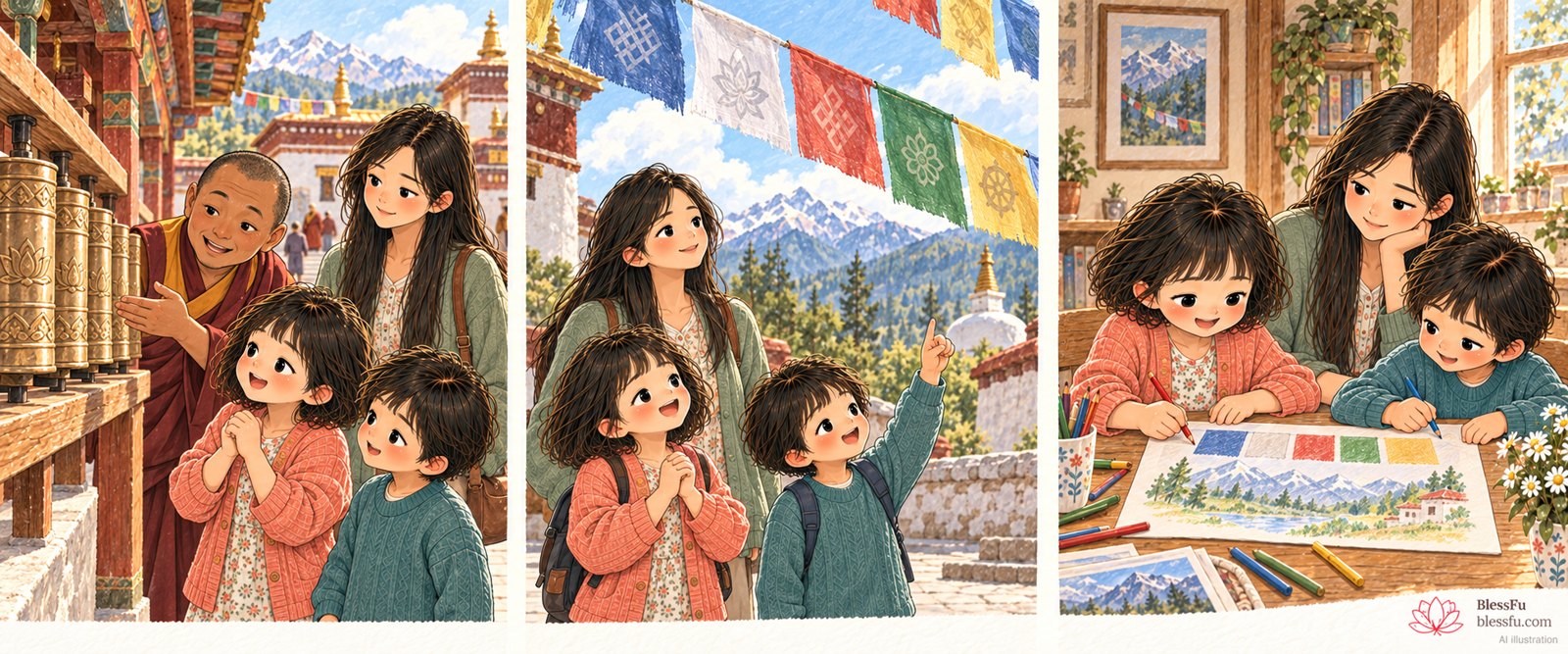
A row of bronze cylinders catches the boy’s eye. Before he reaches out, Mum asks the attendant. “These are prayer wheels. They usually contain mantras,” the attendant explains. The children listen rather than competing to spin them fastest.
Blue, white, red, green and yellow flags flutter above. Mum explains that prayer flags often carry prayers or mantras and images, and have a devotional purpose. “They are more than colourful decorations,” Xiaohe says. They stay on the ground and do not pull the flags.
At home they draw the courtyard, wind and five colours. Mum says, “This is a picture of our visit, not a traditional prayer flag.” Her brother wishes everyone safety. Xiaohe adds, “We can also begin by not pushing other people.”
Think together
Prayer wheels are rotating objects containing mantras. Prayer flags are printed cloth, with horizontal and vertical forms. Neither is simply a toy or party decoration. Learn their devotional meaning without promising control over weather, illness or exam results.
- What can we do before touching an unfamiliar religious object?
- Which small action could accompany a wish for safety?
Try an activity
Make two drawing areas: a prayer wheel and prayer flags. Notice their different shapes, then draw the wind. Use ordinary paper, not real sacred texts; do not open a prayer wheel.
Take it home
Choose a wish and a matching action. For example, wish people safety and pause at a doorway to let someone pass.
For adults: read-aloud script and guidance
This is cultural education, not instruction in filling wheels, choosing ritual dates or chanting. Ask permission and seek local guidance before using a wheel. Children should not climb or swing heavy objects. Leave care of old sacred flags to knowledgeable adults; no burning activity.
Nine-slide lesson outline
1. Prayer Wheels and Flags
Learn together, one small step.
Distinguish prayer wheels from flags and learn respectful observation.
A khata can express good wishes. Other objects also hold a place in devotional life.
2. Look closely
Is everything that moves a toy?
A khata can express good wishes. Other objects also hold a place in devotional life.
Is everything that moves a toy?
3. Story 1 / 3
A row of bronze cylinders catches the boy’s eye. Before he reaches out, Mum asks the attendant. “These are prayer wheels. They usually contain mantras,” the attendant explains. The children listen rather than competing to spin them fastest.
A row of bronze cylinders catches the boy’s eye. Before he reaches out, Mum asks the attendant. “These are prayer wheels. They usually contain mantras,” the attendant explains. The children listen rather than competing to spin them fastest.
4. Story 2 / 3
Blue, white, red, green and yellow flags flutter above. Mum explains that prayer flags often carry prayers or mantras and images, and have a devotional purpose. “They are more than colourful decorations,” Xiaohe says. They stay on the ground and do not pull the flags.
Blue, white, red, green and yellow flags flutter above. Mum explains that prayer flags often carry prayers or mantras and images, and have a devotional purpose. “They are more than colourful decorations,” Xiaohe says. They stay on the ground and do not pull the flags.
5. Story 3 / 3
At home they draw the courtyard, wind and five colours. Mum says, “This is a picture of our visit, not a traditional prayer flag.” Her brother wishes everyone safety. Xiaohe adds, “We can also begin by not pushing other people.”
At home they draw the courtyard, wind and five colours. Mum says, “This is a picture of our visit, not a traditional prayer flag.” Her brother wishes everyone safety. Xiaohe adds, “We can also begin by not pushing other people.”
6. A Buddhist idea
Moving objects are not always toys.
Prayer wheels are rotating objects containing mantras. Prayer flags are printed cloth, with horizontal and vertical forms. Neither is simply a toy or party decoration. Learn their devotional meaning without promising control over weather, illness or exam results.
7. Talk together
What can we do before touching an unfamiliar religious object?
Which small action could accompany a wish for safety?
Listen to different answers. Ask why. Children may discuss the characters rather than private experiences.
8. Try an activity
Draw wheels and flags.
Make two drawing areas: a prayer wheel and prayer flags. Notice their different shapes, then draw the wind. Use ordinary paper, not real sacred texts; do not open a prayer wheel.
Choose a wish and a matching action. For example, wish people safety and pause at a doorway to let someone pass.
9. For grown-ups
Read aloud, discuss and try a small activity.
Stories and exercises: BlessFu
Illustrations: AI-assisted
Full references and guidance are in the companion booklet.
This is cultural education, not instruction in filling wheels, choosing ritual dates or chanting. Ask permission and seek local guidance before using a wheel. Children should not climb or swing heavy objects. Leave care of old sacred flags to knowledgeable adults; no burning activity.
Next, circles and squares in mandala art, and a reminder of change.
Story and references
Reference: FPMT, Resources on Holy Objects, Prayer Wheels and Prayer Flags sections. Basic form and purpose only; the visit and action exercise are original, without promises of ritual effects. AI-assisted teaching illustrations, not historical photographs, a real temple record or ritual instructions. Sources checked 2026-09-15.
Next, circles and squares in mandala art, and a reminder of change.