
Seven Days of Small Kindnesses
Choose manageable kind actions and use a record for reflection, not comparison.
Watch lesson 47
Open the full image, then touch and hold to save on a phone, or right-click and save on a computer.
Let’s begin
We practised pausing and noticing our choices. Now we make a gentle weekly plan.
Is a kindness record for winning or for remembering?
Story time
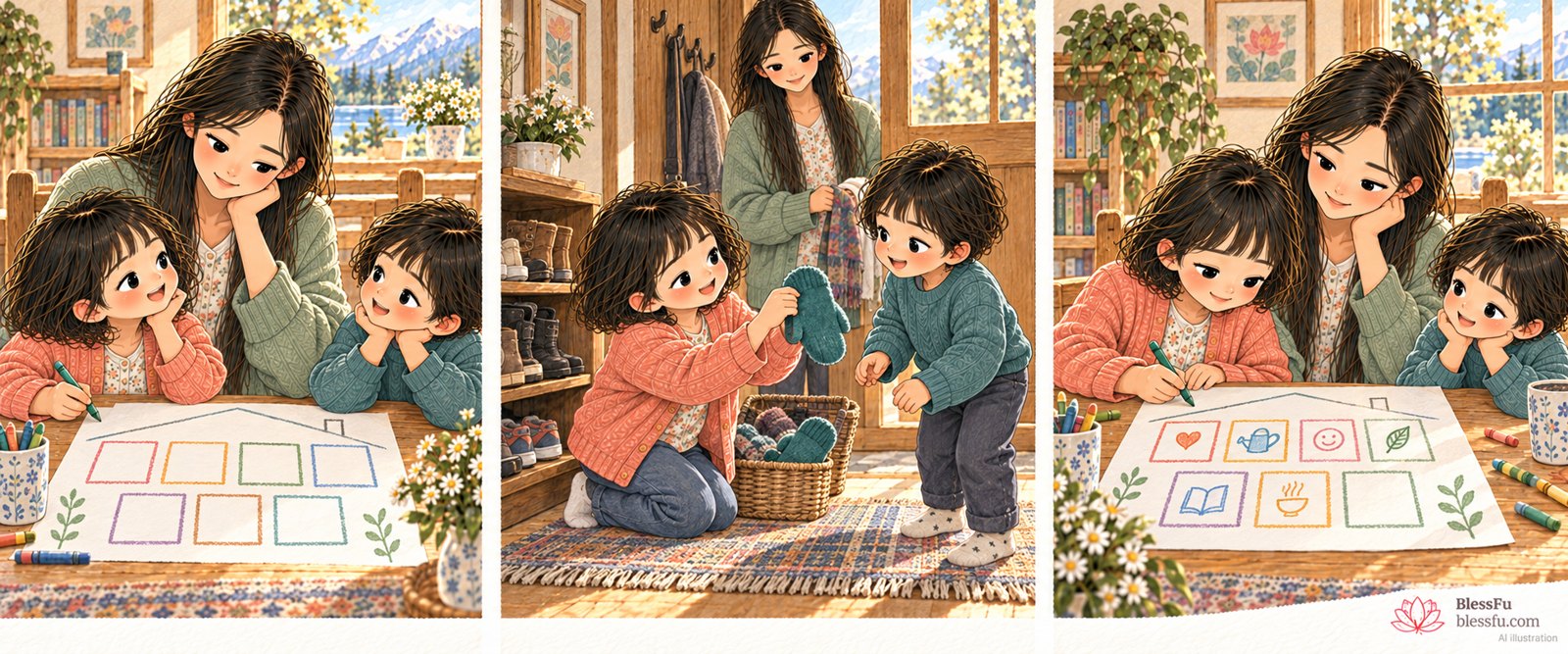
Xiaohe draws seven boxes. Mum does not fill them with assignments. She asks what the children would like to practise. Xiaohe chooses helping to find things, while her brother chooses putting away pencils. Each starts with a small action they want to try.
Before going out, the boy cannot find his mitten and feels upset. Xiaohe asks whether he wants help. Together they discover it beside the shoe basket. He feels relieved. Later Xiaohe draws a mitten to remember how she helped.
A few days later, one box is empty. “Did I fail?” Xiaohe asks. Mum explains that a blank can mean forgetting, resting or not yet recording. They discuss what could make next time easier and how their actions affected others. Nobody counts whose page has the most pictures.
Think together
Kindness involves intention, action and its effect on others. A record supports memory; it does not measure merit or prove one person is better. Plans can change when we are busy, unwell or forget. Honest reflection matters more than filling a box with something that never happened.
- Why ask before helping?
- What different things might an empty box mean?
Try an activity
Use the seven-box sheet to draw or write what you want to try and what happened. You may act, adjust or leave a blank. At the end, discuss one experience. No rankings or photographic proof are needed.
Take it home
Agree on one willing, useful action with your family. Ask whether help is wanted each time, and allow someone to decline.
For adults: read-aloud script and guidance
Do not turn this into rewards points or a merit leaderboard. Keep names and behaviour records private. Choose age-appropriate actions with familiar adult support, not helping strangers alone or taking adult responsibilities. Leave room for rest. Avoid labels such as “good children always help.” Seven days is simply a convenient period for noticing.
Nine-slide lesson outline
1. Seven Days of Small Kindnesses
Learn together, one small step.
Choose manageable kind actions and use a record for reflection, not comparison.
We practised pausing and noticing our choices. Now we make a gentle weekly plan.
2. Look closely
Is a kindness record for winning or for remembering?
We practised pausing and noticing our choices. Now we make a gentle weekly plan.
Is a kindness record for winning or for remembering?
3. Story 1 / 3
Xiaohe draws seven boxes. Mum does not fill them with assignments. She asks what the children would like to practise. Xiaohe chooses helping to find things, while her brother chooses putting away pencils. Each starts with a small action they want to try.
Xiaohe draws seven boxes. Mum does not fill them with assignments. She asks what the children would like to practise. Xiaohe chooses helping to find things, while her brother chooses putting away pencils. Each starts with a small action they want to try.
4. Story 2 / 3
Before going out, the boy cannot find his mitten and feels upset. Xiaohe asks whether he wants help. Together they discover it beside the shoe basket. He feels relieved. Later Xiaohe draws a mitten to remember how she helped.
Before going out, the boy cannot find his mitten and feels upset. Xiaohe asks whether he wants help. Together they discover it beside the shoe basket. He feels relieved. Later Xiaohe draws a mitten to remember how she helped.
5. Story 3 / 3
A few days later, one box is empty. “Did I fail?” Xiaohe asks. Mum explains that a blank can mean forgetting, resting or not yet recording. They discuss what could make next time easier and how their actions affected others. Nobody counts whose page has the most pictures.
A few days later, one box is empty. “Did I fail?” Xiaohe asks. Mum explains that a blank can mean forgetting, resting or not yet recording. They discuss what could make next time easier and how their actions affected others. Nobody counts whose page has the most pictures.
6. A Buddhist idea
Record to reflect, not rank.
Kindness involves intention, action and its effect on others. A record supports memory; it does not measure merit or prove one person is better. Plans can change when we are busy, unwell or forget. Honest reflection matters more than filling a box with something that never happened.
7. Talk together
Why ask before helping?
What different things might an empty box mean?
Listen to different answers. Ask why. Children may discuss the characters rather than private experiences.
8. Try an activity
Draw seven boxes for kind actions.
Blank days are okay. It is not a contest.
Use the seven-box sheet to draw or write what you want to try and what happened. You may act, adjust or leave a blank. At the end, discuss one experience. No rankings or photographic proof are needed.
Agree on one willing, useful action with your family. Ask whether help is wanted each time, and allow someone to decline.
9. For grown-ups
Read aloud, discuss and try a small activity.
Stories and exercises: BlessFu
Illustrations: AI-assisted
Full references and guidance are in the companion booklet.
Do not turn this into rewards points or a merit leaderboard. Keep names and behaviour records private. Choose age-appropriate actions with familiar adult support, not helping strangers alone or taking adult responsibilities. Leave room for rest. Avoid labels such as “good children always help.” Seven days is simply a convenient period for noticing.
In our final lesson, we look back at what learning has left with us.
Story and references
Themes of kindness and daily action: Foundation for Developing Compassion and Wisdom, 16 Guidelines for Life. The seven-box activity, mitten story and questions are original, not that organization’s curriculum or licensed material. Stories, dialogue and activities are original BlessFu writing, not scripture translations. AI-assisted teaching illustrations do not show a complete ritual. Sources checked 2026-09-15.
In our final lesson, we look back at what learning has left with us.