
A Comfortable Quiet Moment
Meet joined palms and recitation, and try a short, voluntary quiet pause.
Watch lesson 46
Open the full image, then touch and hold to save on a phone, or right-click and save on a computer.
Let’s begin
A pause before a meal helped us notice gratitude. Now we try sitting quietly for a moment.
Must we stay perfectly still and have no thoughts?
Story time
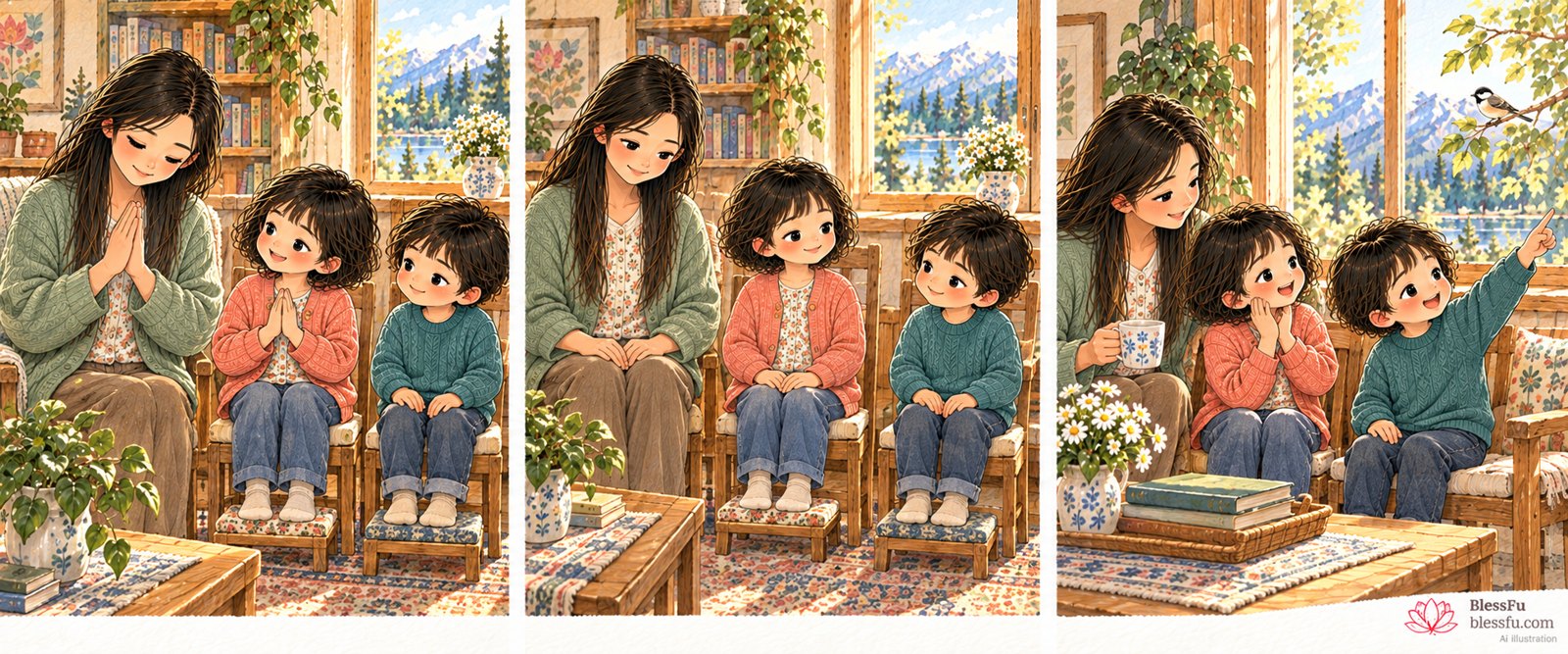
Mum gently joins her palms near her chest as a gesture of respect. Xiaohe wants to try. Her brother prefers his hands on his thighs. “That is fine,” Mum says. Those who wish may quietly recite a familiar Buddha name they understand; listening is also a choice.
They sit on stable chairs with their feet supported. Mum invites them to relax their shoulders and notice ordinary breathing. Xiaohe thinks about a toy, notices, and returns her attention. She does not hold her breath or scold herself for getting distracted.
After a short while, her brother points to a bird outside. “We are finished. What did you notice?” Mum asks. Xiaohe says she could return after getting distracted. Her brother wants to describe the bird. They listen to each other and carry on with their day.
Think together
Recitation can help recall Buddhist teachings, while quiet observation practises awareness. Beginning does not require high counts, special postures or unusual experiences. Noticing distraction and returning gently is part of learning. Children can join palms, listen, sit or choose not to participate.
- How does Mum respond to a different hand position?
- What does Xiaohe do after noticing distraction?
Try an activity
Choose listening, quietly saying a familiar Buddha name, or observing. Sit comfortably, with eyes naturally open if preferred. Try about thirty seconds to a minute and stop whenever needed. Noticing feet or sounds is an alternative to following breath.
Take it home
Choose a suitable moment for a short pause with a caregiver, then describe one thing noticed. Quiet time should not be a punishment.
For adults: read-aloud script and guidance
Adapt to age, willingness and comfort; shorten or skip. Keep breathing natural, without holding, forcing or accelerating it. No subtle-energy exercises or forced crossed legs. Stop if uncomfortable. An adult or teacher can explain a familiar Buddha name, such as Shakyamuni; learning a mantra is not required. No treatment claims or character scores based on sitting duration.
Nine-slide lesson outline
1. A Comfortable Quiet Moment
Learn together, one small step.
Meet joined palms and recitation, and try a short, voluntary quiet pause.
A pause before a meal helped us notice gratitude. Now we try sitting quietly for a moment.
2. Look closely
Must we stay perfectly still and have no thoughts?
A pause before a meal helped us notice gratitude. Now we try sitting quietly for a moment.
Must we stay perfectly still and have no thoughts?
3. Story 1 / 3
Mum gently joins her palms near her chest as a gesture of respect. Xiaohe wants to try. Her brother prefers his hands on his thighs. “That is fine,” Mum says. Those who wish may quietly recite a familiar Buddha name they understand; listening is also a choice.
Mum gently joins her palms near her chest as a gesture of respect. Xiaohe wants to try. Her brother prefers his hands on his thighs. “That is fine,” Mum says. Those who wish may quietly recite a familiar Buddha name they understand; listening is also a choice.
4. Story 2 / 3
They sit on stable chairs with their feet supported. Mum invites them to relax their shoulders and notice ordinary breathing. Xiaohe thinks about a toy, notices, and returns her attention. She does not hold her breath or scold herself for getting distracted.
They sit on stable chairs with their feet supported. Mum invites them to relax their shoulders and notice ordinary breathing. Xiaohe thinks about a toy, notices, and returns her attention. She does not hold her breath or scold herself for getting distracted.
5. Story 3 / 3
After a short while, her brother points to a bird outside. “We are finished. What did you notice?” Mum asks. Xiaohe says she could return after getting distracted. Her brother wants to describe the bird. They listen to each other and carry on with their day.
After a short while, her brother points to a bird outside. “We are finished. What did you notice?” Mum asks. Xiaohe says she could return after getting distracted. Her brother wants to describe the bird. They listen to each other and carry on with their day.
6. A Buddhist idea
Practise awareness, not a contest.
Recitation can help recall Buddhist teachings, while quiet observation practises awareness. Beginning does not require high counts, special postures or unusual experiences. Noticing distraction and returning gently is part of learning. Children can join palms, listen, sit or choose not to participate.
7. Talk together
How does Mum respond to a different hand position?
What does Xiaohe do after noticing distraction?
Listen to different answers. Ask why. Children may discuss the characters rather than private experiences.
8. Try an activity
Try a brief pause and share.
Choose listening, quietly saying a familiar Buddha name, or observing. Sit comfortably, with eyes naturally open if preferred. Try about thirty seconds to a minute and stop whenever needed. Noticing feet or sounds is an alternative to following breath.
Choose a suitable moment for a short pause with a caregiver, then describe one thing noticed. Quiet time should not be a punishment.
9. For grown-ups
Read aloud, discuss and try a small activity.
Stories and exercises: BlessFu
Illustrations: AI-assisted
Full references and guidance are in the companion booklet.
Adapt to age, willingness and comfort; shorten or skip. Keep breathing natural, without holding, forcing or accelerating it. No subtle-energy exercises or forced crossed legs. Stop if uncomfortable. An adult or teacher can explain a familiar Buddha name, such as Shakyamuni; learning a mantra is not required. No treatment claims or character scores based on sitting duration.
Next, we plan a week of small, chosen acts of kindness.
Story and references
Theme reference: Pam Cayton, Morning Intention and Breath Counting with Children, FPMT Mandala, particularly adapting to age and interest. The brief chair activity and family choices are original, not a reproduction of its classroom methods. Stories, dialogue and activities are original BlessFu writing, not scripture translations. AI-assisted teaching illustrations do not show a complete ritual. Sources checked 2026-09-15.
Next, we plan a week of small, chosen acts of kindness.