
Chakrasamvara
One of the three main yidams (meditational deities) of the Gelug school; the sacred Mount Kailash is regarded as his palace.
Watch the video
Who he is
Chakrasamvara's Sanskrit name is Cakrasaṃvara, meaning "Wheel of Supreme Bliss." In Tibetan he is called Demchok. He is the representative of "mother tantra" within Highest Yoga Tantra, the counterpart of Guhyasamaja, who represents "father tantra."
Many of Tibet's famous sacred mountains and holy places are connected with Chakrasamvara. The best known is Mount Kailash in Ngari. Buddhists regard it as Chakrasamvara's palace, and every year many people go there to walk the pilgrimage circuit around the mountain.
What he does
This is a yidam practiced by dedicated practitioners, not a figure to pray to for worldly things. For people who have not yet entered tantra, getting to know him and feeling respect for him is already a way of making a connection for future study and practice.
What people pray to him for
Traditionally, people pray to Chakrasamvara for:
- A good connection with tantra
- Complete merit from pilgrimage to sacred mountains and holy places
- The clearing away of obstacles to practice
Mantra
Traditionally, the mantra and practice of this yidam may be taken up only after receiving empowerment from a qualified teacher. They are not given here.
Story: The Twenty-Four Sacred Places
The story goes that in the distant past, Maheshvara and his retinue took over twenty-four places in the world. There they indulged in pleasure without limit and made sacrifices by killing, and the world fell into chaos.
So the Buddhas emanated as Chakrasamvara, in a form resembling Maheshvara. He subdued Maheshvara and turned those twenty-four places into sacred places for practice.
That is why images of Chakrasamvara always show him treading on two gods. This is not humiliation. It shows that pride and craving have been transformed into wisdom.
How to recognize him
- Blue body, most often with four faces and twelve arms; there is also a form with one face and two arms
- Embraces his red consort, Vajravarahi
- The two central hands cross behind the consort, holding a vajra and a bell
- Hair tied up in a high topknot, with a crescent moon on it
- The two hands at the back stretch out an elephant skin; he treads on two gods
The images
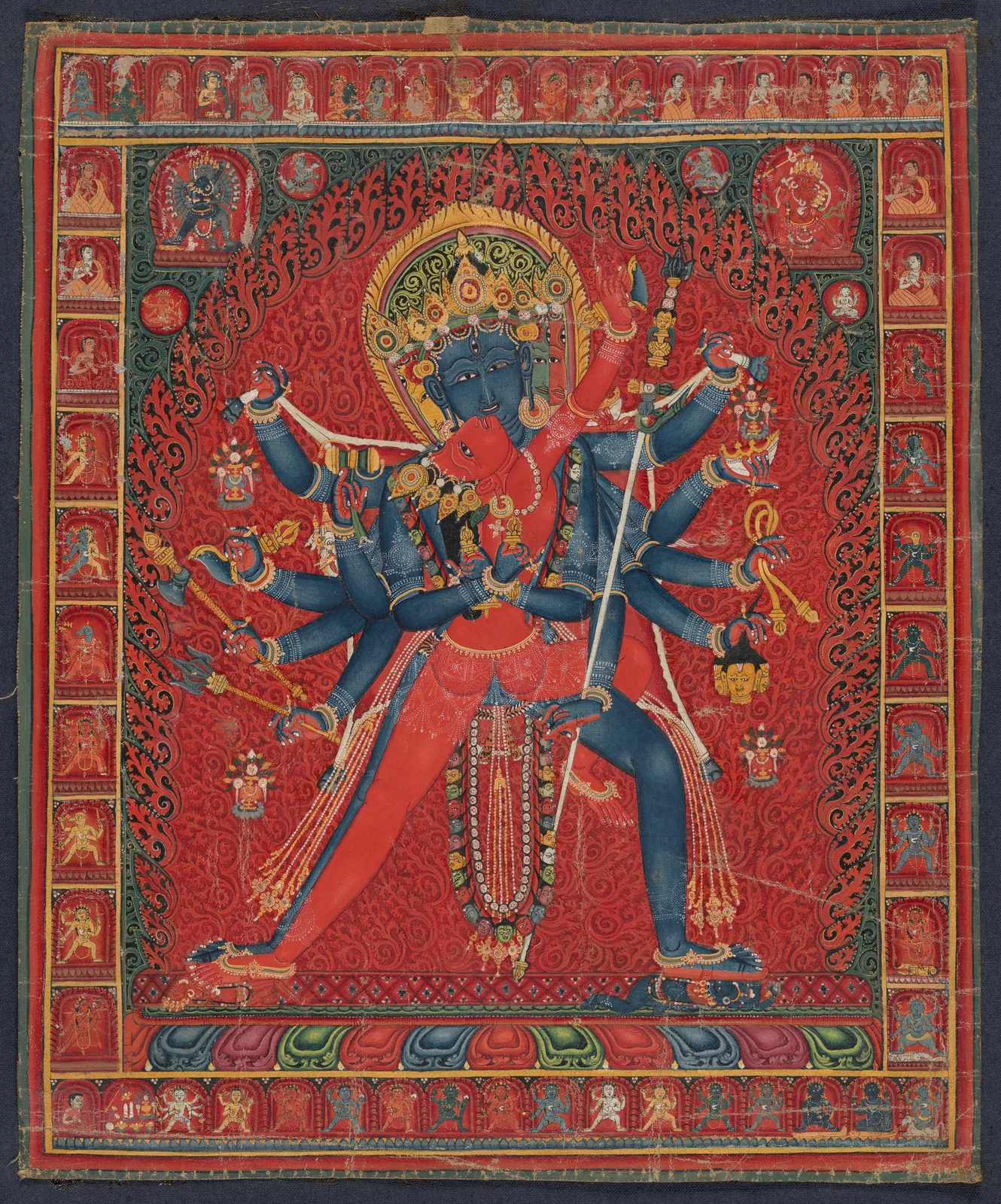
- Date: 1450–1500 (mid-Ming dynasty)
- Origin and medium: Central Tibet · thangka, distemper on cotton; Chakrasamvara and Vajravarahi
- Collection: The Metropolitan Museum of Art, accession no. 2017.371 · Public domain
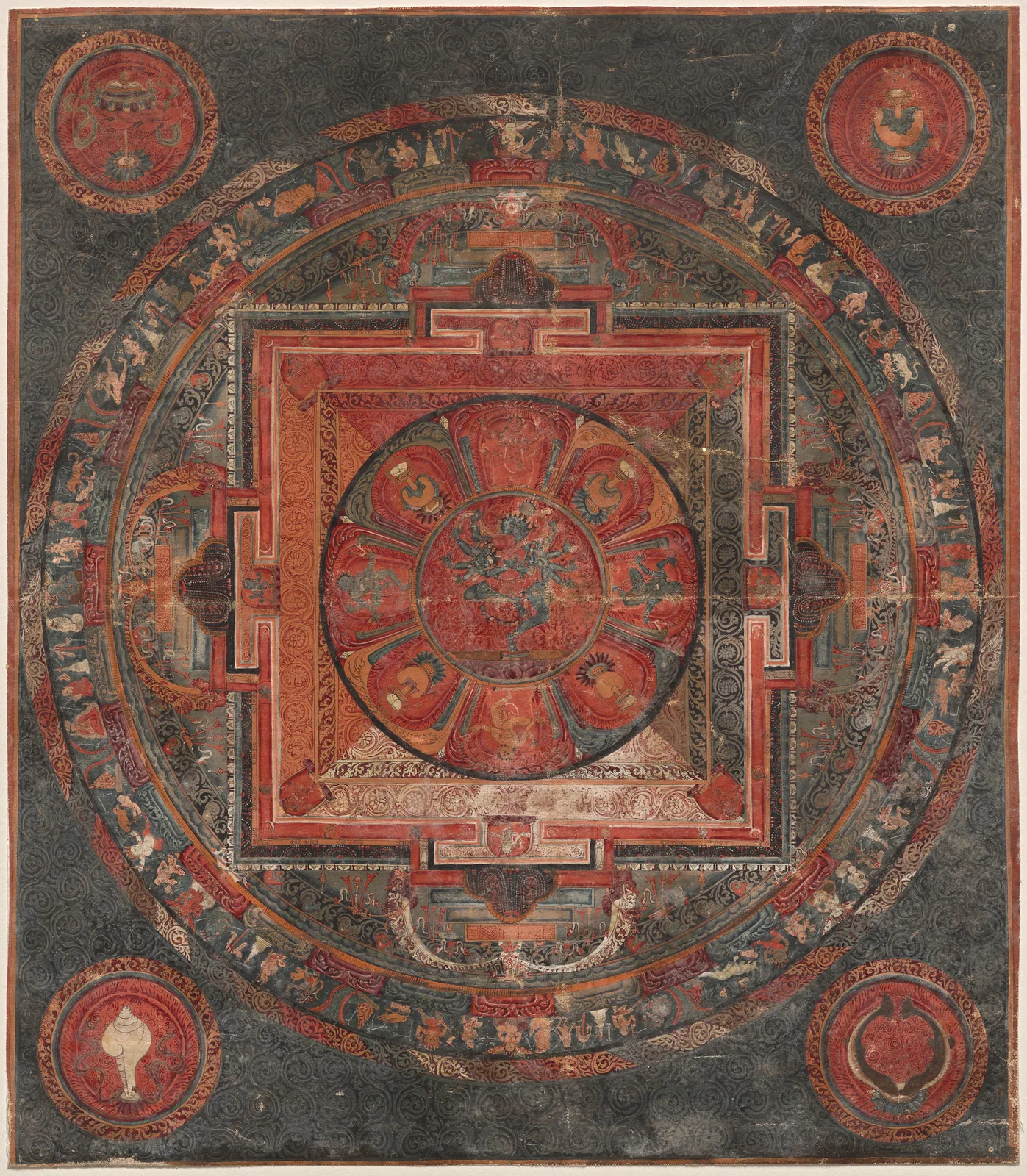
- Date: late 15th century (mid-Ming dynasty)
- Origin and medium: Nepal · mandala on cloth; Chakrasamvara and Vajravarahi
- Collection: Cleveland Museum of Art, accession no. 1960.211 · CC0
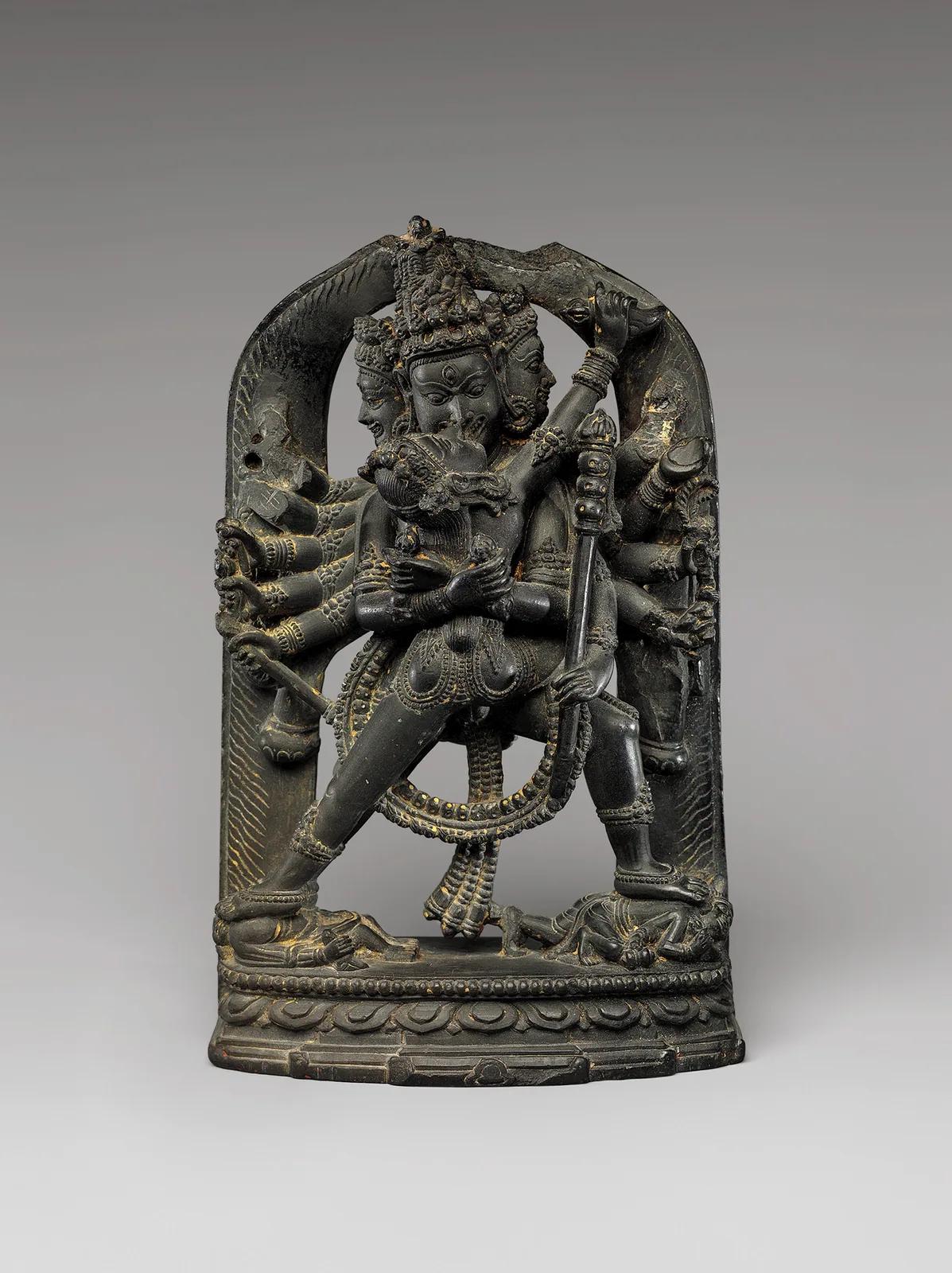
- Date: about 12th century (roughly the Southern Song period)
- Origin and medium: West Bengal, India, or Bangladesh · stone carving in phyllite
- Collection: The Metropolitan Museum of Art, accession no. 1988.392 · Public domain