
Guhyasamaja
First among the three main yidams (meditational deities) of the Gelug school, known as the "King of Tantras."
Watch the video
Who he is
Guhyasamaja's Sanskrit name is Guhyasamāja, meaning "secret assembly." In Tibetan he is called Sangdü. It is the most important tantra in Highest Yoga Tantra and is known as the "King of Tantras."
The three main yidams of the Gelug school are Guhyasamaja, Chakrasamvara, and Yamantaka. Of these, Je Tsongkhapa valued Guhyasamaja most highly and wrote several commentaries on it. The Upper Tantric College and Lower Tantric College of the Gelug school are colleges whose main practice is Guhyasamaja.
What he does
This is a yidam practiced by dedicated practitioners, not a figure to pray to for worldly things. For people who have not yet entered tantra, getting to know him and feeling respect for him is already a way of making a connection for future study and practice.
What people pray to him for
Traditionally, people pray to Guhyasamaja for:
- A good connection with tantra
- The chance, in the future, to study and practice under a qualified teacher
- The clearing away of obstacles to practice
Mantra
Traditionally, the mantra and practice of this yidam may be taken up only after receiving empowerment from a qualified teacher. They are not given here.
Story: The King Who Would Not Become a Monk
The story goes that when the Buddha was alive, there was a king in northwest India named Indrabhuti. He saw the Buddha's disciples flying through the sky, and great faith arose in him. He wanted to find a way to liberation.
But he could not let go of his throne and the life in front of him. So he asked the Buddha: is there a way to be liberated without giving all this up?
The Buddha then taught him Guhyasamaja, showing him how to turn everyday experience into practice. The story shows what is distinctive about tantra: it does not run away from life, it transforms life. This is also why tantra has strict requirements and must be guided personally by a teacher.
How to recognize him
- Dark blue body, three faces, six arms
- Embraces his consort, showing the union of compassion and wisdom
- Holds a vajra, a bell, a Dharma wheel, a lotus, a jewel, and a sword
- The image of the couple in union expresses a doctrinal symbol, not a worldly meaning
The image
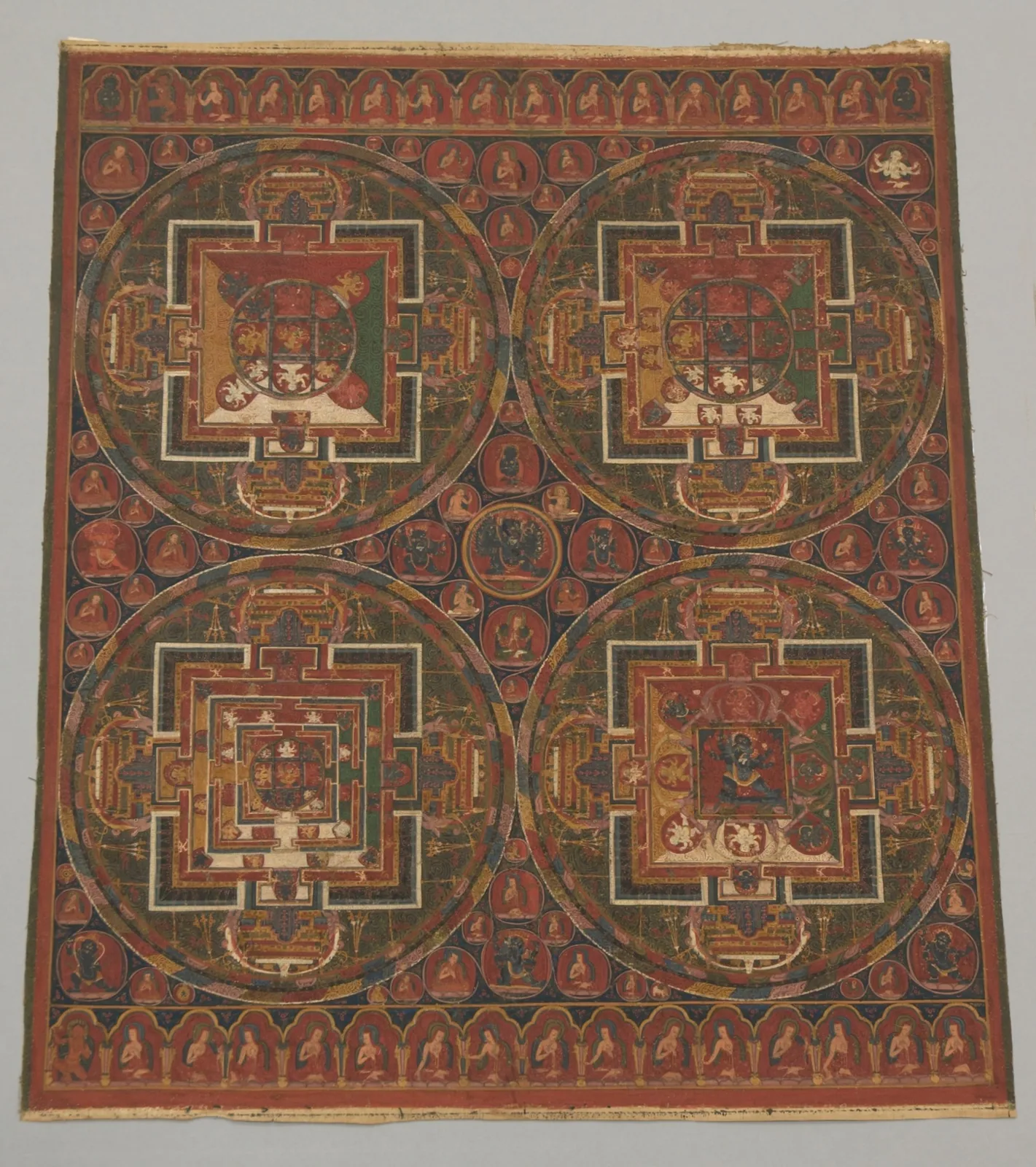
- Date: 16th century (Ming dynasty)
- Origin and medium: Tibet · thangka, distemper on cloth; four mandalas of Guhyasamaja
- Collection: The Metropolitan Museum of Art, accession no. 1989.236.8 · Public domain