
Kalachakra
The yidam (meditational deity) whose teachings explain how the universe, time and the human body correspond; the Tibetan calendar comes from his teachings.
Watch the video
Who he is
Kalachakra's Sanskrit name is Kālacakra, which means "wheel of time." In Tibetan he is called Dükhor. Kalachakra is a very distinctive system within Highest Yoga Tantra, and its content has three levels:
- Outer Kalachakra: the universe, the stars and the calendar.
- Inner Kalachakra: the channels, the winds and the breath of the human body.
- Alternative Kalachakra: the actual methods of practice.
The Tibetan calendar is based on the Kalachakra calendar. The Tibetan count of years in sixty-year cycles starts from 1027 CE, the year the Kalachakra teachings came to Tibet.
The Gelug school gives Kalachakra great weight. Khedrup Je, a disciple of Je Tsongkhapa, wrote a detailed commentary on it. Tashilhunpo has a Kalachakra hall built for the practice of the Kalachakra rituals. Labrang and Kumbum have colleges devoted to Kalachakra.
What he does
The Kalachakra empowerment is one of the few large empowerments in Tibetan Buddhism that are held openly for the general public. Traditionally it is believed to bring peace to the world.
This is a yidam for the dedicated practice of practitioners, not a figure to pray to for worldly matters. For people who have not yet entered tantra, getting to know him and feeling respect for him is already a way of forming a connection for future study and practice.
What people pray to him for
Traditionally, people pray to Kalachakra for:
- World peace and calm times
- A good connection with the Kalachakra teachings
- Auspicious days, and times that go smoothly
Mantra
Traditionally, the mantra and practice of this yidam may be taken up only after receiving the empowerment from a qualified teacher. They are not given here.
A design made of stacked Sanskrit letters is often seen on the lintels of monastery doors, on the covers of scriptures and on amulets. It is called the "Tenfold Powerful One" emblem, and it is the symbol of Kalachakra. Traditionally, hanging it in the home is believed to protect the house.
Story: The King of Shambhala
The story goes that late in his life, in a great stupa in the south of India, the Buddha taught Kalachakra at the request of a king from far away. This king was named Suchandra, and he came from a land in the north called Shambhala.
King Suchandra took the teachings back to Shambhala and wrote them down as scripture. After that, every king of Shambhala in turn upheld the Kalachakra teachings, and everyone in the country practiced them. Only about a thousand years ago did these teachings come back from Shambhala to India, and from there to Tibet.
No one can say for certain where Shambhala is. Traditionally it is described as a pure land ringed by snow mountains and shaped like a lotus. It is generally thought that the word "Shangri-La" developed from it.
How to recognize him
- Blue body, four faces each of a different color, twenty-four hands
- Embracing a yellow consort
- One leg red and one leg white, in a standing posture
- Many kinds of ritual implements in his hands
The image
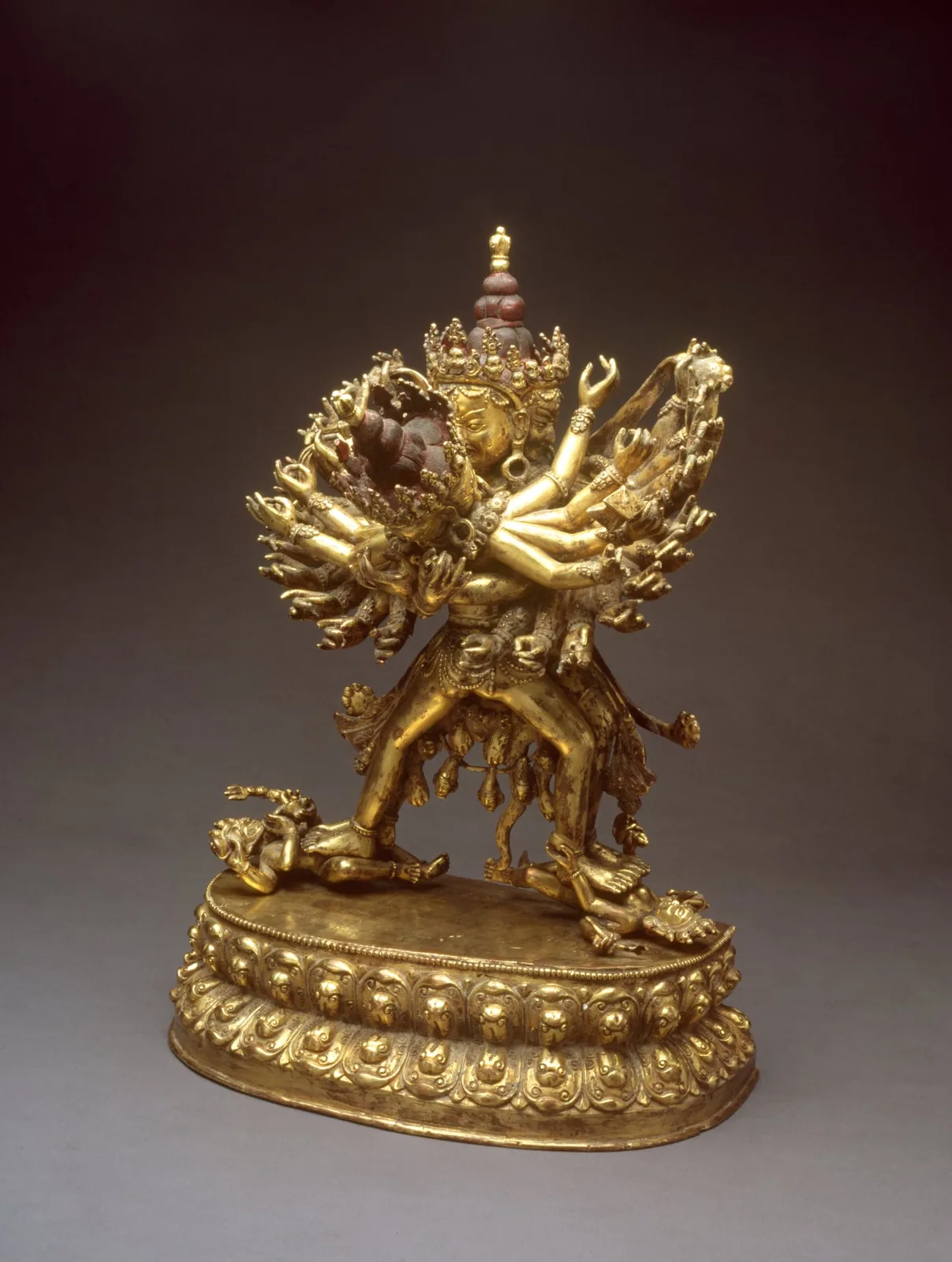
- Date: About 1500 (mid-Ming dynasty)
- Origin and medium: Sino-Tibetan · gilt copper alloy figure with traces of paint, Kalachakra and consort
- Collection: Walters Art Museum, accession no. 54.3103 · CC0