
Vaishravana, Heavenly King of the North
The heavenly king who guards the north, chief of the Four Heavenly Kings, and also a wealth deity and one of the three main Dharma protectors of the Gelug school.
Watch the video
Who he is
Vaishravana's Sanskrit name is Vaiśravaṇa. In Tibetan he is called Namtöse, which means "one who hears much." The name says that he often listens to the Buddha teach, and that his fame has spread in every direction. He guards the north and leads the yakshas.
He holds the highest rank among the Four Heavenly Kings, and he is the only one of them who is honored on his own. In the Gelug school, he, Six-Armed Mahakala and Yama Dharmaraja are known together as the three main protectors. He is also a wealth deity.
What he does
He has three roles: the heavenly king who guards the north, the protector who upholds ethical discipline, and the wealth deity who grants wealth. The Gelug school places great weight on ethical discipline, so it honors him especially.
What people pray to him for
Traditionally, people pray to Vaishravana, Heavenly King of the North, for:
- Keeping their discipline, and practice that does not go off course
- Plenty of wealth and resources
- Safety for monasteries and homes
Mantra
Traditionally, the mantras and practices of protectors must be received from a qualified teacher. They are not given here.
Story: The guardian god of the Silk Road
In Chinese, Vaishravana is also called Pishamen, the Heavenly King. More than a thousand years ago, the ancient kingdom of Khotan on the Silk Road (around today's Hotan in Xinjiang) honored him as the god who protected the country, and its kings called themselves his descendants.
With the traffic along the Silk Road, devotion to him spread to Dunhuang and then on to Chang'an. The story goes that in the Tang dynasty, when the city of Anxi was under siege, he appeared on the tower of the north gate and drove the enemy back. After that, his image was painted on army banners, and army camps everywhere made offerings to him. Many images of him survive in the wall paintings and silk paintings of Dunhuang. Later he traveled on to Japan, where he became a god revered by the samurai.
From India to Khotan, Dunhuang, Chang'an, Tibet and Japan, he is the Buddhist protector who has traveled the farthest.
How to recognize him
- Golden-yellow body, wearing a general's armor, with a stern, commanding look and round, wide-open eyes
- A victory banner raised in his right hand; his left hand holds a jewel-spitting mongoose
- When he appears on his own as a protector and wealth deity, he rides a snow lion
- He is often surrounded by eight generals on horseback
The images
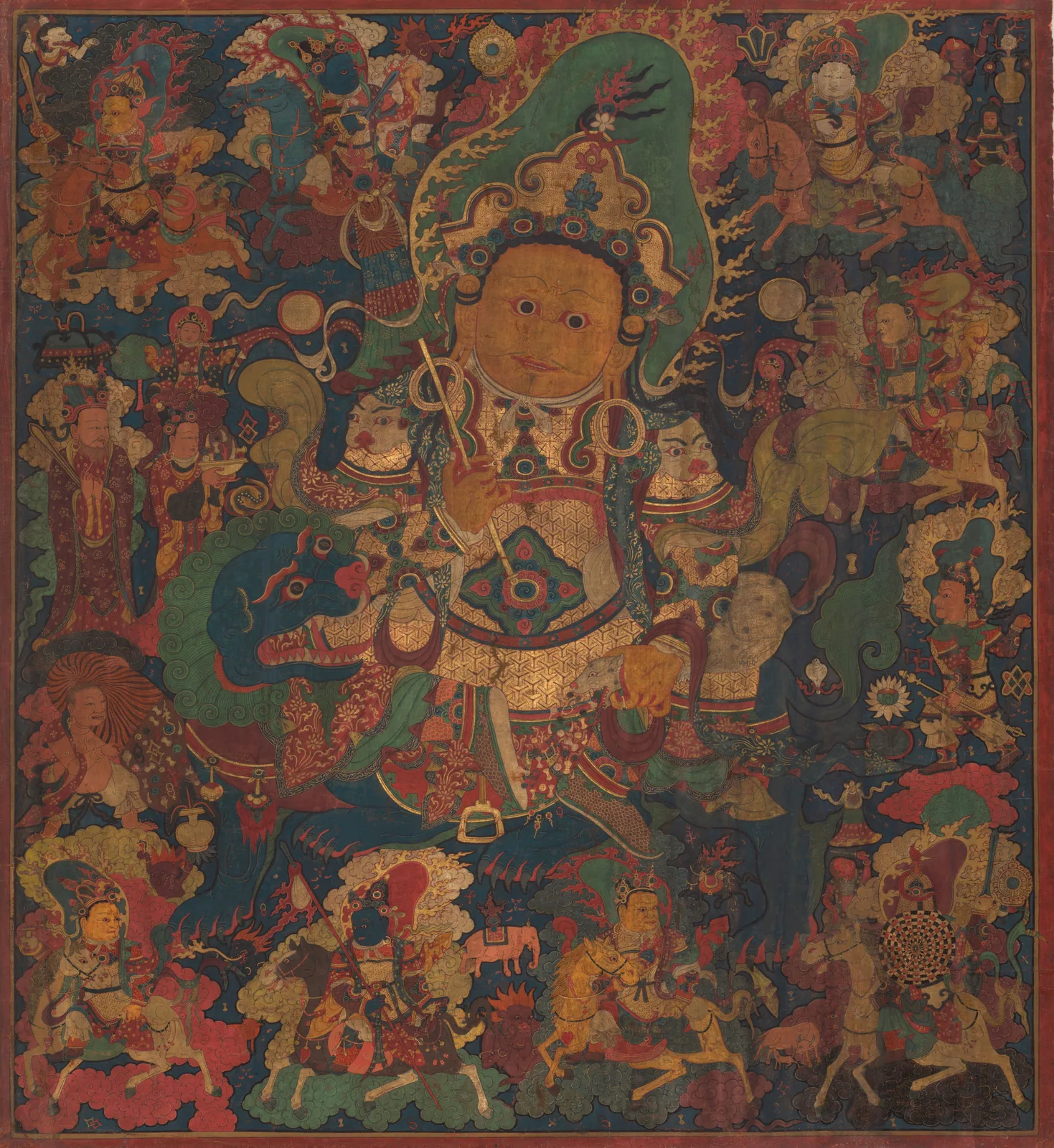
- Date: 15th century (Ming dynasty)
- Origin and medium: Tibet · thangka, distemper on cloth, Vaishravana riding a lion with eight generals
- Collection: The Metropolitan Museum of Art, accession no. 2021.290 · Public domain
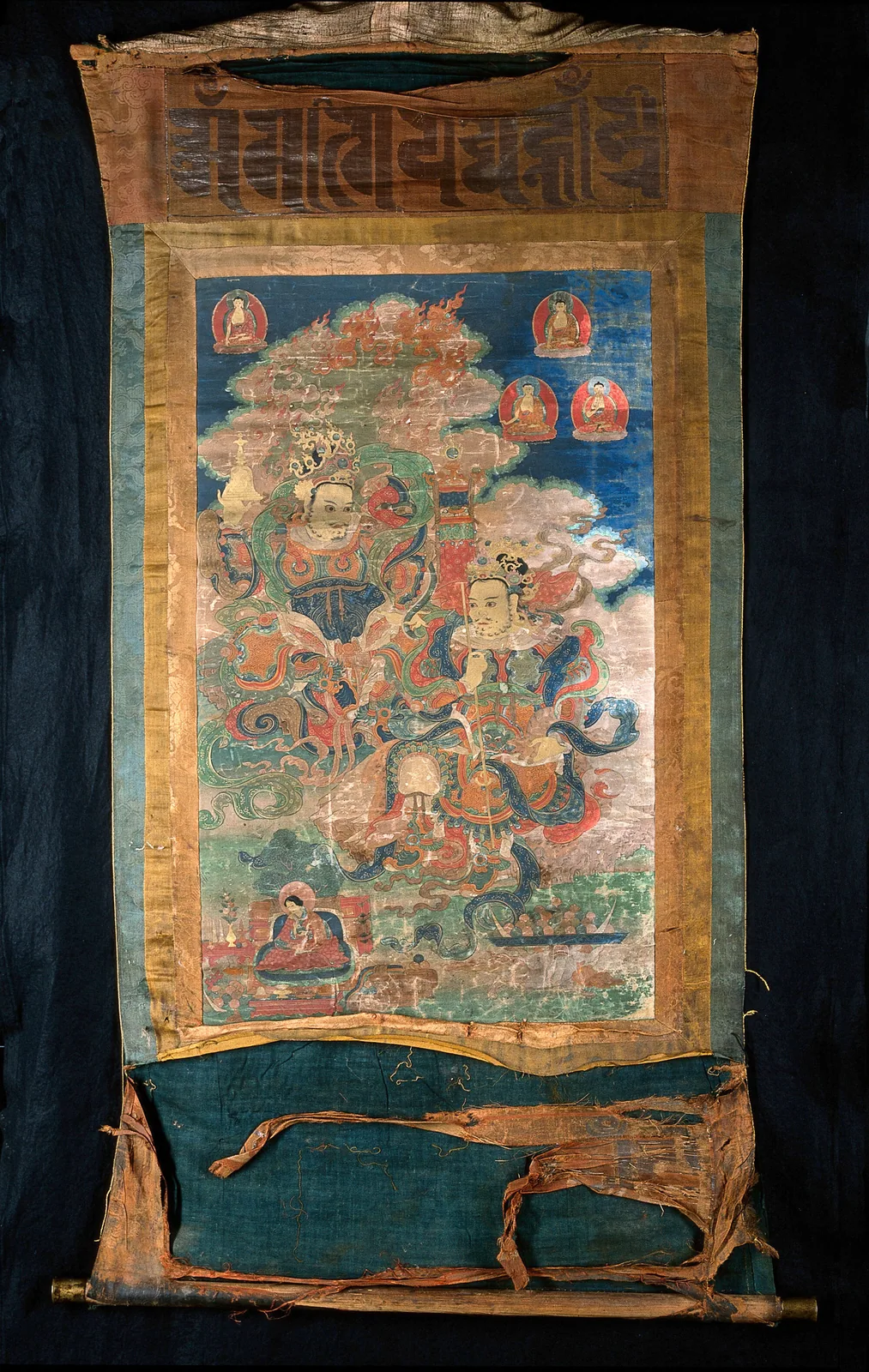
- Date: Date not given
- Origin and medium: Tibet · distemper on cloth, Virupaksha and Vaishravana in the same painting
- Collection: Wellcome Collection, London, accession no. 47068i · Public Domain Mark