
Words Can Build a Bridge
Turn blame into a truthful, specific request that helps solve a problem.
Watch lesson 13
Open the full image, then touch and hold to save on a phone, or right-click and save on a computer.
Let’s begin
Last time we separated a thought from a fact. Now we practise describing what happened.
A block bridge falls. Will saying “You are silly” help rebuild it?
Story time
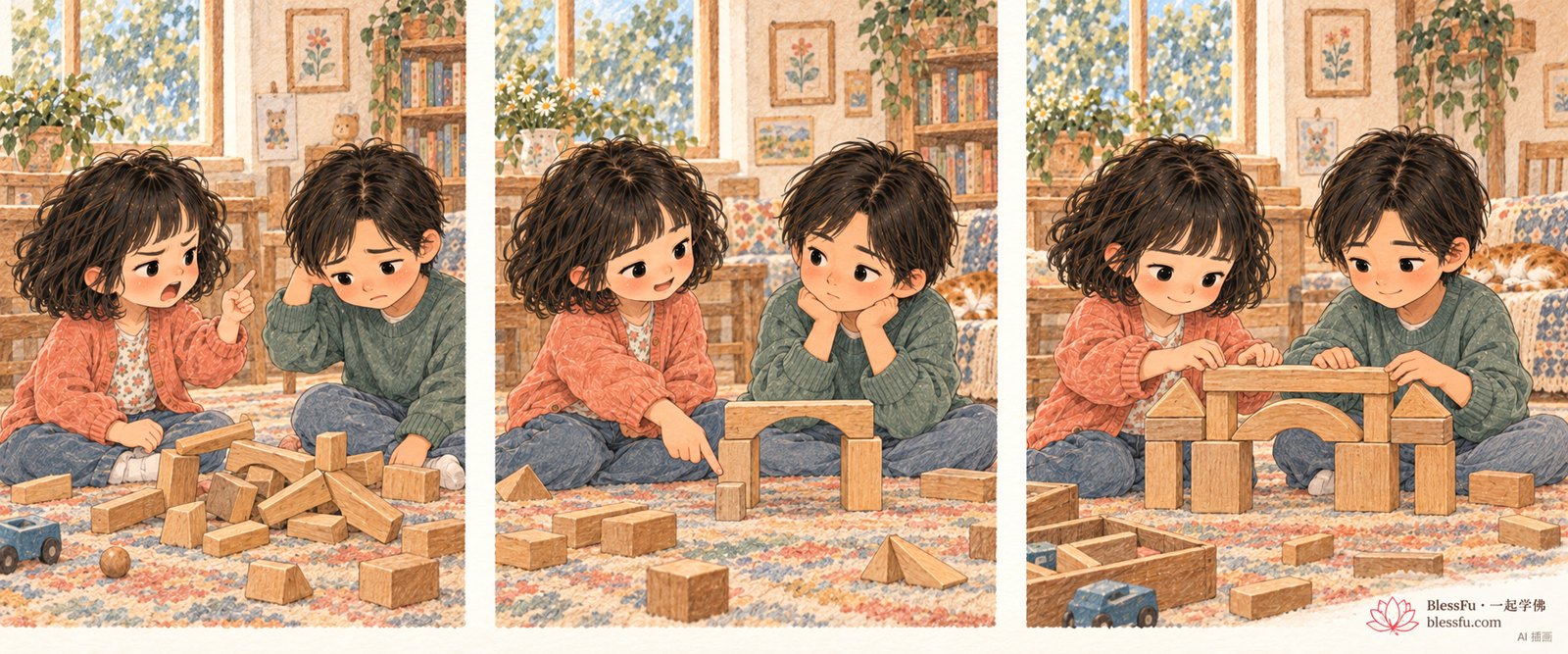
The block bridge tumbled down. Xiaohe almost shouted, “You are so silly!” Then she saw Lele draw back his shoulders and stopped. A small block at the bottom was crooked. That did not mean the person building the bridge was silly. She gathered the fallen blocks toward the middle of the rug.
She tried again. “This bottom block is small, so the bridge wobbles. Shall we try a wider one?” Lele looked up. “I want a tall bridge.” “Me too,” said Xiaohe. “Let us make the bottom steady first.” She did not pretend the bridge had stayed up, and she did not make fun of Lele.
They used wider blocks and tried again. The bridge was not very tall, but it was steadier. “I thought you were going to shout at me,” said Lele. “I felt impatient,” Xiaohe replied, “but I want to build it with you.” A sentence could be a bridge between two people, too.
Think together
Kind speech can be truthful, considerate and useful. Being gentle does not always mean being quiet: in danger, you may say “Stop” clearly and firmly. This everyday activity explores caring for others.
- What did Xiaohe change about her words? How did that help?
- If someone keeps making fun of you, who could help?
Try an activity
Draw two riverbanks and a bridge. Put “The bridge fell” on one side and “We want to fix it” on the other. Add a specific invitation on the bridge, such as “Shall we try a wider block?” Do not name classmates.
Take it home
Choose a small household problem. Replace “You always…” with what happened and one specific request. The adult goes first.
For adults: read-aloud script and guidance
Say, “We can talk about an action without labelling a person.” Children are not responsible for calming an abusive adult. Refusing, leaving and seeking help can also be caring ways to communicate. Smiling or speaking softly is not required.
Nine-slide lesson outline
1. Words Can Build a Bridge
Learn together, one small step.
Turn blame into a truthful, specific request that helps solve a problem.
Last time we separated a thought from a fact. Now we practise describing what happened.
2. Look closely
A block bridge falls. Will saying “You are silly” help rebuild it?
Last time we separated a thought from a fact. Now we practise describing what happened.
A block bridge falls. Will saying “You are silly” help rebuild it?
3. Story 1 / 3
The block bridge tumbled down. Xiaohe almost shouted, “You are so silly!” Then she saw Lele draw back his shoulders and stopped. A small block at the bottom was crooked. That did not mean the person building the bridge was silly. She gathered the fallen blocks toward the middle of the rug.
The block bridge tumbled down. Xiaohe almost shouted, “You are so silly!” Then she saw Lele draw back his shoulders and stopped. A small block at the bottom was crooked. That did not mean the person building the bridge was silly. She gathered the fallen blocks toward the middle of the rug.
4. Story 2 / 3
She tried again. “This bottom block is small, so the bridge wobbles. Shall we try a wider one?” Lele looked up. “I want a tall bridge.” “Me too,” said Xiaohe. “Let us make the bottom steady first.” She did not pretend the bridge had stayed up, and she did not make fun of Lele.
She tried again. “This bottom block is small, so the bridge wobbles. Shall we try a wider one?” Lele looked up. “I want a tall bridge.” “Me too,” said Xiaohe. “Let us make the bottom steady first.” She did not pretend the bridge had stayed up, and she did not make fun of Lele.
5. Story 3 / 3
They used wider blocks and tried again. The bridge was not very tall, but it was steadier. “I thought you were going to shout at me,” said Lele. “I felt impatient,” Xiaohe replied, “but I want to build it with you.” A sentence could be a bridge between two people, too.
They used wider blocks and tried again. The bridge was not very tall, but it was steadier. “I thought you were going to shout at me,” said Lele. “I felt impatient,” Xiaohe replied, “but I want to build it with you.” A sentence could be a bridge between two people, too.
6. A Buddhist idea
Speak truthfully and clearly,
with care for the listener.
Kind speech can be truthful, considerate and useful. Being gentle does not always mean being quiet: in danger, you may say “Stop” clearly and firmly. This everyday activity explores caring for others.
7. Talk together
What did Xiaohe change about her words? How did that help?
If someone keeps making fun of you, who could help?
Listen to different answers. Ask why. Children may discuss the characters rather than private experiences.
8. Try an activity
Draw a bridge made of helpful words.
Draw two riverbanks and a bridge. Put “The bridge fell” on one side and “We want to fix it” on the other. Add a specific invitation on the bridge, such as “Shall we try a wider block?” Do not name classmates.
Choose a small household problem. Replace “You always…” with what happened and one specific request. The adult goes first.
9. For grown-ups
Read aloud, discuss and try a small activity.
Stories and exercises: BlessFu
Illustrations: AI-assisted
Full references and guidance are in the companion booklet.
Say, “We can talk about an action without labelling a person.” Children are not responsible for calming an abusive adult. Refusing, leaving and seeking help can also be caring ways to communicate. Smiling or speaking softly is not required.
Next, we practise asking honestly for help after a small mistake.
Story and references
Theme reference: Matt Lindén, “SEE Learning: Cultivating Social Skills,” Study Buddhism, an abridgment of the Emory University SEE Learning framework. Used only for broad themes of care, listening, diversity and appreciation. This is a universal ethics reference, not a Buddhist scripture. Stories, dialogue and activities are original BlessFu writing, not a translation or an endorsed course.
https://studybuddhism.com/en/essentials/universal-values/see-learning-cultivating-social-skills
Next, we practise asking honestly for help after a small mistake.