
Listen Before You Reply
Try waiting for someone to finish and checking one meaning in your own words.
Watch lesson 15
Open the full image, then touch and hold to save on a phone, or right-click and save on a computer.
Let’s begin
Last time we practised asking for help. Now we help someone feel heard.
You have a great idea, but your friend is still talking. What could you do?
Story time
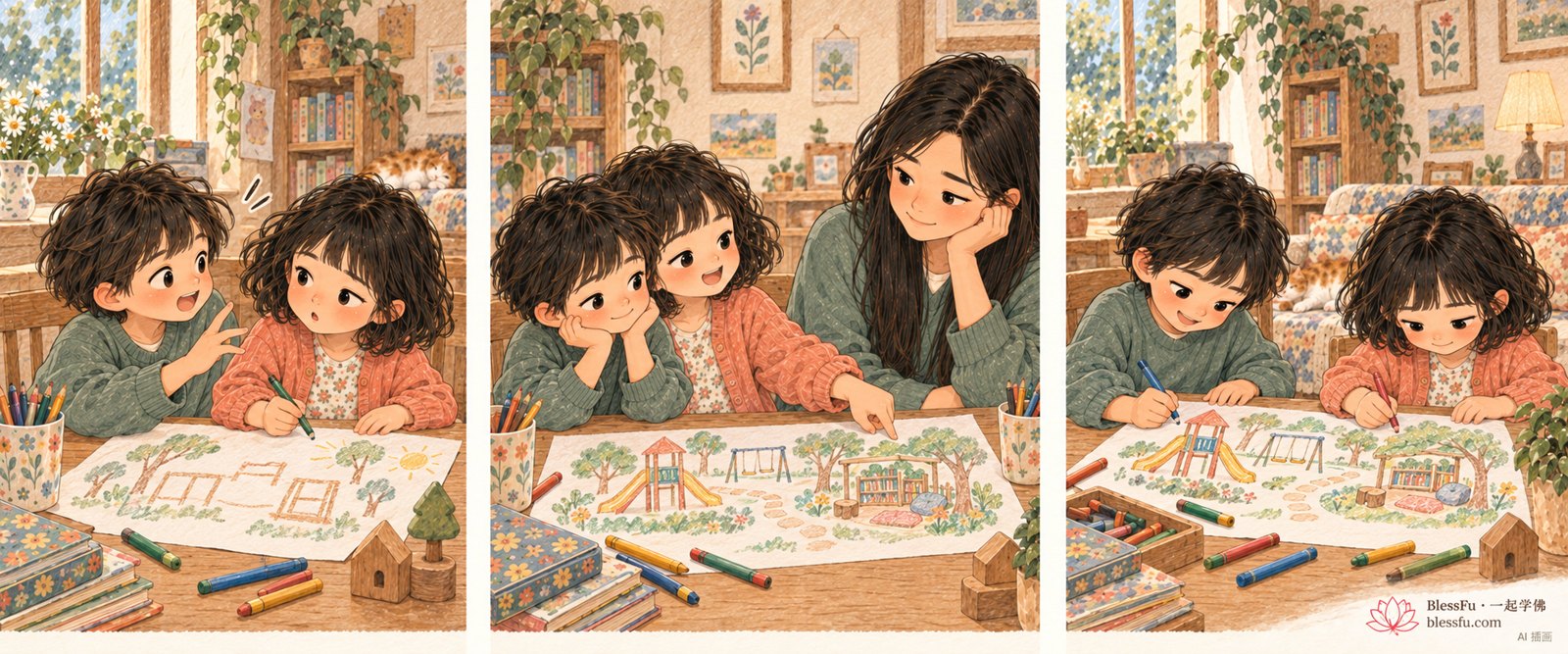
Xiaohe and Lele were drawing an imaginary playground. “I want to leave a space beside…” Xiaohe began. “The tallest slide!” Lele interrupted. Lele drew several long lines. Xiaohe put down her pencil. “But I have not finished yet.”
Lele sketched his own idea on a little piece of paper and set it aside. “What space did you want?” he asked. Xiaohe pointed to a corner. “A quiet reading hut. Sometimes I do not want to keep running.” After listening, Lele checked: “You want somewhere to rest. Is that right?”
“Yes! With soft cushions,” Xiaohe added. When it was Lele’s turn, he explained his slide. They left room on the big sheet for both the slide and the reading hut. Listening did not mean giving up an idea. It gave both children’s ideas a little space.
Think together
Listening is one way to show care. Pause before interrupting, check that you understood, then share your thoughts. Looking at a drawing or responding with a gesture is welcome; understanding matters more than a fixed posture.
- How did drawing his idea on a small sheet help Lele?
- How is “Do you mean…?” different from deciding what another person means?
Try an activity
Take turns describing a corner of an imaginary park. The listener waits, then checks the idea with one sentence or a small drawing, without adding advice first. Try about half a minute each, shorten it, or pass.
Take it home
At a relaxed moment, invite a child to share something small. Listen first, then ask, “Would you like me to listen, or help think of a plan?”
For adults: read-aloud script and guidance
Do not require eye contact, sitting still or spoken answers. Allow drawings, gestures and extra time. Urgent or unsafe situations do not require listening silently for politeness; interrupt and seek help when needed.
Nine-slide lesson outline
1. Listen Before You Reply
Learn together, one small step.
Try waiting for someone to finish and checking one meaning in your own words.
Last time we practised asking for help. Now we help someone feel heard.
2. Look closely
You have a great idea, but your friend is still talking. What could you do?
Last time we practised asking for help. Now we help someone feel heard.
You have a great idea, but your friend is still talking. What could you do?
3. Story 1 / 3
Xiaohe and Lele were drawing an imaginary playground. “I want to leave a space beside…” Xiaohe began. “The tallest slide!” Lele interrupted. Lele drew several long lines. Xiaohe put down her pencil. “But I have not finished yet.”
Xiaohe and Lele were drawing an imaginary playground. “I want to leave a space beside…” Xiaohe began. “The tallest slide!” Lele interrupted. Lele drew several long lines. Xiaohe put down her pencil. “But I have not finished yet.”
4. Story 2 / 3
Lele sketched his own idea on a little piece of paper and set it aside. “What space did you want?” he asked. Xiaohe pointed to a corner. “A quiet reading hut. Sometimes I do not want to keep running.” After listening, Lele checked: “You want somewhere to rest. Is that right?”
Lele sketched his own idea on a little piece of paper and set it aside. “What space did you want?” he asked. Xiaohe pointed to a corner. “A quiet reading hut. Sometimes I do not want to keep running.” After listening, Lele checked: “You want somewhere to rest. Is that right?”
5. Story 3 / 3
“Yes! With soft cushions,” Xiaohe added. When it was Lele’s turn, he explained his slide. They left room on the big sheet for both the slide and the reading hut. Listening did not mean giving up an idea. It gave both children’s ideas a little space.
“Yes! With soft cushions,” Xiaohe added. When it was Lele’s turn, he explained his slide. They left room on the big sheet for both the slide and the reading hut. Listening did not mean giving up an idea. It gave both children’s ideas a little space.
6. A Buddhist idea
Make room for another person,
and for your own ideas too.
Listening is one way to show care. Pause before interrupting, check that you understood, then share your thoughts. Looking at a drawing or responding with a gesture is welcome; understanding matters more than a fixed posture.
7. Talk together
How did drawing his idea on a small sheet help Lele?
How is “Do you mean…?” different from deciding what another person means?
Listen to different answers. Ask why. Children may discuss the characters rather than private experiences.
8. Try an activity
Take turns describing a park corner.
Take turns describing a corner of an imaginary park. The listener waits, then checks the idea with one sentence or a small drawing, without adding advice first. Try about half a minute each, shorten it, or pass.
At a relaxed moment, invite a child to share something small. Listen first, then ask, “Would you like me to listen, or help think of a plan?”
9. For grown-ups
Read aloud, discuss and try a small activity.
Stories and exercises: BlessFu
Illustrations: AI-assisted
Full references and guidance are in the companion booklet.
Do not require eye contact, sitting still or spoken answers. Allow drawings, gestures and extra time. Urgent or unsafe situations do not require listening silently for politeness; interrupt and seek help when needed.
Next, we explore respecting different choices.
Story and references
Theme reference: Matt Lindén, “SEE Learning: Cultivating Social Skills,” Study Buddhism, an abridgment of the Emory University SEE Learning framework. Used only for broad themes of care, listening, diversity and appreciation. This is a universal ethics reference, not a Buddhist scripture. Stories, dialogue and activities are original BlessFu writing, not a translation or an endorsed course.
https://studybuddhism.com/en/essentials/universal-values/see-learning-cultivating-social-skills
Next, we explore respecting different choices.