
Small Actions Have Effects
Distinguish an intended action from an accident and suggest a step of repair.
Watch lesson 21
Open the full image, then touch and hold to save on a phone, or right-click and save on a computer.
Let’s begin
A meal needs many conditions. Our actions are also conditions that influence events.
If you block a friend’s train, does saying sorry erase what happened?
Story time
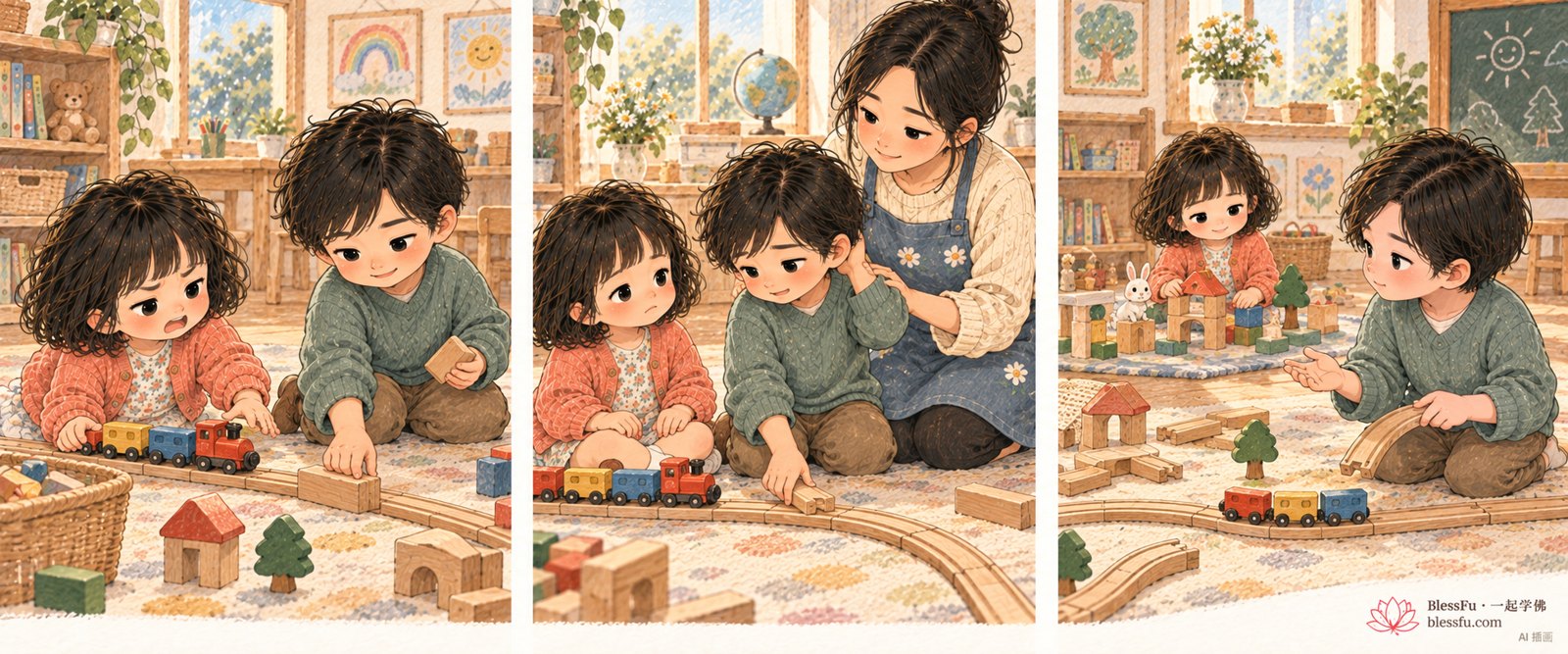
Lele wanted his toy train to go first, so he deliberately put a block on Xiaohe’s track. Her train stopped. “I have not finished!” she said, upset. The teacher came over and asked Lele to remove the block. Then both children paused.
“I wanted to go first, so I blocked you. I am sorry,” said Lele. He hoped to play together again, but Xiaohe said, “I want to play on my own for a while.” The teacher explained, “You can apologise and respect her choice. We can also repair the track that got pushed crooked.”
Lele straightened the track. Next time he moved a block, he asked first. He did not earn a reward star for apologising, and he had not become a bad child forever. Repeated choices affect how people get along. Beginning a different habit today still mattered.
Think together
Buddhist discussions of karma attend to motivations and habits involved in bodily, verbal and mental behaviour. We begin with intended actions, effects and change. Outcomes have many conditions; another person’s illness or hardship is not evidence that they did something bad.
- What did Lele want, and how did his action affect Xiaohe?
- How could he respond when she wanted time alone?
Try an activity
Draw an action chain for the story: what I wanted → what I did → who was affected → a possible repair. Use characters or toys rather than private experiences.
Take it home
An adult models a small repair: name the action, address its effect and try a different approach next time, without demanding forgiveness.
For adults: read-aloud script and guidance
Do not call every mechanical cause and effect karma or say all suffering is self-caused. Do not force forgiveness or make children responsible for adults’ actions. Accidents may still need repair, but are not the same as deliberate harm.
Nine-slide lesson outline
1. Small Actions Have Effects
Learn together, one small step.
Distinguish an intended action from an accident and suggest a step of repair.
A meal needs many conditions. Our actions are also conditions that influence events.
2. Look closely
If you block a friend’s train, does saying sorry erase what happened?
A meal needs many conditions. Our actions are also conditions that influence events.
If you block a friend’s train, does saying sorry erase what happened?
3. Story 1 / 3
Lele wanted his toy train to go first, so he deliberately put a block on Xiaohe’s track. Her train stopped. “I have not finished!” she said, upset. The teacher came over and asked Lele to remove the block. Then both children paused.
Lele wanted his toy train to go first, so he deliberately put a block on Xiaohe’s track. Her train stopped. “I have not finished!” she said, upset. The teacher came over and asked Lele to remove the block. Then both children paused.
4. Story 2 / 3
“I wanted to go first, so I blocked you. I am sorry,” said Lele. He hoped to play together again, but Xiaohe said, “I want to play on my own for a while.” The teacher explained, “You can apologise and respect her choice. We can also repair the track that got pushed crooked.”
“I wanted to go first, so I blocked you. I am sorry,” said Lele. He hoped to play together again, but Xiaohe said, “I want to play on my own for a while.” The teacher explained, “You can apologise and respect her choice. We can also repair the track that got pushed crooked.”
5. Story 3 / 3
Lele straightened the track. Next time he moved a block, he asked first. He did not earn a reward star for apologising, and he had not become a bad child forever. Repeated choices affect how people get along. Beginning a different habit today still mattered.
Lele straightened the track. Next time he moved a block, he asked first. He did not earn a reward star for apologising, and he had not become a bad child forever. Repeated choices affect how people get along. Beginning a different habit today still mattered.
6. A Buddhist idea
Actions have effects.
New choices can begin now.
Buddhist discussions of karma attend to motivations and habits involved in bodily, verbal and mental behaviour. We begin with intended actions, effects and change. Outcomes have many conditions; another person’s illness or hardship is not evidence that they did something bad.
7. Talk together
What did Lele want, and how did his action affect Xiaohe?
How could he respond when she wanted time alone?
Listen to different answers. Ask why. Children may discuss the characters rather than private experiences.
8. Try an activity
Draw a route from action to repair.
Draw an action chain for the story: what I wanted → what I did → who was affected → a possible repair. Use characters or toys rather than private experiences.
An adult models a small repair: name the action, address its effect and try a different approach next time, without demanding forgiveness.
9. For grown-ups
Read aloud, discuss and try a small activity.
Stories and exercises: BlessFu
Illustrations: AI-assisted
Full references and guidance are in the companion booklet.
Do not call every mechanical cause and effect karma or say all suffering is self-caused. Do not force forgiveness or make children responsible for adults’ actions. Accidents may still need repair, but are not the same as deliberate harm.
Next, we notice the voice that says “I want a little more.”
Story and references
Theme reference: Alexander Berzin and Matt Lindén, What Is Karma?. Introductory themes: karma is not predestination, and behaviour and habits can be examined. The story does not prove karmic results or judge others’ hardship. Stories, dialogue, questions and activities are original BlessFu writing, not a scripture translation or an endorsed course.
https://studybuddhism.com/en/essentials/what-is/what-is-karma
Next, we notice the voice that says “I want a little more.”