
One More, or Enough for Now?
Notice the urge to take more, pause and choose an amount that fits the task.
Watch lesson 22
Open the full image, then touch and hold to save on a phone, or right-click and save on a computer.
Let’s begin
We practised changing an action. Today we notice the wish that comes before it.
Do you need a whole box of stickers to make one card?
Story time
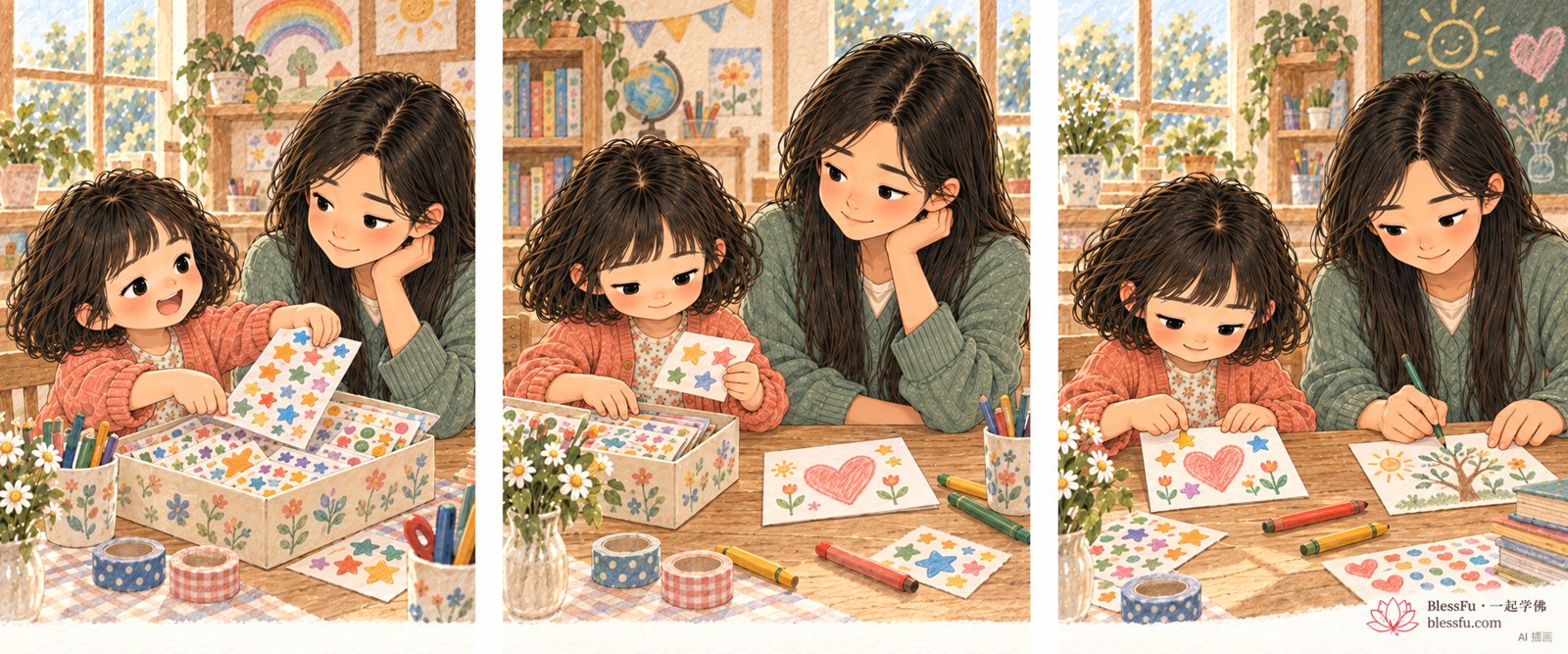
A box of shiny star stickers sat on the craft table. Xiaohe chose a sheet, then reached for more. “Every colour is lovely!” she said. Mother was waiting for a turn. Mother did not say liking stickers was bad. She asked, “What are you making today? How much will you need?”
Xiaohe looked at her unfinished card. She kept one favourite sheet beside it and returned the rest to the shared box. “I still want the other colours,” she admitted. “You can like them without taking them right now,” said Mother. “First see what you can do with this sheet.”
Xiaohe added a few stickers and drew more stars with a pencil. The card was not covered, but it had its own style. Mother found stickers for her card too. Pausing when she had enough did not ban happiness. It left room for other choices.
Think together
Contentment need not mean rejecting every wish. We can notice what we have and consider what is enough. Wanting something is common; pause, consider its use and choose. Some wishes, such as learning and helping, are worth developing.
- Could Xiaohe still want the stickers after returning them?
- Could “enough” differ for different projects?
Try an activity
Plan a small card. Draw materials needed now and things that could wait. Existing paper and pencils are enough; no sticker purchase is required.
Take it home
Before a small activity, agree on useful materials. Afterwards notice what could be saved for another time.
For adults: read-aloud script and guidance
Do not romanticise poverty or use contentment to deny basic needs. Avoid ranking children who take less. Focus on fair use of shared materials, not shaming attraction to beautiful things.
Nine-slide lesson outline
1. One More, or Enough for Now?
Learn together, one small step.
Notice the urge to take more, pause and choose an amount that fits the task.
We practised changing an action. Today we notice the wish that comes before it.
2. Look closely
Do you need a whole box of stickers to make one card?
We practised changing an action. Today we notice the wish that comes before it.
Do you need a whole box of stickers to make one card?
3. Story 1 / 3
A box of shiny star stickers sat on the craft table. Xiaohe chose a sheet, then reached for more. “Every colour is lovely!” she said. Mother was waiting for a turn. Mother did not say liking stickers was bad. She asked, “What are you making today? How much will you need?”
A box of shiny star stickers sat on the craft table. Xiaohe chose a sheet, then reached for more. “Every colour is lovely!” she said. Mother was waiting for a turn. Mother did not say liking stickers was bad. She asked, “What are you making today? How much will you need?”
4. Story 2 / 3
Xiaohe looked at her unfinished card. She kept one favourite sheet beside it and returned the rest to the shared box. “I still want the other colours,” she admitted. “You can like them without taking them right now,” said Mother. “First see what you can do with this sheet.”
Xiaohe looked at her unfinished card. She kept one favourite sheet beside it and returned the rest to the shared box. “I still want the other colours,” she admitted. “You can like them without taking them right now,” said Mother. “First see what you can do with this sheet.”
5. Story 3 / 3
Xiaohe added a few stickers and drew more stars with a pencil. The card was not covered, but it had its own style. Mother found stickers for her card too. Pausing when she had enough did not ban happiness. It left room for other choices.
Xiaohe added a few stickers and drew more stars with a pencil. The card was not covered, but it had its own style. Mother found stickers for her card too. Pausing when she had enough did not ban happiness. It left room for other choices.
6. A Buddhist idea
A wish can be present,
and action can still be chosen.
Contentment need not mean rejecting every wish. We can notice what we have and consider what is enough. Wanting something is common; pause, consider its use and choose. Some wishes, such as learning and helping, are worth developing.
7. Talk together
Could Xiaohe still want the stickers after returning them?
Could “enough” differ for different projects?
Listen to different answers. Ask why. Children may discuss the characters rather than private experiences.
8. Try an activity
Plan materials for a little card.
Plan a small card. Draw materials needed now and things that could wait. Existing paper and pencils are enough; no sticker purchase is required.
Before a small activity, agree on useful materials. Afterwards notice what could be saved for another time.
9. For grown-ups
Read aloud, discuss and try a small activity.
Stories and exercises: BlessFu
Illustrations: AI-assisted
Full references and guidance are in the companion booklet.
Do not romanticise poverty or use contentment to deny basic needs. Avoid ranking children who take less. Focus on fair use of shared materials, not shaming attraction to beautiful things.
Next, we help a kind intention find a suitable action.
Story and references
Theme reference: Lama Zopa Rinpoche, Joyful Parents, Successful Children, chapter 4. Contentment theme only; claims linking lack of contentment to illness and pressure through suffering are not used. Stories, dialogue, questions and activities are original BlessFu writing, not a scripture translation or an endorsed course.
https://www.lamayeshe.com/article/chapter/4-teaching-seven-foundations
Next, we help a kind intention find a suitable action.