
Kind Help Starts with a Question
Ask what help is wanted and involve an adult when a task exceeds your ability.
Watch lesson 23
Open the full image, then touch and hold to save on a phone, or right-click and save on a computer.
Let’s begin
We can pause and choose. Now we use that care when helping someone.
Someone pauses at a puddle. Is pulling them along necessarily helpful?
Story time
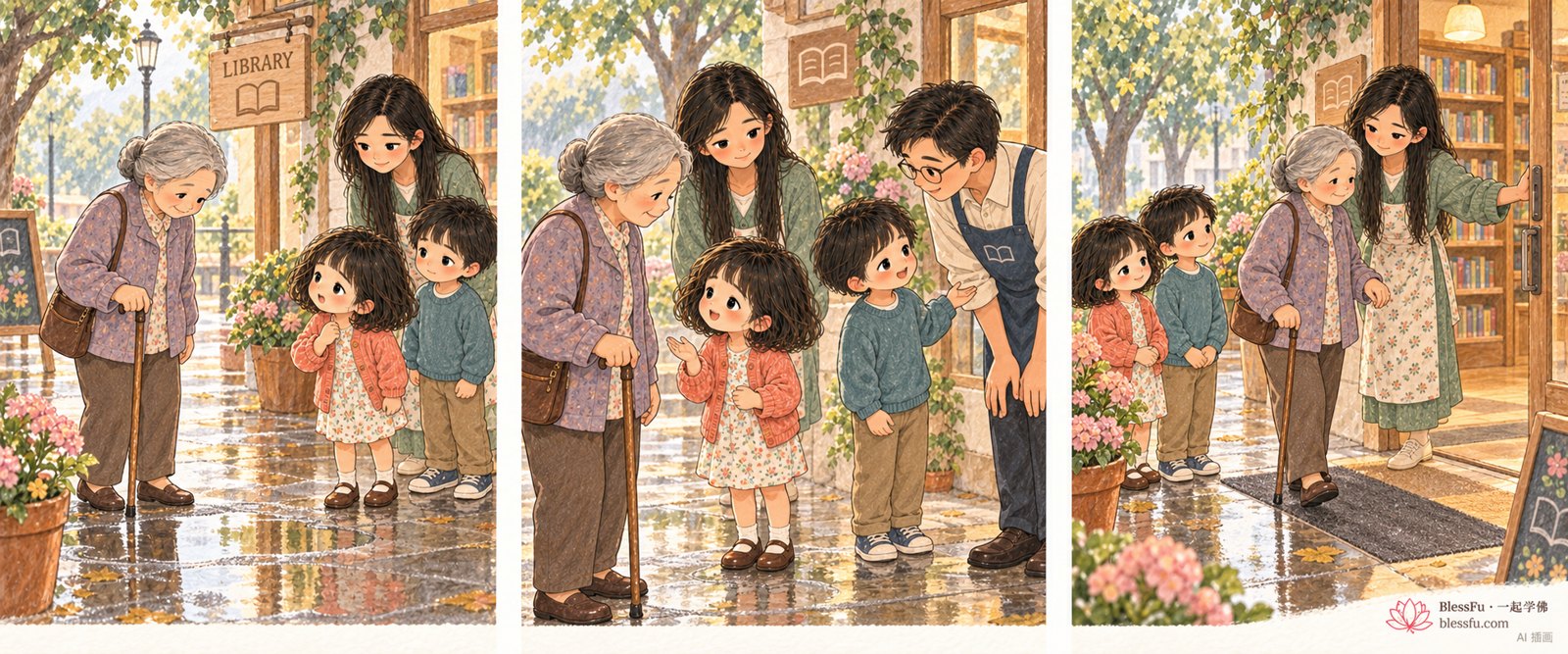
After rain, a small puddle lay near the library door. An older person using a cane paused nearby. Xiaohe wanted to take their hand and pull them through. Mother gently reminded her, “Ask what help is wanted first.” Xiaohe stood out of the way. “Would you like some help?”
“Thank you. Holding the door is enough. I can use the dry path myself,” the person replied. Lele asked Mother to hold the door. The children stepped aside. They did not pull an arm or take away the cane. The person knew which way of walking suited them.
The person slowly entered along the dry path and thanked them. “I thought pulling would be quicker,” Xiaohe said. Mother replied, “Wanting to help is warm-hearted. Asking and observing make useful help more likely.” They remembered: care, understand, then take a suitable step.
Think together
Compassion includes wishing others free from suffering. Wisdom helps us observe and choose suitable means. Children can begin by asking, respecting the answer and acting within their abilities. Good intentions are not a reason to decide for someone else.
- What help did the person actually want?
- What could the children do if the answer were “No, thank you”?
Try an activity
Use toys to practise: “Would you like help?” followed by a request or “Not now, thank you.” Listen before choosing an action. Do not act out lifting, pulling or medical care.
Take it home
Ask what help a family member wants with a small task. Respect a refusal too.
For adults: read-aloud script and guidance
Do not portray older or disabled people as automatically helpless. Children should not handle traffic, falls or medical dangers alone; adults take responsibility. Declining help is a choice, not ingratitude.
Nine-slide lesson outline
1. Kind Help Starts with a Question
Learn together, one small step.
Ask what help is wanted and involve an adult when a task exceeds your ability.
We can pause and choose. Now we use that care when helping someone.
2. Look closely
Someone pauses at a puddle. Is pulling them along necessarily helpful?
We can pause and choose. Now we use that care when helping someone.
Someone pauses at a puddle. Is pulling them along necessarily helpful?
3. Story 1 / 3
After rain, a small puddle lay near the library door. An older person using a cane paused nearby. Xiaohe wanted to take their hand and pull them through. Mother gently reminded her, “Ask what help is wanted first.” Xiaohe stood out of the way. “Would you like some help?”
After rain, a small puddle lay near the library door. An older person using a cane paused nearby. Xiaohe wanted to take their hand and pull them through. Mother gently reminded her, “Ask what help is wanted first.” Xiaohe stood out of the way. “Would you like some help?”
4. Story 2 / 3
“Thank you. Holding the door is enough. I can use the dry path myself,” the person replied. Lele asked Mother to hold the door. The children stepped aside. They did not pull an arm or take away the cane. The person knew which way of walking suited them.
“Thank you. Holding the door is enough. I can use the dry path myself,” the person replied. Lele asked Mother to hold the door. The children stepped aside. They did not pull an arm or take away the cane. The person knew which way of walking suited them.
5. Story 3 / 3
The person slowly entered along the dry path and thanked them. “I thought pulling would be quicker,” Xiaohe said. Mother replied, “Wanting to help is warm-hearted. Asking and observing make useful help more likely.” They remembered: care, understand, then take a suitable step.
The person slowly entered along the dry path and thanked them. “I thought pulling would be quicker,” Xiaohe said. Mother replied, “Wanting to help is warm-hearted. Asking and observing make useful help more likely.” They remembered: care, understand, then take a suitable step.
6. A Buddhist idea
Care, observation and thought
help kindness find a suitable way.
Compassion includes wishing others free from suffering. Wisdom helps us observe and choose suitable means. Children can begin by asking, respecting the answer and acting within their abilities. Good intentions are not a reason to decide for someone else.
7. Talk together
What help did the person actually want?
What could the children do if the answer were “No, thank you”?
Listen to different answers. Ask why. Children may discuss the characters rather than private experiences.
8. Try an activity
Let toys practise asking and listening.
Use toys to practise: “Would you like help?” followed by a request or “Not now, thank you.” Listen before choosing an action. Do not act out lifting, pulling or medical care.
Ask what help a family member wants with a small task. Respect a refusal too.
9. For grown-ups
Read aloud, discuss and try a small activity.
Stories and exercises: BlessFu
Illustrations: AI-assisted
Full references and guidance are in the companion booklet.
Do not portray older or disabled people as automatically helpless. Children should not handle traffic, falls or medical dangers alone; adults take responsibility. Declining help is a choice, not ingratitude.
Next, we connect learning, understanding and practice.
Story and references
Theme reference: Alexander Berzin and Matt Lindén, What Is Compassion?. Theme: compassion joined with knowledge and wisdom. Asking and helping within one’s abilities are original child-focused examples. Stories, dialogue, questions and activities are original BlessFu writing, not a scripture translation or an endorsed course.
https://studybuddhism.com/en/essentials/what-is/what-is-compassion
Next, we connect learning, understanding and practice.