
Four Friends: Whose Skill Matters?
Recognise the four friends and share a task with attention to others.
Watch lesson 25
Open the full image, then touch and hold to save on a phone, or right-click and save on a computer.
Let’s begin
We practised listening, thinking and trying. Now we explore traditional stories.
An elephant, monkey, hare and partridge: who deserves to be heard?
Story time
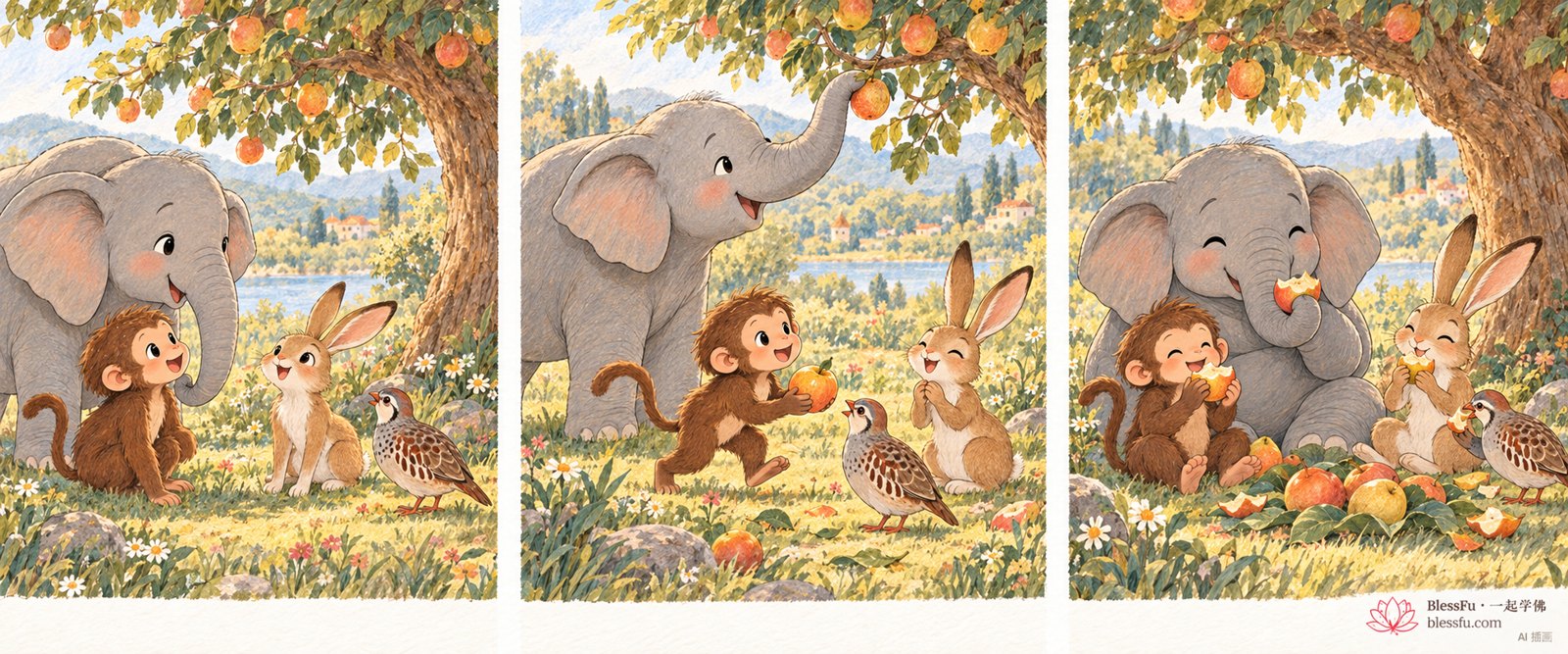
Tibetan art often shows these four animal friends. Here is a new little fable inspired by their mutual help. Under a fruit tree, the monkey looked up, the hare looked around and the partridge fluttered its wings. Everyone wanted some fruit.
The elephant reached a low branch with its trunk. The monkey took a fruit and passed it to the hare. The hare set a little portion beside the bird. Even the smallest friend had a place. No one simply piled everything in front of themselves.
The four shared their fruit in the shade. Imagine the hare asking, 'Together next time too?' and the monkey nodding. In this newly imagined scene, abilities differ, but everyone's care matters. Before helping, look at what your companions need.
Think together
The Four Harmonious Friends are a traditional subject in Tibetan Buddhist art, expressing harmony, respect and mutual help. Size, age and strength do not determine a person’s worth. Animals cooperate in this fable; real wild animals need their own space.
- What might be missed if only the elephant decided?
- How could someone join in without doing the same amount?
Try an activity
Draw the four animals and something each could contribute. Build a low block bridge together after agreeing who will fetch, place and check the blocks. Roles may change.
Take it home
Choose a small household task. Agree on roles, then name one helpful thing someone else did.
For adults: read-aloud script and guidance
This is an original fable inspired by a traditional image, not a word-for-word scripture translation. Do not stack children or imitate animals standing on backs. Age does not require unquestioning obedience. Offer a different task or a break if someone does not want to join.
Nine-slide lesson outline
1. Four Friends: Whose Skill Matters?
Learn together, one small step.
Recognise the four friends and share a task with attention to others.
We practised listening, thinking and trying. Now we explore traditional stories.
2. Look closely
An elephant, monkey, hare and partridge: who deserves to be heard?
We practised listening, thinking and trying. Now we explore traditional stories.
An elephant, monkey, hare and partridge: who deserves to be heard?
3. Story 1 / 3
Tibetan art often shows these four animal friends. Here is a new little fable inspired by their mutual help. Under a fruit tree, the monkey looked up, the hare looked around and the partridge fluttered its wings. Everyone wanted some fruit.
Tibetan art often shows these four animal friends. Here is a new little fable inspired by their mutual help. Under a fruit tree, the monkey looked up, the hare looked around and the partridge fluttered its wings. Everyone wanted some fruit.
4. Story 2 / 3
The elephant reached a low branch with its trunk. The monkey took a fruit and passed it to the hare. The hare set a little portion beside the bird. Even the smallest friend had a place. No one simply piled everything in front of themselves.
The elephant reached a low branch with its trunk. The monkey took a fruit and passed it to the hare. The hare set a little portion beside the bird. Even the smallest friend had a place. No one simply piled everything in front of themselves.
5. Story 3 / 3
The four shared their fruit in the shade. Imagine the hare asking, 'Together next time too?' and the monkey nodding. In this newly imagined scene, abilities differ, but everyone's care matters. Before helping, look at what your companions need.
The four shared their fruit in the shade. Imagine the hare asking, 'Together next time too?' and the monkey nodding. In this newly imagined scene, abilities differ, but everyone's care matters. Before helping, look at what your companions need.
6. A Buddhist idea
Harmony and care
make room for everyone.
The Four Harmonious Friends are a traditional subject in Tibetan Buddhist art, expressing harmony, respect and mutual help. Size, age and strength do not determine a person’s worth. Animals cooperate in this fable; real wild animals need their own space.
7. Talk together
What might be missed if only the elephant decided?
How could someone join in without doing the same amount?
Listen to different answers. Ask why. Children may discuss the characters rather than private experiences.
8. Try an activity
Agree on roles and build a low block bridge.
Draw the four animals and something each could contribute. Build a low block bridge together after agreeing who will fetch, place and check the blocks. Roles may change.
Choose a small household task. Agree on roles, then name one helpful thing someone else did.
9. For grown-ups
Read aloud, discuss and try a small activity.
Stories and exercises: BlessFu
Illustrations: AI-assisted
Full references and guidance are in the companion booklet.
This is an original fable inspired by a traditional image, not a word-for-word scripture translation. Do not stack children or imitate animals standing on backs. Age does not require unquestioning obedience. Offer a different task or a break if someone does not want to join.
Next, meet Atisha and explore humble learning.
Story and references
Source: Lama Yeshe Wisdom Archive, The Four Harmonious Brothers (Lama Zopa Rinpoche, 2018/2020); Himalayan Art Resources, Four Harmonious Brothers, set 1179. The animal identities and mutual giving provide the theme. Tree scenes, dialogue and activities are newly written, not an entire Jataka retelling.
Next, meet Atisha and explore humble learning.