
Listen, Think, Try
Explain learning, reflection and practice through one everyday example.
Watch lesson 24
Open the full image, then touch and hold to save on a phone, or right-click and save on a computer.
Let’s begin
We explored change, connections, actions, contentment and helpful care. Now we connect how we learn.
Does hearing “Ask before borrowing” mean we always remember to do it?
Story time
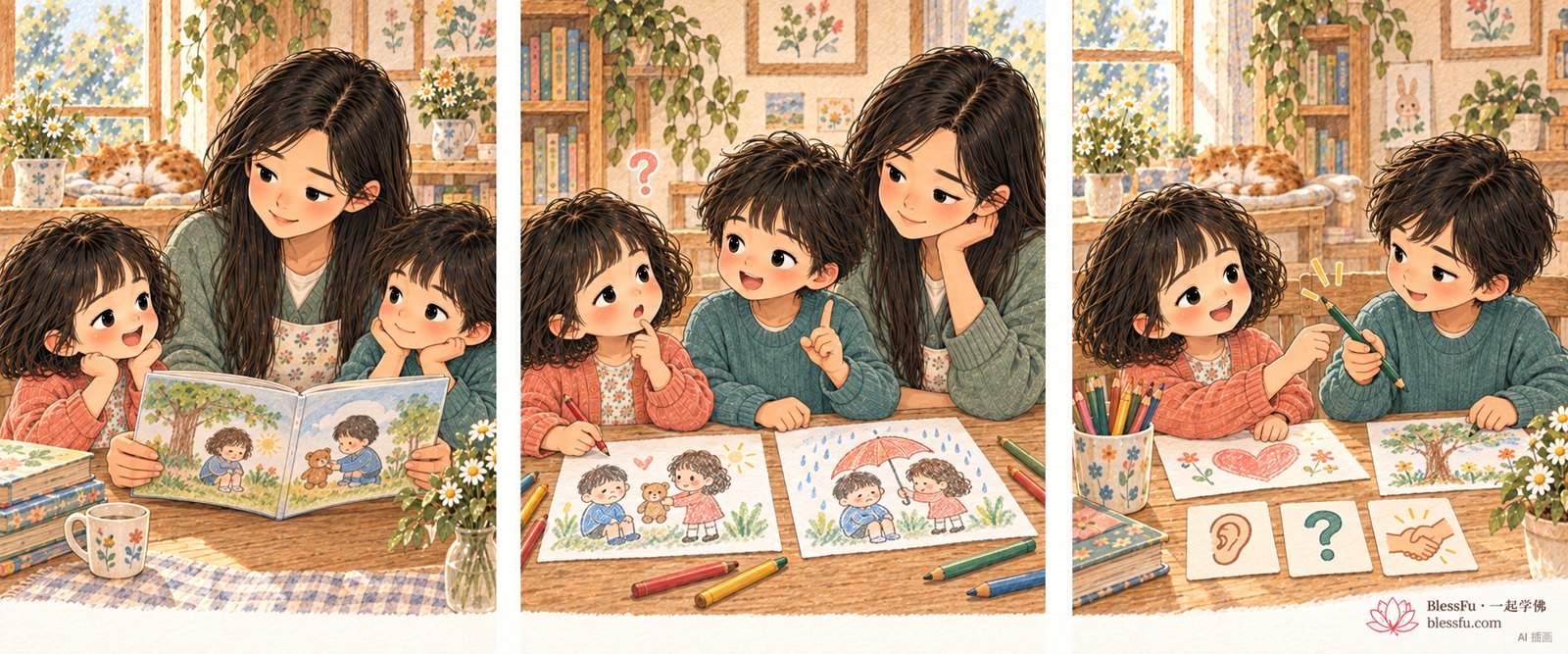
Mother read a picture story about helping a friend. “I understand,” said Lele. “Ask what help is wanted first.” Xiaohe asked, “Even with a friend I know well?” Instead of turning the page, they paused to explore her question.
Mother invited them to draw two scenes: a friend who could not find a toy, and someone without an umbrella in the rain. “Different situations need different help,” Xiaohe said. Lele wondered, “What if they say they do not need help now?” Together they considered respectful responses.
Later Xiaohe wanted Lele’s coloured pencil. She almost reached for it, then paused. “May I use the green one?” Lele handed it to her. They drew an ear, a question mark and helping hands: learn, understand, practise. Forgetting once did not end the learning; they could try again.
Think together
Hearing, reflection and meditation are important stages in Buddhist learning: receive teachings, examine their meaning, and cultivate familiarity through practice. Our everyday example is introductory. Buddhist practice is not simply finishing a craft or doing a task once.
- How did Xiaohe’s question help everyone understand?
- How could Xiaohe continue if she forgot next time?
Try an activity
Choose an earlier theme and draw three boxes: what I learned, what I still wonder, and what I would like to practise. An adult may write your words. Do not rank who does best.
Take it home
Review one small practice together: what helped and what questions remain? Adjust or rest as needed, without merit scores.
For adults: read-aloud script and guidance
Do not equate hearing teachings with obedience or discourage questions. Explain the limits of the analogy. One exercise is not a claim of spiritual realisation. Specific religious practices need reliable, age-appropriate guidance.
Nine-slide lesson outline
1. Listen, Think, Try
Learn together, one small step.
Explain learning, reflection and practice through one everyday example.
We explored change, connections, actions, contentment and helpful care. Now we connect how we learn.
2. Look closely
Does hearing “Ask before borrowing” mean we always remember to do it?
We explored change, connections, actions, contentment and helpful care. Now we connect how we learn.
Does hearing “Ask before borrowing” mean we always remember to do it?
3. Story 1 / 3
Mother read a picture story about helping a friend. “I understand,” said Lele. “Ask what help is wanted first.” Xiaohe asked, “Even with a friend I know well?” Instead of turning the page, they paused to explore her question.
Mother read a picture story about helping a friend. “I understand,” said Lele. “Ask what help is wanted first.” Xiaohe asked, “Even with a friend I know well?” Instead of turning the page, they paused to explore her question.
4. Story 2 / 3
Mother invited them to draw two scenes: a friend who could not find a toy, and someone without an umbrella in the rain. “Different situations need different help,” Xiaohe said. Lele wondered, “What if they say they do not need help now?” Together they considered respectful responses.
Mother invited them to draw two scenes: a friend who could not find a toy, and someone without an umbrella in the rain. “Different situations need different help,” Xiaohe said. Lele wondered, “What if they say they do not need help now?” Together they considered respectful responses.
5. Story 3 / 3
Later Xiaohe wanted Lele’s coloured pencil. She almost reached for it, then paused. “May I use the green one?” Lele handed it to her. They drew an ear, a question mark and helping hands: learn, understand, practise. Forgetting once did not end the learning; they could try again.
Later Xiaohe wanted Lele’s coloured pencil. She almost reached for it, then paused. “May I use the green one?” Lele handed it to her. They drew an ear, a question mark and helping hands: learn, understand, practise. Forgetting once did not end the learning; they could try again.
6. A Buddhist idea
Learn, reflect and practise:
become familiar with a caring direction.
Hearing, reflection and meditation are important stages in Buddhist learning: receive teachings, examine their meaning, and cultivate familiarity through practice. Our everyday example is introductory. Buddhist practice is not simply finishing a craft or doing a task once.
7. Talk together
How did Xiaohe’s question help everyone understand?
How could Xiaohe continue if she forgot next time?
Listen to different answers. Ask why. Children may discuss the characters rather than private experiences.
8. Try an activity
Draw your “learn, ask, practise” sheet.
Choose an earlier theme and draw three boxes: what I learned, what I still wonder, and what I would like to practise. An adult may write your words. Do not rank who does best.
Review one small practice together: what helped and what questions remain? Adjust or rest as needed, without merit scores.
9. For grown-ups
Read aloud, discuss and try a small activity.
Stories and exercises: BlessFu
Illustrations: AI-assisted
Full references and guidance are in the companion booklet.
Do not equate hearing teachings with obedience or discourage questions. Explain the limits of the analogy. One exercise is not a claim of spiritual realisation. Specific religious practices need reliable, age-appropriate guidance.
Next batch brings traditional stories, with their sources and type clearly explained.
Story and references
Theme reference: Alexander Berzin, Details of Ways of Knowing: 13 Listening, Thinking and Meditating. Only the learning sequence is referenced. Adult meditation visualisations and contemplation of bodily impurity are not adapted. Stories, dialogue, questions and activities are original BlessFu writing, not a scripture translation or an endorsed course.
Next batch brings traditional stories, with their sources and type clearly explained.