
The Intention in a Small Lamp
Explore generosity through Nanda’s lamp without comparing the price of gifts.
Watch lesson 27
Open the full image, then touch and hold to save on a phone, or right-click and save on a computer.
Let’s begin
We explored humility. Today a small offering carries a generous wish.
What intention could a small lamp express?
Story time
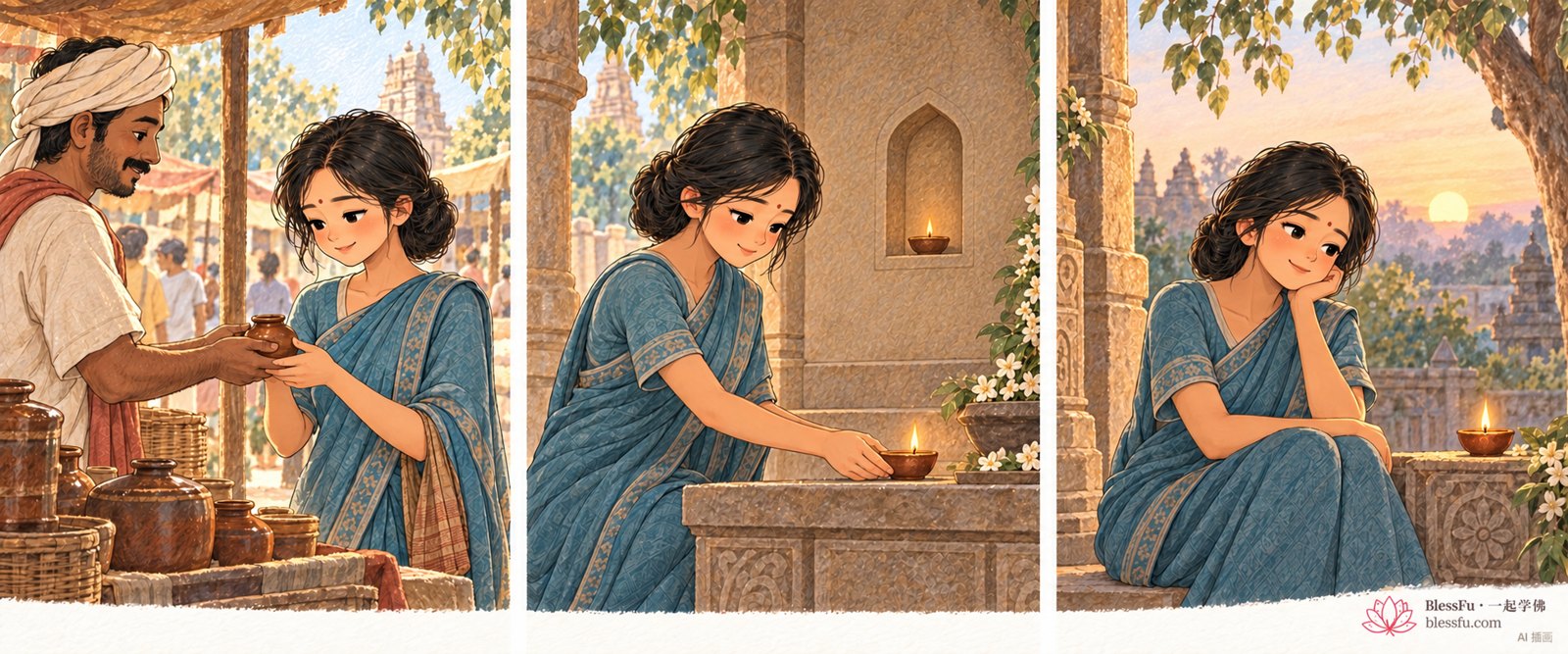
The Sutra of the Wise and the Foolish tells of a woman called Nanda. She lived in poverty and wished to make an offering to the Buddha. She took a little money to buy oil. Hearing her intention, the seller added enough oil for a small lamp.
Nanda placed her lamp among the others. She wished to grow in wisdom and help beings overcome ignorance and suffering. Her wish included others. The lamp was small, but the story draws attention to intention rather than the number of lamps.
The scripture goes on to describe the lamp still shining at dawn, beyond Maudgalyayana's attempts to extinguish it. This is a special event within a religious story. A real lamp's flame does not test anyone's faith. We can express care through company and practical help too.
Think together
Buddhist generosity values intention and the needs of those receiving help. The price of a gift does not measure someone’s worth. Choose an act you freely wish to do and can afford. Taking care of basic needs matters too.
- How did the oil seller help?
- How can someone offer care without money?
Try an activity
Draw a lamp on paper. In its light, draw someone you wish well. Below it, draw a helpful action you can actually take. Use paper or an electronic light, never a real flame.
Take it home
Try a free act of care, such as fetching a book for a busy family member or listening patiently. Talk about the intention behind it.
For adults: read-aloud script and guidance
Adapted from selected events in Xianyu jing, volume 3, chapter 20, Poor Woman Nanda (T202). The unextinguished lamp is identified as a religious narrative, not a promise of wealth, healing or protection from disasters. Children do not handle flames alone or give away food money or all their allowance.
Nine-slide lesson outline
1. The Intention in a Small Lamp
Learn together, one small step.
Explore generosity through Nanda’s lamp without comparing the price of gifts.
We explored humility. Today a small offering carries a generous wish.
2. Look closely
What intention could a small lamp express?
We explored humility. Today a small offering carries a generous wish.
What intention could a small lamp express?
3. Story 1 / 3
The Sutra of the Wise and the Foolish tells of a woman called Nanda. She lived in poverty and wished to make an offering to the Buddha. She took a little money to buy oil. Hearing her intention, the seller added enough oil for a small lamp.
The Sutra of the Wise and the Foolish tells of a woman called Nanda. She lived in poverty and wished to make an offering to the Buddha. She took a little money to buy oil. Hearing her intention, the seller added enough oil for a small lamp.
4. Story 2 / 3
Nanda placed her lamp among the others. She wished to grow in wisdom and help beings overcome ignorance and suffering. Her wish included others. The lamp was small, but the story draws attention to intention rather than the number of lamps.
Nanda placed her lamp among the others. She wished to grow in wisdom and help beings overcome ignorance and suffering. Her wish included others. The lamp was small, but the story draws attention to intention rather than the number of lamps.
5. Story 3 / 3
The scripture goes on to describe the lamp still shining at dawn, beyond Maudgalyayana's attempts to extinguish it. This is a special event within a religious story. A real lamp's flame does not test anyone's faith. We can express care through company and practical help too.
The scripture goes on to describe the lamp still shining at dawn, beyond Maudgalyayana's attempts to extinguish it. This is a special event within a religious story. A real lamp's flame does not test anyone's faith. We can express care through company and practical help too.
6. A Buddhist idea
Notice a generous intention
without pricing a person’s worth.
Buddhist generosity values intention and the needs of those receiving help. The price of a gift does not measure someone’s worth. Choose an act you freely wish to do and can afford. Taking care of basic needs matters too.
7. Talk together
How did the oil seller help?
How can someone offer care without money?
Listen to different answers. Ask why. Children may discuss the characters rather than private experiences.
8. Try an activity
Draw a lamp and a possible act of care.
Draw a lamp on paper. In its light, draw someone you wish well. Below it, draw a helpful action you can actually take. Use paper or an electronic light, never a real flame.
Try a free act of care, such as fetching a book for a busy family member or listening patiently. Talk about the intention behind it.
9. For grown-ups
Read aloud, discuss and try a small activity.
Stories and exercises: BlessFu
Illustrations: AI-assisted
Full references and guidance are in the companion booklet.
Adapted from selected events in Xianyu jing, volume 3, chapter 20, Poor Woman Nanda (T202). The unextinguished lamp is identified as a religious narrative, not a promise of wealth, healing or protection from disasters. Children do not handle flames alone or give away food money or all their allowance.
Next, how does the Buddha turn compassion into care?
Story and references
Source: 《贤愚经》卷三〈贫女难陀品第二十〉,大正藏 T04 no.202, 370c23–371a(CBETA电子文本,台大镜像). Based on the classical Nanda lamp episode, not copied from a modern storybook. Later past-life episodes are omitted. The miraculous event is labelled religious narrative; discussions and activities are original.
https://dlbs.liberal.ntu.edu.tw/BDLM/sutra/html/T04/T04n0202.htm
Next, how does the Buddha turn compassion into care?