
The Buddha Cares for a Sick Monk
Notice responsibility for care and know when children should ask adults for help.
Watch lesson 28
Open the full image, then touch and hold to save on a phone, or right-click and save on a computer.
Let’s begin
The lamp story explored intention. Today care becomes an action.
Does someone who cannot help others while ill still deserve care?
Story time
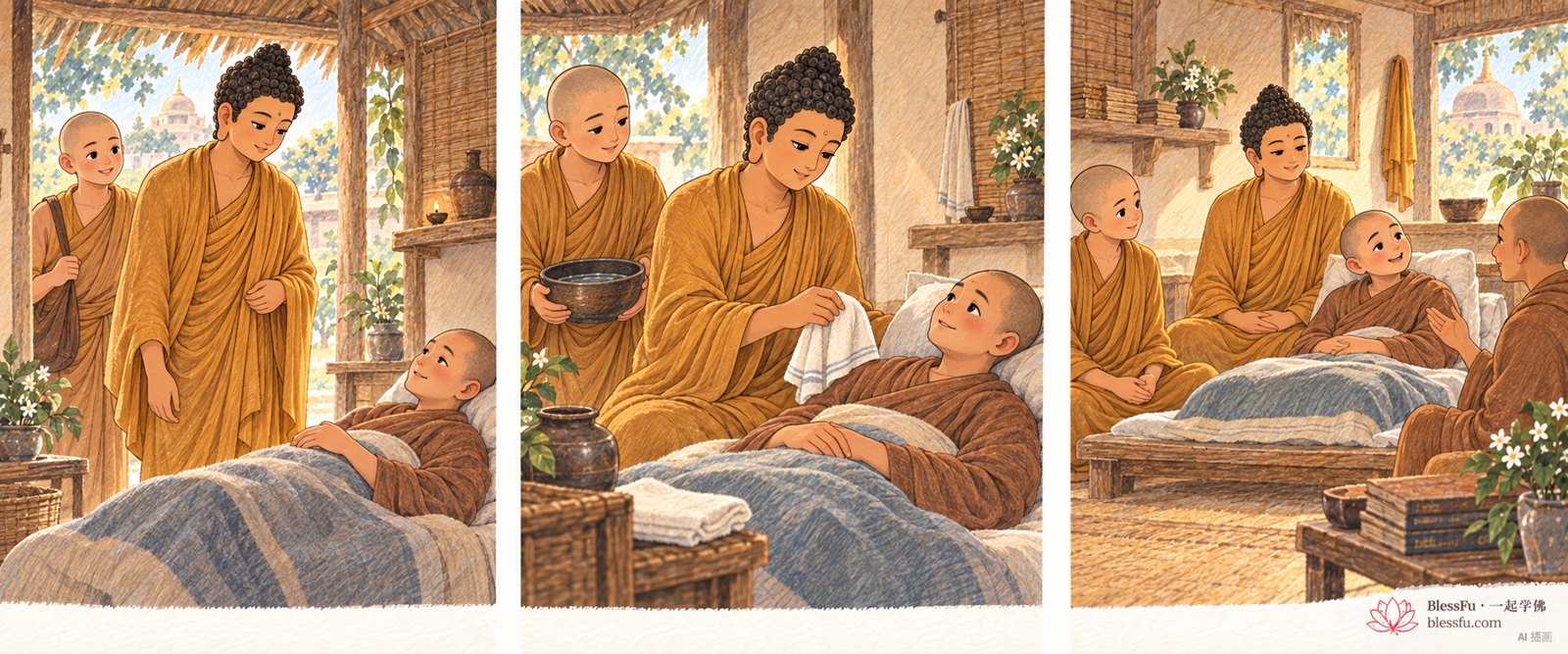
A Buddhist monastic text tells how the Buddha and Ananda found a sick monk without anyone caring for him. The Buddha stopped to find out what was needed. He did not leave the monk aside because he was unable to do useful work.
Ananda fetched water. Together they cleaned the monk and settled him on a bed. Both carers in the story were adults. Our illustration shows water and a clean cloth, keeping the person's dignity and practical needs in view.
Later the Buddha gathered the monks and emphasised their responsibility to care for one another when sick. Care is not reserved for someone who is useful. Today a child can tell a trusted adult when someone seems unwell, then ask what safe little task might help.
Think together
Compassion can mean noticing a need and arranging care. People deserve respect even when they cannot work or help. This is a story from Buddhist monastic discipline, not a modern medical instruction.
- What did the Buddha do when he noticed the sick monk?
- How do children’s tasks differ from adults’ caring responsibilities?
Try an activity
With a toy, practise noticing discomfort, telling an adult and asking, “Is there a small thing I can do?” Draw a rest card. Moving, washing or giving medicine to a person is not part of the children’s activity.
Take it home
Ask whether a tired person would like quiet. Put away toys or lower the noise. Adults handle illness and decisions about care.
For adults: read-aloud script and guidance
Source: Pali Vinaya, Mahavagga 8.26.1–8. This is shared Buddhist learning material, not a uniquely Gelug story. Graphic details are omitted. Children must not be made sole carers or responsible for recovery. Do not blame illness on karma.
Nine-slide lesson outline
1. The Buddha Cares for a Sick Monk
Learn together, one small step.
Notice responsibility for care and know when children should ask adults for help.
The lamp story explored intention. Today care becomes an action.
2. Look closely
Does someone who cannot help others while ill still deserve care?
The lamp story explored intention. Today care becomes an action.
Does someone who cannot help others while ill still deserve care?
3. Story 1 / 3
A Buddhist monastic text tells how the Buddha and Ananda found a sick monk without anyone caring for him. The Buddha stopped to find out what was needed. He did not leave the monk aside because he was unable to do useful work.
A Buddhist monastic text tells how the Buddha and Ananda found a sick monk without anyone caring for him. The Buddha stopped to find out what was needed. He did not leave the monk aside because he was unable to do useful work.
4. Story 2 / 3
Ananda fetched water. Together they cleaned the monk and settled him on a bed. Both carers in the story were adults. Our illustration shows water and a clean cloth, keeping the person's dignity and practical needs in view.
Ananda fetched water. Together they cleaned the monk and settled him on a bed. Both carers in the story were adults. Our illustration shows water and a clean cloth, keeping the person's dignity and practical needs in view.
5. Story 3 / 3
Later the Buddha gathered the monks and emphasised their responsibility to care for one another when sick. Care is not reserved for someone who is useful. Today a child can tell a trusted adult when someone seems unwell, then ask what safe little task might help.
Later the Buddha gathered the monks and emphasised their responsibility to care for one another when sick. Care is not reserved for someone who is useful. Today a child can tell a trusted adult when someone seems unwell, then ask what safe little task might help.
6. A Buddhist idea
Someone unable to help
still deserves kindness.
Compassion can mean noticing a need and arranging care. People deserve respect even when they cannot work or help. This is a story from Buddhist monastic discipline, not a modern medical instruction.
7. Talk together
What did the Buddha do when he noticed the sick monk?
How do children’s tasks differ from adults’ caring responsibilities?
Listen to different answers. Ask why. Children may discuss the characters rather than private experiences.
8. Try an activity
Ask an adult, then choose a safe small task.
With a toy, practise noticing discomfort, telling an adult and asking, “Is there a small thing I can do?” Draw a rest card. Moving, washing or giving medicine to a person is not part of the children’s activity.
Ask whether a tired person would like quiet. Put away toys or lower the noise. Adults handle illness and decisions about care.
9. For grown-ups
Adapted and shortened by BlessFu from Pali Vinaya, Mahavagga 8.26.1–8.
The Monk with Dysentery
Translation ©1997 Thanissaro Bhikkhu, Access to Insight.
Licence: Creative Commons Attribution–NonCommercial 4.0
https://creativecommons.org/licenses/by-nc/4.0/
Retold for children; bodily details omitted.
Original exercises and AI-assisted illustrations: BlessFu.
Full source link and caregiver guidance: companion booklet.
Source: Pali Vinaya, Mahavagga 8.26.1–8. This is shared Buddhist learning material, not a uniquely Gelug story. Graphic details are omitted. Children must not be made sole carers or responsible for recovery. Do not blame illness on karma.
The next lesson discusses loss. Adults should read it first; children may skip it.
Story and references
Source: Pali Vinaya, Mahavagga 8.26.1–8; Thanissaro Bhikkhu, The Monk with Dysentery, Access to Insight (1997). Events checked against the translation, retold with bodily details omitted. Translation licence: CC BY-NC 4.0, https://creativecommons.org/licenses/by-nc/4.0/ . This free lesson is an adaptation, not translator endorsement.
https://accesstoinsight.org/tipitaka/vin/mv/mv.08.26.01-08.than.html
The next lesson discusses loss. Adults should read it first; children may skip it.