
A Mustard Seed: Company in Sadness
With an adult, recognise grief and the choice to talk, pause or skip.
Watch lesson 29
Open the full image, then touch and hold to save on a phone, or right-click and save on a computer.
Let’s begin
This lesson mentions the death of a child. Adults should read first. A child may pause or go to the next lesson.
How could we keep someone company when they feel very sad?
Story time
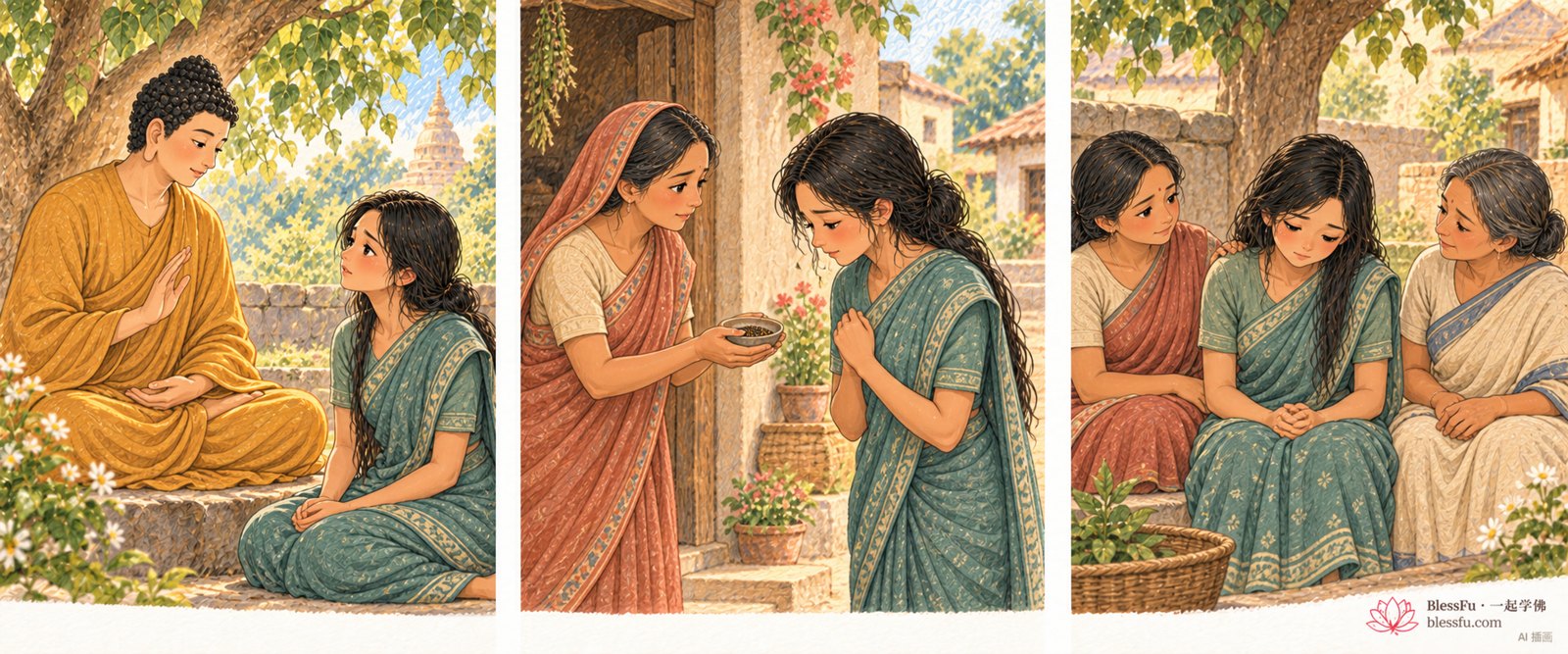
In a traditional commentary story, Kisa Gotami's young child had died. Deeply grieving, she hoped someone could bring him back. She sought the Buddha's help. He asked her to find a mustard seed from a household where nobody had ever died.
She visited homes. Mustard seeds were easy to find, but every household had also lost someone. Through these conversations she discovered that loss had touched other families too. Mustard seeds are not medicine that brings someone back to life, or a task we must repeat today.
The traditional story ends with her returning to the Buddha and continuing to learn. Our picture adds quiet companions to express care. Knowing life changes does not require us to stop missing someone. We can seek trusted company, or choose not to talk yet.
Think together
This story is often used to discuss impermanence and grief. People grieve at different paces. Missing someone and carrying on with life can coexist. “Everyone experiences loss” should not silence a person’s feelings. Grief does not mean insufficient faith.
- What could others do if Gotami wanted some quiet?
- Does companionship need lots of explanations?
Try an activity
Make a companionship card. Draw a chair, water or someone willing to sit nearby. Discuss only the story characters if preferred. No personal loss or names need to be shared.
Take it home
Choose a comfortable quiet activity with a trusted adult. You can also skip this lesson and read a favourite story.
For adults: read-aloud script and guidance
The mustard-seed story belongs to the commentary associated with Therigatha 10.1, not the canonical verses word for word. Ask whether the child wants to hear it. Do not show bodies or describe death as sleep. Families recently bereaved may postpone. Seek appropriate support for continuing distress. The pictured companions are an added teaching illustration.
Nine-slide lesson outline
1. A Mustard Seed: Company in Sadness
This story mentions the death of a child.
Read with an adult. You may pause or skip.
With an adult, recognise grief and the choice to talk, pause or skip.
This lesson mentions the death of a child. Adults should read first. A child may pause or go to the next lesson.
2. Look closely
How could we keep someone company when they feel very sad?
This lesson mentions the death of a child. Adults should read first. A child may pause or go to the next lesson.
How could we keep someone company when they feel very sad?
3. Story 1 / 3
In a traditional commentary story, Kisa Gotami's young child had died. Deeply grieving, she hoped someone could bring him back. She sought the Buddha's help. He asked her to find a mustard seed from a household where nobody had ever died.
In a traditional commentary story, Kisa Gotami's young child had died. Deeply grieving, she hoped someone could bring him back. She sought the Buddha's help. He asked her to find a mustard seed from a household where nobody had ever died.
4. Story 2 / 3
She visited homes. Mustard seeds were easy to find, but every household had also lost someone. Through these conversations she discovered that loss had touched other families too. Mustard seeds are not medicine that brings someone back to life, or a task we must repeat today.
She visited homes. Mustard seeds were easy to find, but every household had also lost someone. Through these conversations she discovered that loss had touched other families too. Mustard seeds are not medicine that brings someone back to life, or a task we must repeat today.
5. Story 3 / 3
The traditional story ends with her returning to the Buddha and continuing to learn. Our picture adds quiet companions to express care. Knowing life changes does not require us to stop missing someone. We can seek trusted company, or choose not to talk yet.
The traditional story ends with her returning to the Buddha and continuing to learn. Our picture adds quiet companions to express care. Knowing life changes does not require us to stop missing someone. We can seek trusted company, or choose not to talk yet.
6. A Buddhist idea
Missing someone and feeling sad
can be met with company.
This story is often used to discuss impermanence and grief. People grieve at different paces. Missing someone and carrying on with life can coexist. “Everyone experiences loss” should not silence a person’s feelings. Grief does not mean insufficient faith.
7. Talk together
What could others do if Gotami wanted some quiet?
Does companionship need lots of explanations?
Listen to different answers. Ask why. Children may discuss the characters rather than private experiences.
8. Try an activity
Draw a companionship card, or choose to skip.
Make a companionship card. Draw a chair, water or someone willing to sit nearby. Discuss only the story characters if preferred. No personal loss or names need to be shared.
Choose a comfortable quiet activity with a trusted adult. You can also skip this lesson and read a favourite story.
9. For grown-ups
Adapted and abridged by BlessFu from Andrew Olendzki, Skinny Gotami & the Mustard Seed (2005), Access to Insight. Original source translation: ©2005 Andrew Olendzki. Free educational edition.
You may copy, reformat, reprint, republish, and redistribute this work in any medium whatsoever, provided that: (1) you only make such copies, etc. available free of charge; (2) you clearly indicate that any derivatives of this work (including translations) are derived from this source document; and (3) you include the full text of this license in any copies or derivatives of this work. Otherwise, all rights reserved. Documents linked from this page may be subject to other restrictions.
The mustard-seed story belongs to the commentary associated with Therigatha 10.1, not the canonical verses word for word. Ask whether the child wants to hear it. Do not show bodies or describe death as sleep. Families recently bereaved may postpone. Seek appropriate support for continuing distress. The pictured companions are an added teaching illustration.
Next, Tsongkhapa’s learning brings this group of lessons to a close.
Story and references
Source: Therigatha commentary 10.1; Andrew Olendzki, Skinny Gotami & the Mustard Seed (2005), Access to Insight. Derived from the traditional narrative, checked against Andrew Olendzki’s translation. Retold, abridged and supplemented with companionship discussion. ©2005 Andrew Olendzki for the source translation. Free distribution; full source licence is included in “第29课来源许可.txt”. No copied modern illustrations or implied endorsement.
Original source licence (Andrew Olendzki, ©2005):
You may copy, reformat, reprint, republish, and redistribute this work in any medium whatsoever, provided that: (1) you only make such copies, etc. available free of charge; (2) you clearly indicate that any derivatives of this work (including translations) are derived from this source document; and (3) you include the full text of this license in any copies or derivatives of this work. Otherwise, all rights reserved. Documents linked from this page may be subject to other restrictions.
https://www.accesstoinsight.org/noncanon/comy/thiga-10-01-ao0.html
Next, Tsongkhapa’s learning brings this group of lessons to a close.