
Looking at a Mandala
Explore mandala art, then use an ordinary pattern game to reflect on cooperation and change.
Watch lesson 42
Open the full image, then touch and hold to save on a phone, or right-click and save on a computer.
Let’s begin
We have explored paintings, objects and patterns. Today, look for circles, squares and a centre.
When a beautiful pattern is put away, is everything we learned gone?
Story time
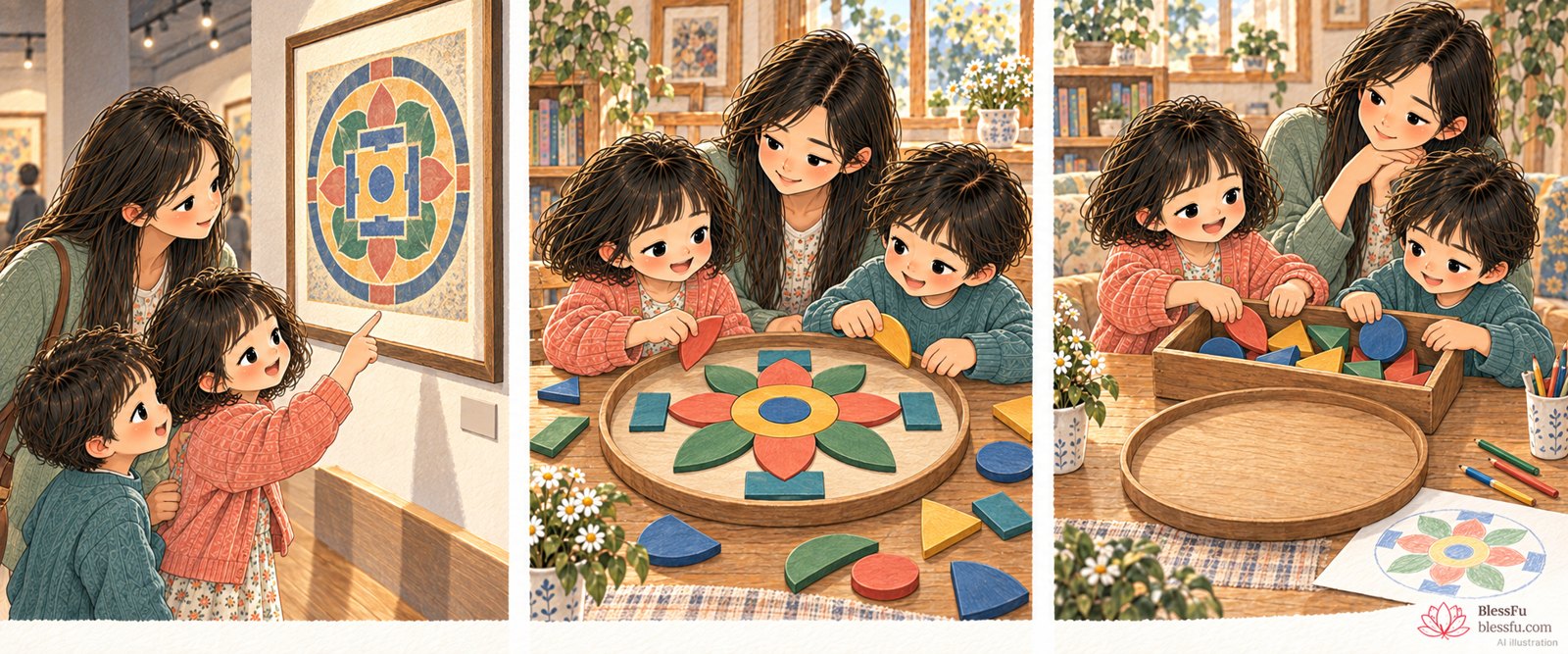
At an exhibition, Xiaohe sees circles around a square, with lines leading towards a centre. Mum explains that many Buddhist mandalas use such arrangements, though there are other forms. They have religious meanings; not every circular pattern is a Buddhist mandala.
At home they arrange large coloured shapes into a flower-like pattern. Her brother adds one piece, then Xiaohe adds another. Mum explains: “This is an ordinary pattern game for observation and cooperation, not a ritual mandala.” Xiaohe draws their creation on paper.
When it is time to tidy, Xiaohe feels reluctant. Mum asks whether she wants another moment to look or to keep her drawing first. After a pause, she helps put the pieces away. The pattern changes; their experience of taking turns and looking carefully can continue.
Think together
Buddhist mandalas may be painted or three-dimensional, representing a cosmos or sacred realm and supporting religious practice. Their detailed making and visualization follow traditions and guidance. Our game revisits change, but does not reproduce a mandala ritual.
- Is every circular design a Buddhist mandala?
- What choice does Mum offer when Xiaohe is not ready to tidy?
Try an activity
Use large paper shapes or blocks to make an original pattern from the centre out. Take turns, draw it and tidy together. Avoid fine sand, small beads and sacred letters. Call it a “cooperation pattern,” not a consecration or ritual.
Take it home
Discuss one change you noticed today and one thing you learned that you can use again.
For adults: read-aloud script and guidance
No restricted visualization, iconometric instructions or ritual procedures are taught. Let a child keep a creation temporarily; do not demand its destruction to prove detachment. If viewing a sand-mandala event, explain its particular religious context. Tidying ordinary craft pieces is enough for this activity.
Nine-slide lesson outline
1. Looking at a Mandala
Learn together, one small step.
Explore mandala art, then use an ordinary pattern game to reflect on cooperation and change.
We have explored paintings, objects and patterns. Today, look for circles, squares and a centre.
2. Look closely
When a beautiful pattern is put away, is everything we learned gone?
We have explored paintings, objects and patterns. Today, look for circles, squares and a centre.
When a beautiful pattern is put away, is everything we learned gone?
3. Story 1 / 3
At an exhibition, Xiaohe sees circles around a square, with lines leading towards a centre. Mum explains that many Buddhist mandalas use such arrangements, though there are other forms. They have religious meanings; not every circular pattern is a Buddhist mandala.
At an exhibition, Xiaohe sees circles around a square, with lines leading towards a centre. Mum explains that many Buddhist mandalas use such arrangements, though there are other forms. They have religious meanings; not every circular pattern is a Buddhist mandala.
4. Story 2 / 3
At home they arrange large coloured shapes into a flower-like pattern. Her brother adds one piece, then Xiaohe adds another. Mum explains: “This is an ordinary pattern game for observation and cooperation, not a ritual mandala.” Xiaohe draws their creation on paper.
At home they arrange large coloured shapes into a flower-like pattern. Her brother adds one piece, then Xiaohe adds another. Mum explains: “This is an ordinary pattern game for observation and cooperation, not a ritual mandala.” Xiaohe draws their creation on paper.
5. Story 3 / 3
When it is time to tidy, Xiaohe feels reluctant. Mum asks whether she wants another moment to look or to keep her drawing first. After a pause, she helps put the pieces away. The pattern changes; their experience of taking turns and looking carefully can continue.
When it is time to tidy, Xiaohe feels reluctant. Mum asks whether she wants another moment to look or to keep her drawing first. After a pause, she helps put the pieces away. The pattern changes; their experience of taking turns and looking carefully can continue.
6. A Buddhist idea
Distinguish culture from a game.
Buddhist mandalas may be painted or three-dimensional, representing a cosmos or sacred realm and supporting religious practice. Their detailed making and visualization follow traditions and guidance. Our game revisits change, but does not reproduce a mandala ritual.
7. Talk together
Is every circular design a Buddhist mandala?
What choice does Mum offer when Xiaohe is not ready to tidy?
Listen to different answers. Ask why. Children may discuss the characters rather than private experiences.
8. Try an activity
Build a cooperation pattern.
Use large paper shapes or blocks to make an original pattern from the centre out. Take turns, draw it and tidy together. Avoid fine sand, small beads and sacred letters. Call it a “cooperation pattern,” not a consecration or ritual.
Discuss one change you noticed today and one thing you learned that you can use again.
9. For grown-ups
Read aloud, discuss and try a small activity.
Stories and exercises: BlessFu
Illustrations: AI-assisted
Full references and guidance are in the companion booklet.
No restricted visualization, iconometric instructions or ritual procedures are taught. Let a child keep a creation temporarily; do not demand its destruction to prove detachment. If viewing a sand-mandala event, explain its particular religious context. Tidying ordinary craft pieces is enough for this activity.
Next batch, we begin with a cup of water and bring learning into everyday life.
Story and references
Reference: Rubin Museum, Art of Mandala, for forms and religious context. The pattern game, dialogue and reflection are original; no ritual design or liturgy is reproduced. AI-assisted teaching illustrations, not historical photographs, a real temple record or ritual instructions. Sources checked 2026-09-15.
Next batch, we begin with a cup of water and bring learning into everyday life.