
A Pause Before We Eat
Notice the work behind a meal and practise gratitude and taking what we need.
Watch lesson 45
Open the full image, then touch and hold to save on a phone, or right-click and save on a computer.
Let’s begin
A flower card can express thanks. Many people also help bring food to our table.
Where does a carrot travel before it reaches our meal?
Story time
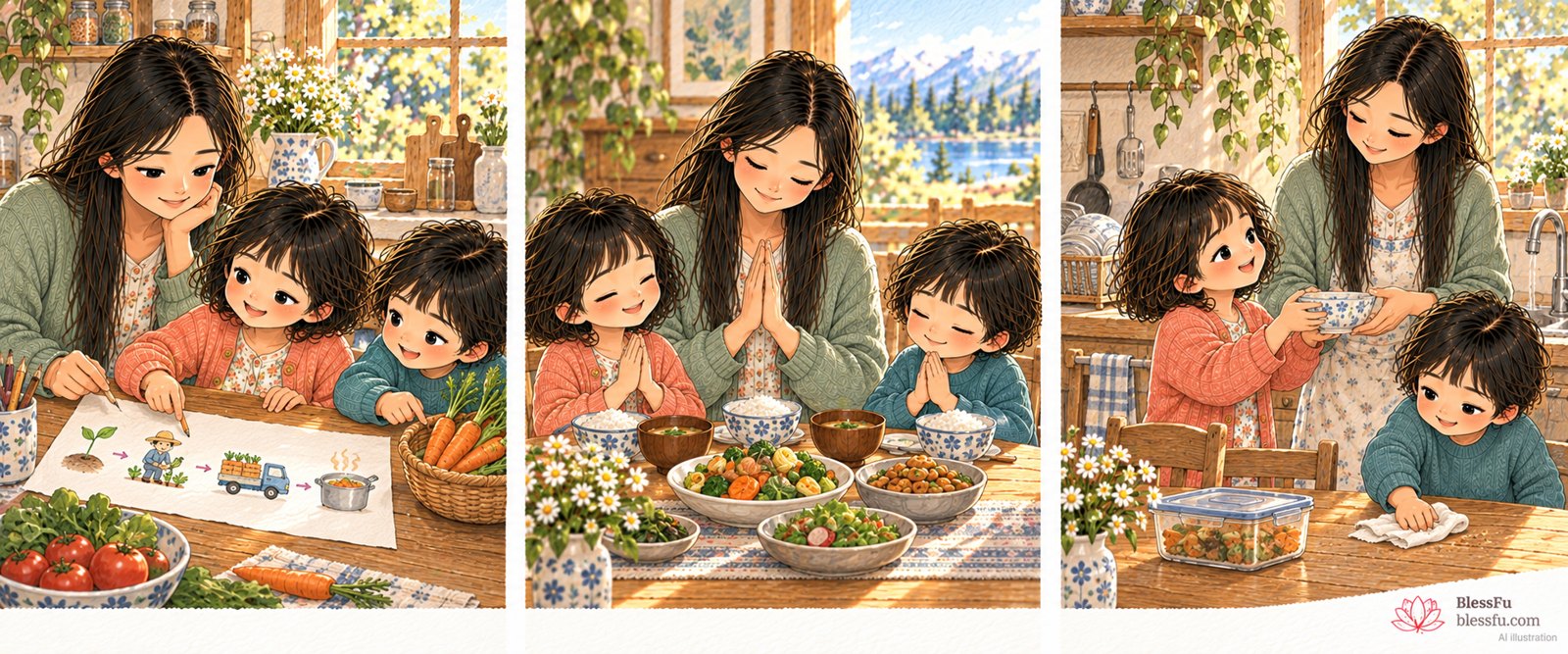
Xiaohe draws a seedling. Mum adds a gardener, and her son draws a delivery van. They also think of shopping, washing vegetables and cooking. Xiaohe looks at a carrot in the basket. “Our meal did not arrive all by itself!”
Before eating, they pause briefly. Mum explains that Buddhist families may remember the Three Jewels and make a food offering. Today they begin with words they understand. Xiaohe thanks the people who helped provide the meal. Her brother wishes that other people have enough to eat too. Then they eat.
Xiaohe takes a suitable portion and can have more if needed. Afterwards she hands Mum her bowl while her brother wipes the table. Mum promptly stores suitable leftovers. Xiaohe discovers that caring for food means thoughtful choices and tidying, not forcing down more than her body needs.
Think together
Food depends on human work and natural conditions. A brief pause can make gratitude specific. Buddhist food offerings also involve remembering the Three Jewels and a beneficial intention. Our simple words are not a formal offering verse. Eating should care for the body.
- Who helps besides the person who cooks?
- Does caring for food mean forcing ourselves to eat too much?
Try an activity
Draw a food journey with at least three stops: growing or making, transport and the table. Name something to appreciate at each stop. If you wish, express it in your own words before another meal.
Take it home
Help with one suitable preparation task, such as setting utensils or washing a vegetable. Ask how first, and thank someone working alongside you.
For adults: read-aloud script and guidance
Do not use guilt, comments about body size or comparisons of appetite and family resources. Follow existing care arrangements for allergies, swallowing and other dietary needs. Do not delay a hungry child with a long ritual. Adults store leftovers safely. Ask your teacher about formal offering texts and methods; this course does not reproduce modern teaching transcripts.
Nine-slide lesson outline
1. A Pause Before We Eat
Learn together, one small step.
Notice the work behind a meal and practise gratitude and taking what we need.
A flower card can express thanks. Many people also help bring food to our table.
2. Look closely
Where does a carrot travel before it reaches our meal?
A flower card can express thanks. Many people also help bring food to our table.
Where does a carrot travel before it reaches our meal?
3. Story 1 / 3
Xiaohe draws a seedling. Mum adds a gardener, and her son draws a delivery van. They also think of shopping, washing vegetables and cooking. Xiaohe looks at a carrot in the basket. “Our meal did not arrive all by itself!”
Xiaohe draws a seedling. Mum adds a gardener, and her son draws a delivery van. They also think of shopping, washing vegetables and cooking. Xiaohe looks at a carrot in the basket. “Our meal did not arrive all by itself!”
4. Story 2 / 3
Before eating, they pause briefly. Mum explains that Buddhist families may remember the Three Jewels and make a food offering. Today they begin with words they understand. Xiaohe thanks the people who helped provide the meal. Her brother wishes that other people have enough to eat too. Then they eat.
Before eating, they pause briefly. Mum explains that Buddhist families may remember the Three Jewels and make a food offering. Today they begin with words they understand. Xiaohe thanks the people who helped provide the meal. Her brother wishes that other people have enough to eat too. Then they eat.
5. Story 3 / 3
Xiaohe takes a suitable portion and can have more if needed. Afterwards she hands Mum her bowl while her brother wipes the table. Mum promptly stores suitable leftovers. Xiaohe discovers that caring for food means thoughtful choices and tidying, not forcing down more than her body needs.
Xiaohe takes a suitable portion and can have more if needed. Afterwards she hands Mum her bowl while her brother wipes the table. Mum promptly stores suitable leftovers. Xiaohe discovers that caring for food means thoughtful choices and tidying, not forcing down more than her body needs.
6. A Buddhist idea
Make gratitude specific.
Food depends on human work and natural conditions. A brief pause can make gratitude specific. Buddhist food offerings also involve remembering the Three Jewels and a beneficial intention. Our simple words are not a formal offering verse. Eating should care for the body.
7. Talk together
Who helps besides the person who cooks?
Does caring for food mean forcing ourselves to eat too much?
Listen to different answers. Ask why. Children may discuss the characters rather than private experiences.
8. Try an activity
Draw three stops on food’s journey.
Who would you like to thank?
Draw a food journey with at least three stops: growing or making, transport and the table. Name something to appreciate at each stop. If you wish, express it in your own words before another meal.
Help with one suitable preparation task, such as setting utensils or washing a vegetable. Ask how first, and thank someone working alongside you.
9. For grown-ups
Read aloud, discuss and try a small activity.
Stories and exercises: BlessFu
Illustrations: AI-assisted
Full references and guidance are in the companion booklet.
Do not use guilt, comments about body size or comparisons of appetite and family resources. Follow existing care arrangements for allergies, swallowing and other dietary needs. Do not delay a hungry child with a long ritual. Adults store leftovers safely. Ask your teacher about formal offering texts and methods; this course does not reproduce modern teaching transcripts.
Next, we try a comfortable quiet moment.
Story and references
Theme reference: Venerable Thubten Chodron, Offering our Food and Drink, on Sravasti Abbey’s website, for intention and gratitude before meals. The carrot journey and family dialogue are original. No offering verse or visualization is reproduced. AI-assisted educational art. Sources checked 2026-09-15.
Next, we try a comfortable quiet moment.