
Light and Flower Offerings
Explore light and flower offerings through simple, thoughtful participation.
Watch lesson 44
Open the full image, then touch and hold to save on a phone, or right-click and save on a computer.
Let’s begin
We prepared a small bowl of water. This time Mum brings a little lamp.
Must a candle-shaped light have a real flame?
Story time
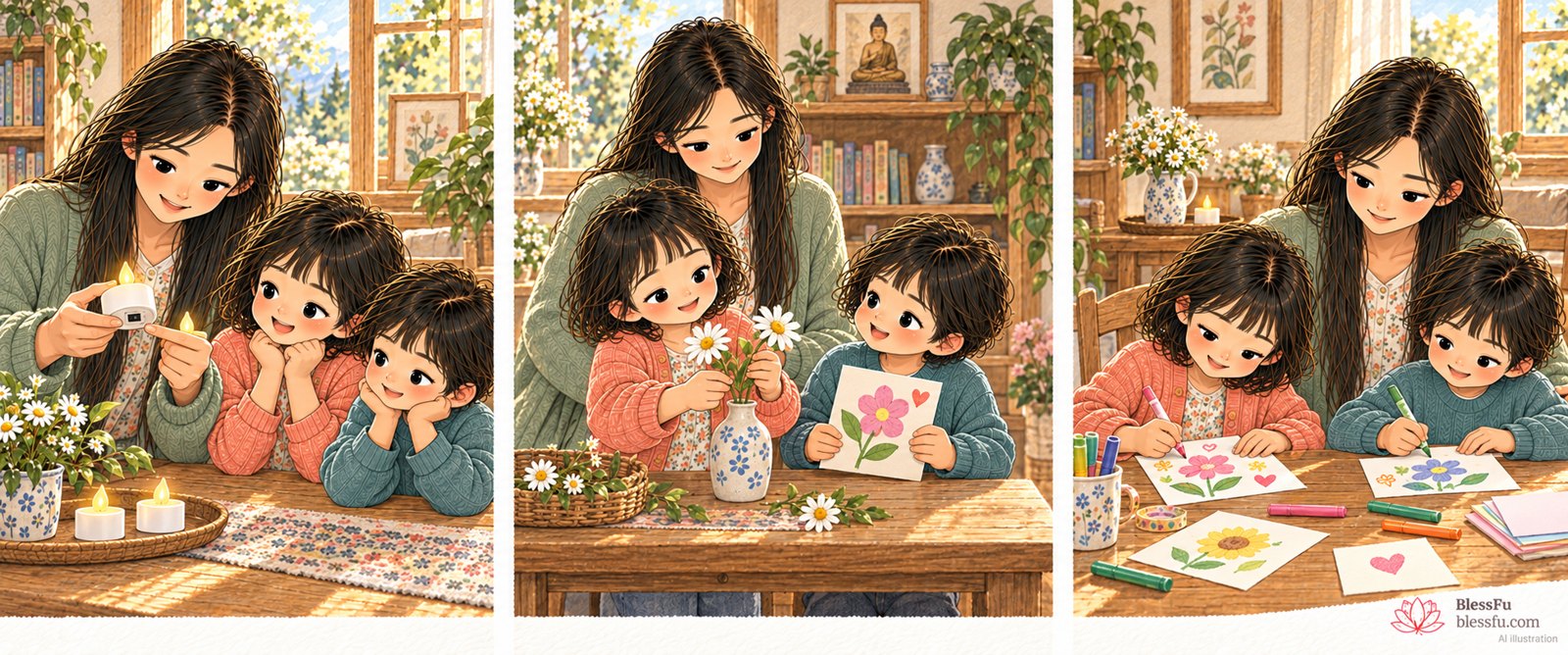
Mum presses a switch and the little light comes on. “No matches!” her son notices. Mum explains that it is an electric candle. “Light offerings can express an aspiration for wisdom. We will explore this with a flameless light.” Xiaohe looks at the switch without taking it apart.
Xiaohe gently places two flowers the family already has in a stable vase. Her brother holds a paper flower card. “I want to share a wish too.” Mum invites him to describe it. They do not compare whose object is prettier or pick flowers from a public garden.
At the dining table, the children make thank-you cards. Xiaohe draws a bright garden and her brother adds leaves to his flower. “Who would you like to thank?” Mum asks. Xiaohe thinks of someone who helped her learn patience. The lesson reminds them of everyday help.
Think together
In Buddhist offerings, light is often associated with wisdom, and flowers are also common gifts. The intention to respect and give matters; this need not become a spending competition. An electric light suits our introductory activity. Follow family guidance for a formal offering arrangement.
- How is this lamp different from a burning candle?
- How can we express thanks without fresh flowers?
Try an activity
An adult operates an intact flameless light. Children look, draw a light and flower, and express thanks. Families who wish to offer flowers can use suitable flowers they already have. The drawing activity needs no purchase.
Take it home
Thank a willing family member for a specific thing they did. You may give them a handmade flower card.
For adults: read-aloud script and guidance
No fire, smoke or hot oil in this activity. Battery compartments must be secure; an adult handles batteries. Use stable containers and avoid allergens or plants that children or pets might eat. A paper card is an original gratitude activity, not a claim that every tradition treats it as a fresh-flower offering. The light need not remain on for a long time.
Nine-slide lesson outline
1. Light and Flower Offerings
Learn together, one small step.
Explore light and flower offerings through simple, thoughtful participation.
We prepared a small bowl of water. This time Mum brings a little lamp.
2. Look closely
Must a candle-shaped light have a real flame?
We prepared a small bowl of water. This time Mum brings a little lamp.
Must a candle-shaped light have a real flame?
3. Story 1 / 3
Mum presses a switch and the little light comes on. “No matches!” her son notices. Mum explains that it is an electric candle. “Light offerings can express an aspiration for wisdom. We will explore this with a flameless light.” Xiaohe looks at the switch without taking it apart.
Mum presses a switch and the little light comes on. “No matches!” her son notices. Mum explains that it is an electric candle. “Light offerings can express an aspiration for wisdom. We will explore this with a flameless light.” Xiaohe looks at the switch without taking it apart.
4. Story 2 / 3
Xiaohe gently places two flowers the family already has in a stable vase. Her brother holds a paper flower card. “I want to share a wish too.” Mum invites him to describe it. They do not compare whose object is prettier or pick flowers from a public garden.
Xiaohe gently places two flowers the family already has in a stable vase. Her brother holds a paper flower card. “I want to share a wish too.” Mum invites him to describe it. They do not compare whose object is prettier or pick flowers from a public garden.
5. Story 3 / 3
At the dining table, the children make thank-you cards. Xiaohe draws a bright garden and her brother adds leaves to his flower. “Who would you like to thank?” Mum asks. Xiaohe thinks of someone who helped her learn patience. The lesson reminds them of everyday help.
At the dining table, the children make thank-you cards. Xiaohe draws a bright garden and her brother adds leaves to his flower. “Who would you like to thank?” Mum asks. Xiaohe thinks of someone who helped her learn patience. The lesson reminds them of everyday help.
6. A Buddhist idea
Practise respect and generosity.
In Buddhist offerings, light is often associated with wisdom, and flowers are also common gifts. The intention to respect and give matters; this need not become a spending competition. An electric light suits our introductory activity. Follow family guidance for a formal offering arrangement.
7. Talk together
How is this lamp different from a burning candle?
How can we express thanks without fresh flowers?
Listen to different answers. Ask why. Children may discuss the characters rather than private experiences.
8. Try an activity
Draw a lamp and a flower.
Add a sentence of thanks.
An adult operates an intact flameless light. Children look, draw a light and flower, and express thanks. Families who wish to offer flowers can use suitable flowers they already have. The drawing activity needs no purchase.
Thank a willing family member for a specific thing they did. You may give them a handmade flower card.
9. For grown-ups
Read aloud, discuss and try a small activity.
Stories and exercises: BlessFu
Illustrations: AI-assisted
Full references and guidance are in the companion booklet.
No fire, smoke or hot oil in this activity. Battery compartments must be secure; an adult handles batteries. Use stable containers and avoid allergens or plants that children or pets might eat. A paper card is an original gratitude activity, not a claim that every tradition treats it as a fresh-flower offering. The light need not remain on for a long time.
Next, we bring gratitude to the meal table.
Story and references
Background on flower and light offerings, including small electric lights: Losang Dragpa Centre, Altar Set-up. The family story, cards and safety arrangements are original educational design, not a transcription of the ritual. Stories, dialogue and activities are original BlessFu writing, not scripture translations. AI-assisted teaching illustrations do not show a complete ritual. Sources checked 2026-09-15.
Next, we bring gratitude to the meal table.