
Green Tara
The female Buddha who is quickest to rescue. One foot is already stretched out, ready to rise and help at any moment.
Watch the video
Who she is
The name Tara means "she who rescues". In Tibetan she is called Drolma. Tara has many forms. Green Tara is the most fundamental one, and there are also twenty-one emanations. She is also the best-loved female Buddha in Tibet.
What she does
She stands for the Buddhas' power to act. When people are afraid, anxious, or out of options, what they need most is "someone coming right now". Green Tara stands for exactly this kind of swift protection.
What people pray to her for
Traditionally, people pray to Green Tara for:
- Protection when facing something urgent or difficult
- Safe travels
- Freedom from fear and worry
- Things going smoothly and obstacles dissolving
Mantra
OṂ TĀRE TUTTĀRE TURE SVĀHĀ
Almost everyone in Tibet knows how to recite it. It is openly taught; anyone may recite it.
The scriptures say she can rescue beings from the "eight dangers": lions, elephants, fire, snakes, thieves, imprisonment, water, and non-human beings. Later, people also came to understand these eight dangers as eight troubling states of mind. For example, pride is like a lion, ignorance is like an elephant, and anger is like fire.
Story: Avalokiteshvara's tears
The story goes that Avalokiteshvara (Chenrezig) saw that the suffering of living beings had no end, and he wept. The tears fell and turned into a lotus, and from the lotus Tara was born. She comforted Avalokiteshvara and vowed to help him rescue living beings.
This is why Tara is often seen as an emanation of Avalokiteshvara's compassion.
Story: The vow to become a Buddha in a woman's body
In another story, very long ago there was a princess named Wisdom Moon (Yeshe Dawa), who practiced with great diligence. Some monks said to her: "You should make a vow to be reborn as a man in your next life. That is the way to become a Buddha."
The princess answered that awakening has no male or female. She made a vow: from now on, until she became a Buddha, she would help living beings in a woman's body in every lifetime. This princess later became Tara.
How to recognize her
- Green body, with a young and peaceful face
- Right foot stretched forward, resting on a small lotus: ready to rise at any moment
- Right hand open and lowered: giving help
- Left hand at the chest, holding a blue lotus
The images
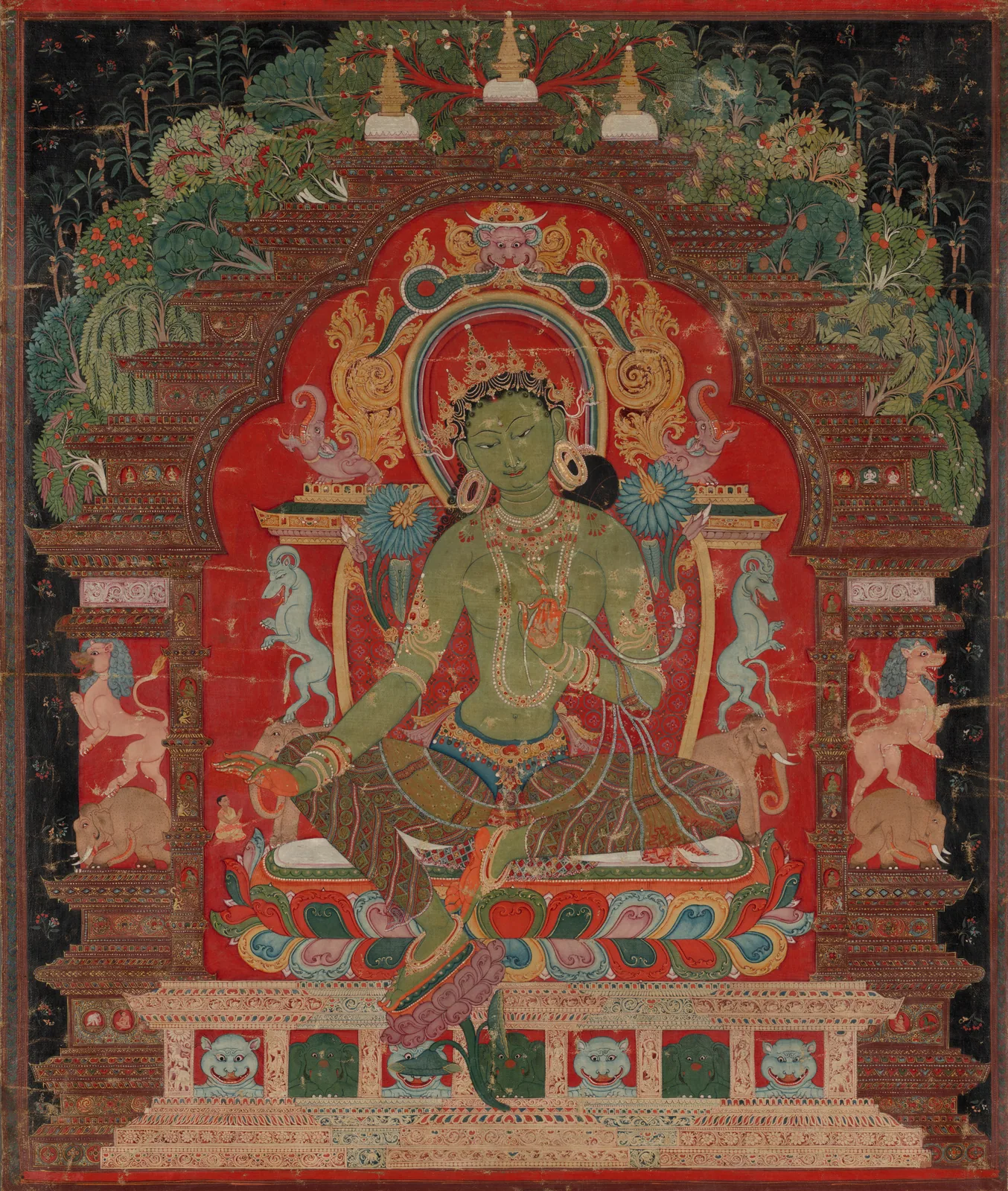
- Date: About the 1260s (Mongol–Yuan period)
- Origin and medium: Central Tibet · Thangka on cotton
- Collection: Cleveland Museum of Art, accession no. 1970.156 · CC0
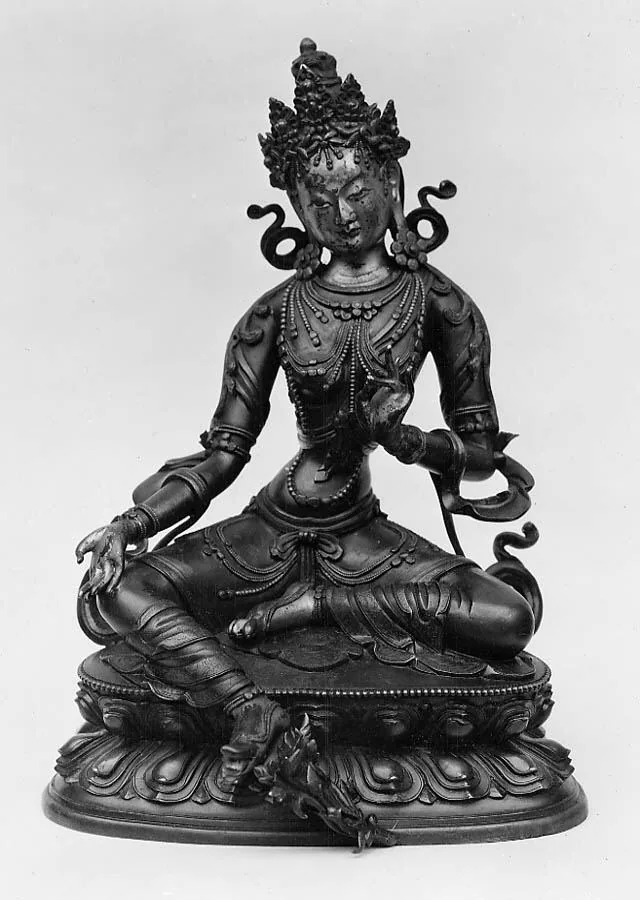
- Date: 17th–18th century (late Ming to Qing dynasty)
- Origin and medium: Tibet · Copper alloy statue, 25.9 cm high
- Collection: The Metropolitan Museum of Art, accession no. 50.138.3 · Public domain
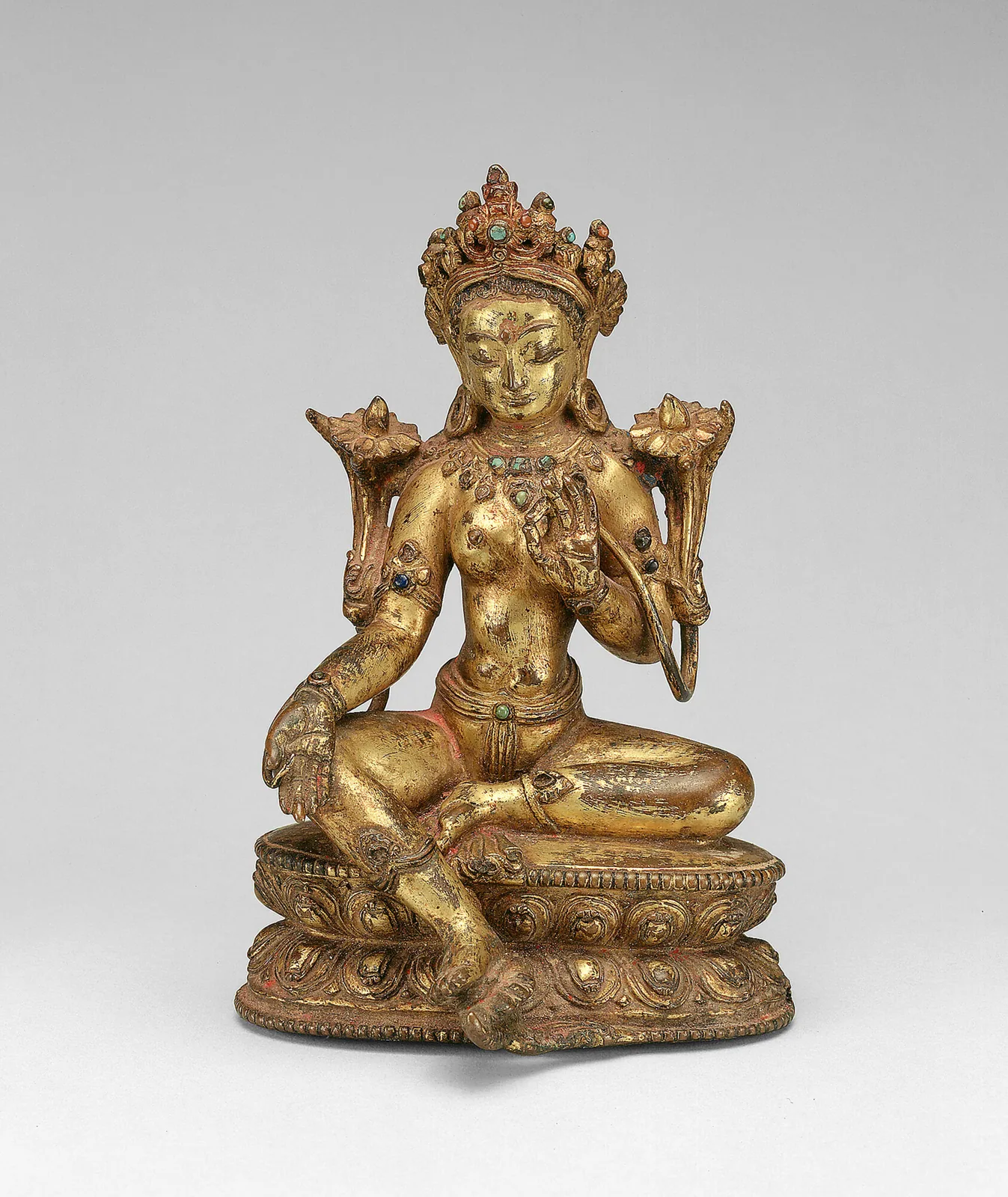
- Date: 14th century (Yuan to early Ming dynasty)
- Origin and medium: Southern Tibet · Metal statue
- Collection: Art Institute of Chicago, accession no. 2014.1017 · CC0