
Four Traditions, Shared Curiosity
Recognize four names and approach differences with respect.
Watch lesson 35
Open the full image, then touch and hold to save on a phone, or right-click and save on a computer.
Let’s begin
We have met some Buddhist figures. How do teachings pass from teacher to student?
Do four different names mean we must choose a winner?
Story time
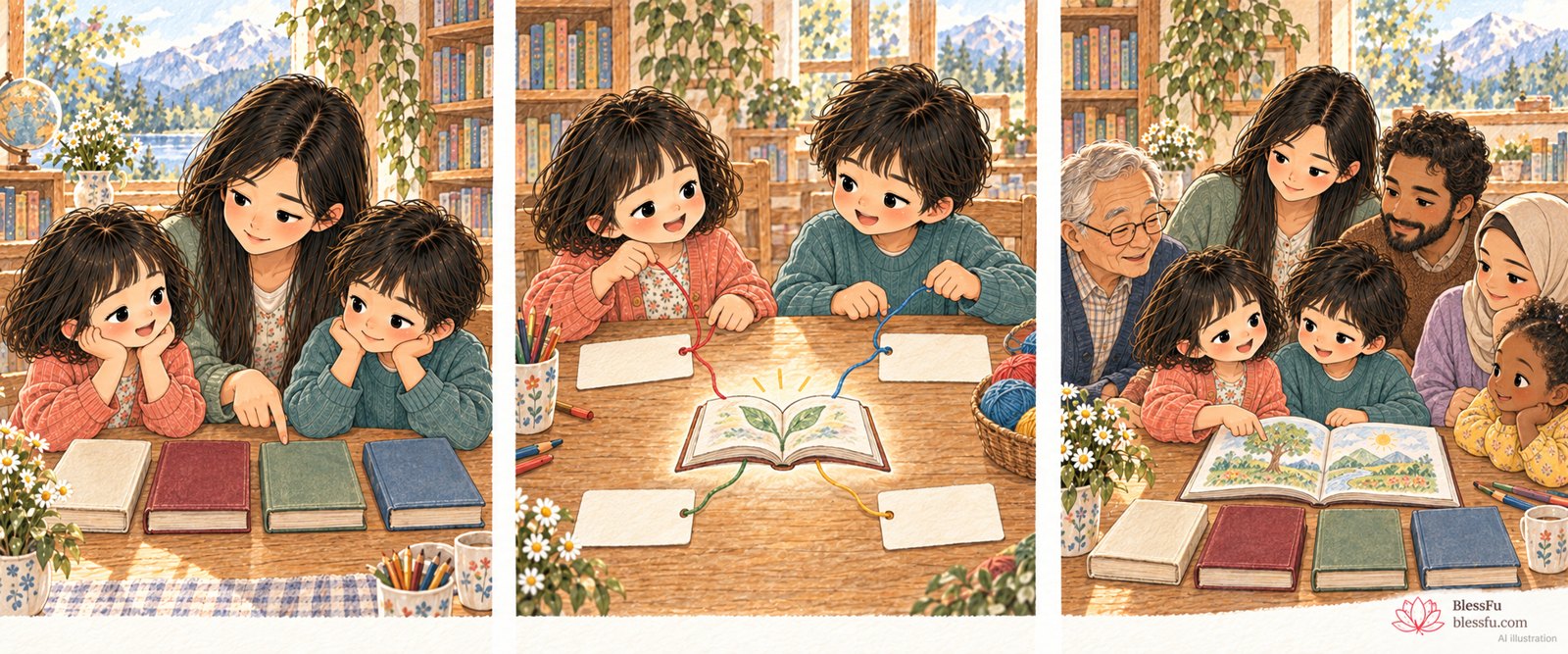
At the library, Mum places four little books on the table. “Nyingma, Kagyu, Sakya and Gelug are often called the four main Tibetan Buddhist traditions.” Xiaohe asks about tradition. “Start by thinking of teachings, learning and practice passed from teachers to students,” Mum says.
The children connect four cards to a drawing of an open book. Each tradition has its own history, teachers and approaches, as well as shared Buddhist foundations. “It is too simple to say one only studies and another only meditates,” Mum adds. Their cards are a memory aid, not a real map.
Another family comes to borrow books and mentions a temple they know. “What have you learned there?” Xiaohe asks. She hears a new story. The four names do not need to become competing teams. Start with respect, then gradually learn more about each rich tradition.
Think together
There are branches within the four traditions and exchanges between them. This lesson does not cover every Tibetan religious tradition: Bon has its own history and traditions. We can study one lineage deeply while respecting those we do not yet understand.
- Can a hat or colour tell us everything about a tradition?
- What could you ask about an unfamiliar tradition?
Try an activity
Make four equal-sized bookmarks labelled Nyingma, Kagyu, Sakya and Gelug. An adult can add the Chinese names. Choose any colours; these are not school emblems. Write “Learn carefully; ask respectfully” on the back.
Take it home
Ask a family member for one tradition name they know. If none comes to mind, read the reference together. There is no need to memorize every teacher and date today.
For adults: read-aloud script and guidance
Avoid stereotypes, rankings or pressure to choose an affiliation. The four books and connecting lines are memory aids, not official symbols, geographic maps or permission to combine rituals. Formal practice follows the guidance of its tradition.
Nine-slide lesson outline
1. Four Traditions, Shared Curiosity
Learn together, one small step.
Recognize four names and approach differences with respect.
We have met some Buddhist figures. How do teachings pass from teacher to student?
2. Look closely
Do four different names mean we must choose a winner?
We have met some Buddhist figures. How do teachings pass from teacher to student?
Do four different names mean we must choose a winner?
3. Story 1 / 3
At the library, Mum places four little books on the table. “Nyingma, Kagyu, Sakya and Gelug are often called the four main Tibetan Buddhist traditions.” Xiaohe asks about tradition. “Start by thinking of teachings, learning and practice passed from teachers to students,” Mum says.
At the library, Mum places four little books on the table. “Nyingma, Kagyu, Sakya and Gelug are often called the four main Tibetan Buddhist traditions.” Xiaohe asks about tradition. “Start by thinking of teachings, learning and practice passed from teachers to students,” Mum says.
4. Story 2 / 3
The children connect four cards to a drawing of an open book. Each tradition has its own history, teachers and approaches, as well as shared Buddhist foundations. “It is too simple to say one only studies and another only meditates,” Mum adds. Their cards are a memory aid, not a real map.
The children connect four cards to a drawing of an open book. Each tradition has its own history, teachers and approaches, as well as shared Buddhist foundations. “It is too simple to say one only studies and another only meditates,” Mum adds. Their cards are a memory aid, not a real map.
5. Story 3 / 3
Another family comes to borrow books and mentions a temple they know. “What have you learned there?” Xiaohe asks. She hears a new story. The four names do not need to become competing teams. Start with respect, then gradually learn more about each rich tradition.
Another family comes to borrow books and mentions a temple they know. “What have you learned there?” Xiaohe asks. She hears a new story. The four names do not need to become competing teams. Start with respect, then gradually learn more about each rich tradition.
6. A Buddhist idea
Listen and learn,
without ranking people.
There are branches within the four traditions and exchanges between them. This lesson does not cover every Tibetan religious tradition: Bon has its own history and traditions. We can study one lineage deeply while respecting those we do not yet understand.
7. Talk together
Can a hat or colour tell us everything about a tradition?
What could you ask about an unfamiliar tradition?
Listen to different answers. Ask why. Children may discuss the characters rather than private experiences.
8. Try an activity
Make four equal-sized tradition bookmarks.
Make four equal-sized bookmarks labelled Nyingma, Kagyu, Sakya and Gelug. An adult can add the Chinese names. Choose any colours; these are not school emblems. Write “Learn carefully; ask respectfully” on the back.
Ask a family member for one tradition name they know. If none comes to mind, read the reference together. There is no need to memorize every teacher and date today.
9. For grown-ups
Read aloud, discuss and try a small activity.
Stories and exercises: BlessFu
Illustrations: AI-assisted
Full references and guidance are in the companion booklet.
Avoid stereotypes, rankings or pressure to choose an affiliation. The four books and connecting lines are memory aids, not official symbols, geographic maps or permission to combine rituals. Formal practice follows the guidance of its tradition.
Next, explore learning and debate in the Gelug tradition.
Story and references
Alexander Berzin, The Tibetan Buddhist and Bon Traditions: A Comparison, Study Buddhism. Themes: shared foundations, differences and avoiding stereotypes. Library story and bookmarks are original. All illustrations are AI-assisted educational images, not historical photographs, formal iconographic templates or ritual instructions. Sources checked 2026-09-15.
Next, explore learning and debate in the Gelug tradition.