
Learning in a Monastery
Explore study and debate, giving reasons without attacking people.
Watch lesson 36
Open the full image, then touch and hold to save on a phone, or right-click and save on a computer.
Let’s begin
We met four traditions. Now look at Gelug, closely associated with Tsongkhapa.
Does a lively discussion always mean an argument?
Story time
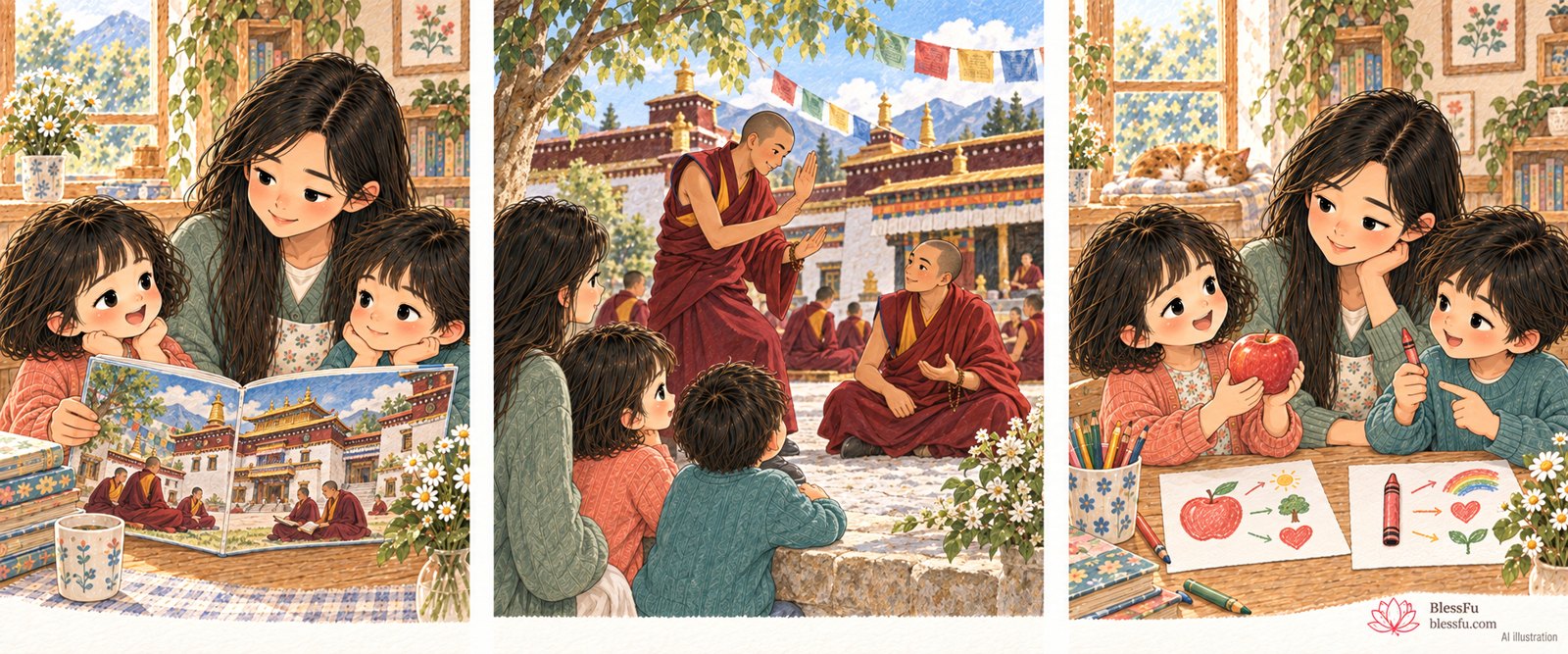
Xiaohe opens a book showing a monastery courtyard. Some people read; others listen to a teacher. Mum explains that Tsongkhapa founded the Gelug school. Learning means working to understand, not only remembering words. This courtyard illustration is imagined, not a record of one particular day.
In another picture, one monk stands to ask and another sits to reply, with a hand-clapping gesture. “Are they fighting?” the boy asks. Mum explains that debate can test understanding through questions and reasons. The point is not to overpower someone with a loud voice.
At home, the boy says, “Everything red is an apple.” Xiaohe brings a red crayon: “What about this?” He laughs and changes his statement. They agree to take turns and not mock each other. Their game is not formal debate, but practises a wish to understand carefully.
Think together
Debate is a Tibetan Buddhist learning method especially emphasized in Gelug; other traditions also practise related forms of study. Formal debate has specific topics, terms and training. This simple object game is only an introduction, not the same as Buddhist philosophical debate.
- How does the crayon test the claim about red things?
- How can disagreement help both people learn?
Try an activity
Draw an apple and a red crayon. An adult says, “Everything red is an apple.” Find a counterexample, then exchange roles. Agree to take turns, give reasons and avoid mocking. You may choose different objects.
Take it home
In one discussion this week, try “My reason is…” and listen to the other reason. If unsure, check together instead of trying to win.
For adults: read-aloud script and guidance
Debate theme refers to Study Buddhism; the Tsongkhapa link continues lesson 30. The game is original. No need to copy monastic gestures or raise voices. This is not a spiritual assessment. Welcome drawings and different ways of expressing an answer.
Nine-slide lesson outline
1. Learning in a Monastery
Learn together, one small step.
Explore study and debate, giving reasons without attacking people.
We met four traditions. Now look at Gelug, closely associated with Tsongkhapa.
2. Look closely
Does a lively discussion always mean an argument?
We met four traditions. Now look at Gelug, closely associated with Tsongkhapa.
Does a lively discussion always mean an argument?
3. Story 1 / 3
Xiaohe opens a book showing a monastery courtyard. Some people read; others listen to a teacher. Mum explains that Tsongkhapa founded the Gelug school. Learning means working to understand, not only remembering words. This courtyard illustration is imagined, not a record of one particular day.
Xiaohe opens a book showing a monastery courtyard. Some people read; others listen to a teacher. Mum explains that Tsongkhapa founded the Gelug school. Learning means working to understand, not only remembering words. This courtyard illustration is imagined, not a record of one particular day.
4. Story 2 / 3
In another picture, one monk stands to ask and another sits to reply, with a hand-clapping gesture. “Are they fighting?” the boy asks. Mum explains that debate can test understanding through questions and reasons. The point is not to overpower someone with a loud voice.
In another picture, one monk stands to ask and another sits to reply, with a hand-clapping gesture. “Are they fighting?” the boy asks. Mum explains that debate can test understanding through questions and reasons. The point is not to overpower someone with a loud voice.
5. Story 3 / 3
At home, the boy says, “Everything red is an apple.” Xiaohe brings a red crayon: “What about this?” He laughs and changes his statement. They agree to take turns and not mock each other. Their game is not formal debate, but practises a wish to understand carefully.
At home, the boy says, “Everything red is an apple.” Xiaohe brings a red crayon: “What about this?” He laughs and changes his statement. They agree to take turns and not mock each other. Their game is not formal debate, but practises a wish to understand carefully.
6. A Buddhist idea
Clarity together
matters more than winning.
Debate is a Tibetan Buddhist learning method especially emphasized in Gelug; other traditions also practise related forms of study. Formal debate has specific topics, terms and training. This simple object game is only an introduction, not the same as Buddhist philosophical debate.
7. Talk together
How does the crayon test the claim about red things?
How can disagreement help both people learn?
Listen to different answers. Ask why. Children may discuss the characters rather than private experiences.
8. Try an activity
Use an apple and a crayon to find a counterexample.
Draw an apple and a red crayon. An adult says, “Everything red is an apple.” Find a counterexample, then exchange roles. Agree to take turns, give reasons and avoid mocking. You may choose different objects.
In one discussion this week, try “My reason is…” and listen to the other reason. If unsure, check together instead of trying to win.
9. For grown-ups
Read aloud, discuss and try a small activity.
Stories and exercises: BlessFu
Illustrations: AI-assisted
Full references and guidance are in the companion booklet.
Debate theme refers to Study Buddhism; the Tsongkhapa link continues lesson 30. The game is original. No need to copy monastic gestures or raise voices. This is not a spiritual assessment. Welcome drawings and different ways of expressing an answer.
Next batch starts with lesson 37: visiting a temple politely and comfortably.
Story and references
Study Buddhism, The Purpose and Benefits of Debate: checking understanding through questions. Background continues the Tsongkhapa biography source in lesson 30. Apple-and-crayon scene is original. All illustrations are AI-assisted educational images, not historical photographs, formal iconographic templates or ritual instructions. Sources checked 2026-09-15.
Next batch starts with lesson 37: visiting a temple politely and comfortably.